49 works in this view — arrow keys or swipe to move between them.
Dance in Art
Group — Plate 7
Gregorio Lambranzi
- Medium:
- Copper-plate engraving
- Dance:
- Notation/Choreography
- Era:
- 1700s (Enlightenment/Minuet Era)
- Collection:
- Nuova e curiosa scuola de' balli theatrali (1716)
- Source:
- Library of Congress
- Rights:
- Public domain — free to use, share and adapt.
- Recorded as:
- Public Domain
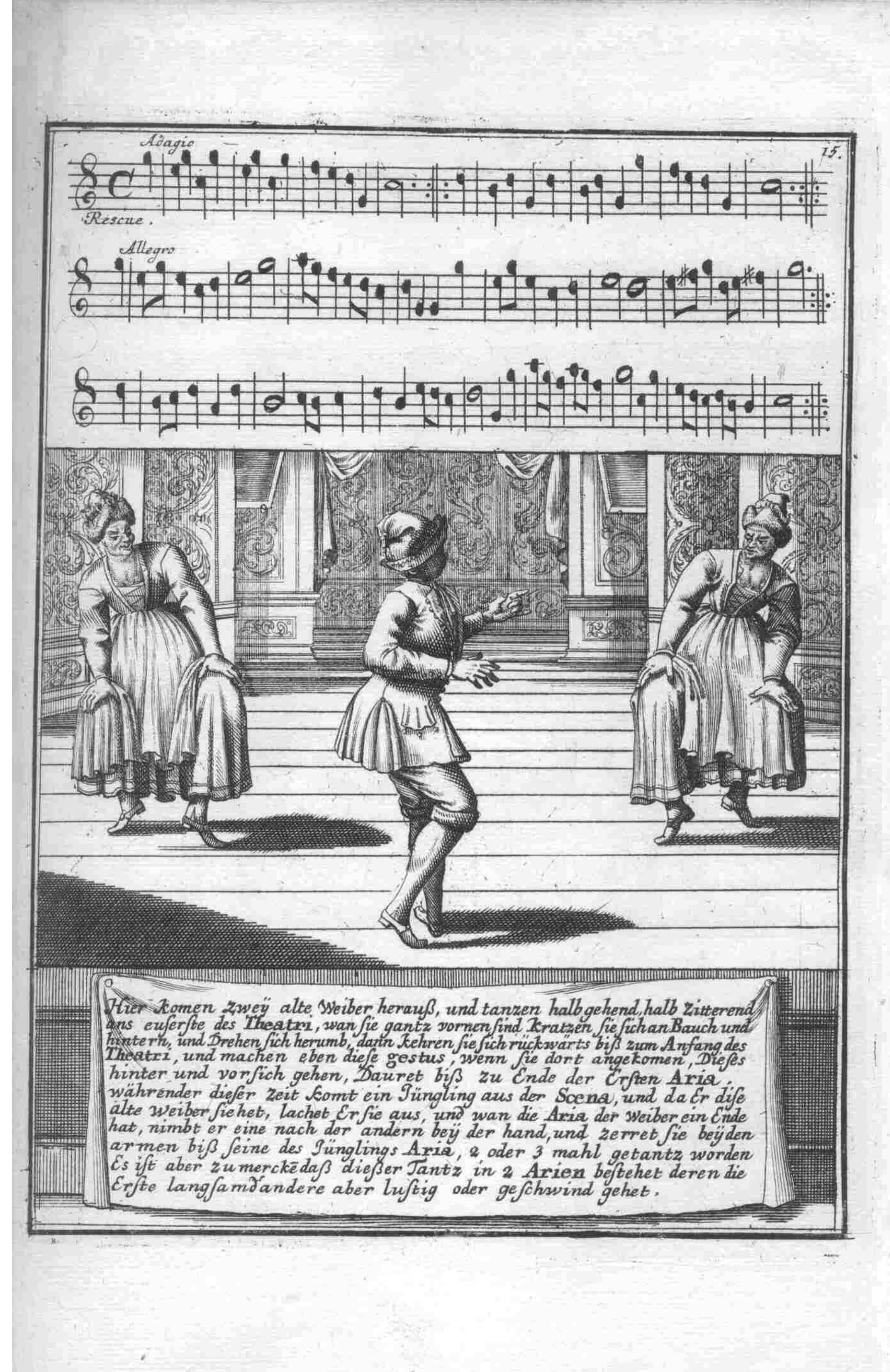
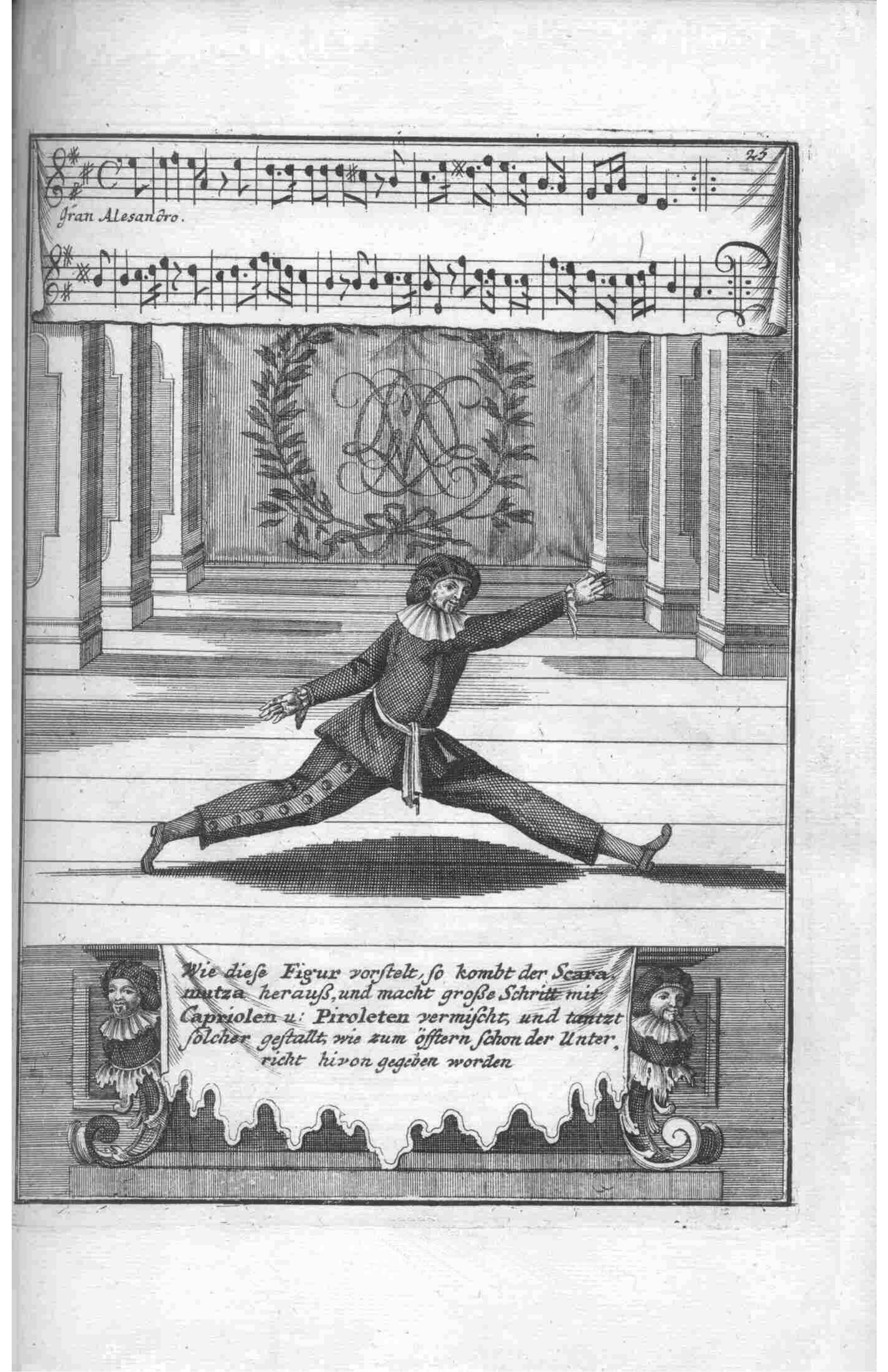
Lambranzi's plates are among the rare surviving evidence of how theatrical and comic dances were actually performed in the early 18th century—the costumes, the spatial relationships, the dramatic intention. Unlike purely notational systems, the engravings show a dance *in character and in place*, revealing how social and courtly vocabularies were adapted, amplified, and made comic for the stage. For historians and dancers, these images are invaluable proof that theatrical dance was not separate from social dance but a heightened, costumed, staged version of it.
What you are looking at
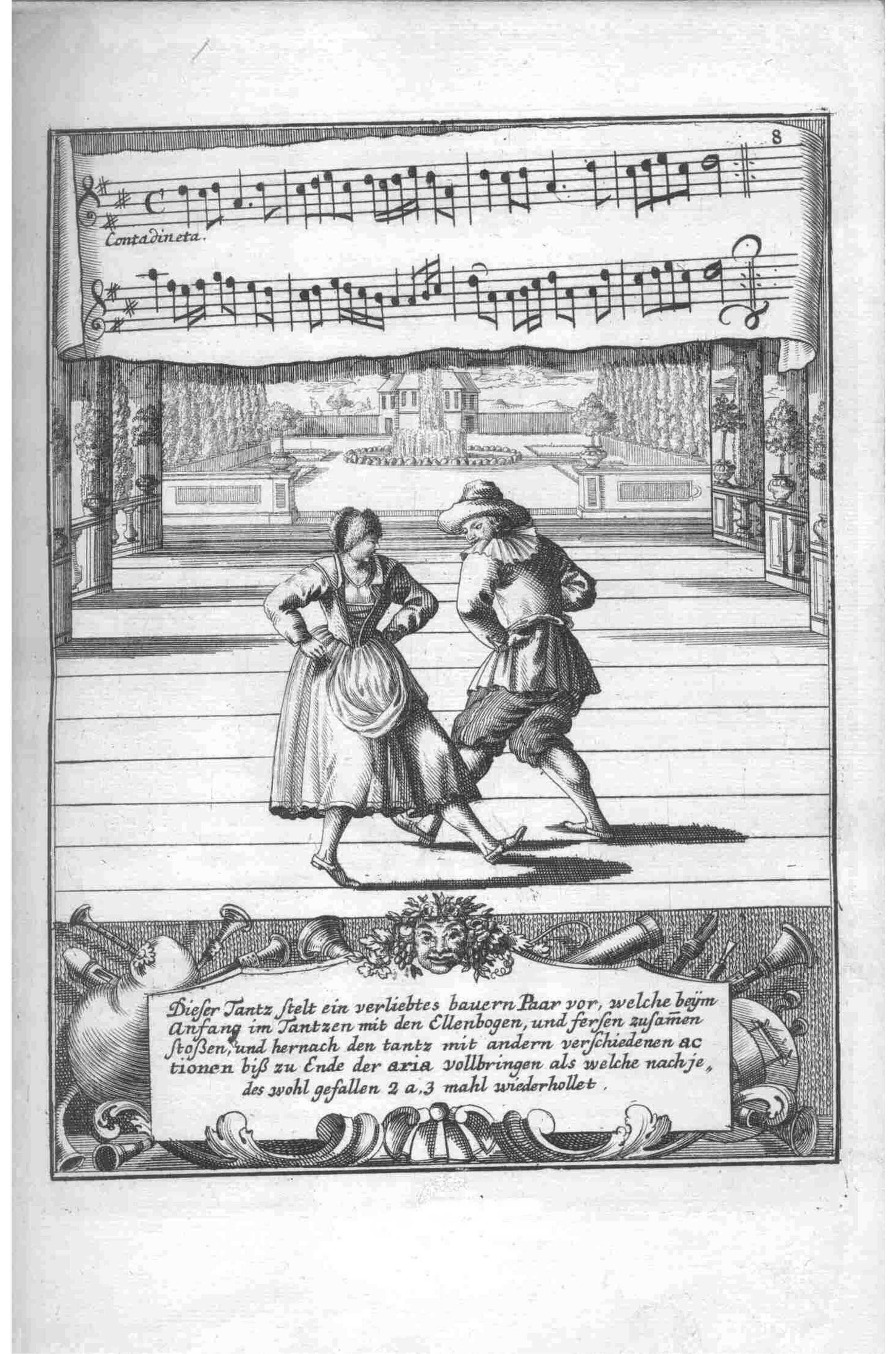
A man and woman perform a theatrical dance on a wooden stage framed by a proscenium arch with draped curtains. The woman wears a light, pleated skirt and fitted bodice; the man wears dark breeches, a plumed hat, and what appears to be a short coat. Both are in a dynamic moment of social interaction—the woman stands with hand on hip in a pose of spirited engagement, while the man leans toward her in an attitude of courtship or comic approach. The stage floor is rendered in perspective lines; beyond the arch, a formal garden with symmetrical plantings and a distant palazzo creates the illusion of depth. The musical notation at the top, labeled *Contadineta* ("The Peasant Girl"), suggests this depicts a theatrical dance tune. A decorative cartouche beneath, containing German text, frames the composition in the manner of a instructional plate.
The dancing
The woman's posture is upright and assertive, her weight clearly on one leg with the other bent, creating a contrapposto that reads as flirtatious confidence. The man's body angles forward from the hips, his hat and tilted stance suggesting comic exaggeration—his approach is theatrical rather than balletic. Both figures occupy the stage space dynamically rather than in a static alignment; the woman's gesture and turned-away gaze invite chase or courtship. The spatial relationship between them—close enough for interaction but not in contact—suggests the moment just before or during a comedic advance.
The dance depicted
This plate illustrates a *contadina* or peasant-themed theatrical dance, likely a comic or mock-pastoral number performed on the stage of 18th-century opera or commedia dell'arte. The dress and setting suggest a lower-class or rustic scenario translated into courtly performance. The gestural quality—the woman's sass, the man's exaggerated courtship—points to social dance vocabulary adapted for theatrical character and comedy rather than the formal minuet that dominated aristocratic ballrooms. The pairing of notation with choreographic illustration indicates this was a repeatable, teachable sequence rather than improvisation.
How it was made
This is a copper-plate engraving, a medium that allowed fine detail and wide reproduction. The technique required precise line work: the cross-hatching creates shadow and form, while the clarity of the notation and text made this an ideal vehicle for dance instruction. Engravings of this quality circulated as printed books and bound volumes, making them accessible to dance masters, theatre professionals, and educated amateurs across Europe. The format—image paired with music and text—was standard for the period's dance manuals and testifies to a sophisticated publishing apparatus for theatrical knowledge.
About this work
This is one of 102 plates from Gregorio Lambranzi's *Nuova e curiosa scuola de' balli theatrali* (*New and Curious School of Theatrical Dances*), published in Nuremberg in 1716. Lambranzi's manual was one of the most influential instructional texts of the early 18th century, bridging courtly dance, theatrical performance, and popular entertainment. Each plate pairs musical notation with a costumed dancer in character on a stage set, offering a record not only of steps but of costume, scenery, and dramatic intention. This particular plate captures a peasant-girl character in a moment of flirtation—a genre scene that would have been instantly recognizable to theatre audiences across Europe.
How to look at it
Notice the woman's witty posture—her hand on her hip and averted gaze are performance gestures, not the contained elegance of a minuet. The man's exaggerated lean and the angle of his hat read as comedy. The stage setting and proscenium frame make clear that this is *theatrical* dance, performed in character on a visible stage, not a private ballroom activity. The moment chosen is just before or during interaction, capturing the social game of courtship in its most dramatically charged instant. The notation at the top and the German verse below frame this as reproducible knowledge, not a fleeting performance—Lambranzi's innovation was to make theatrical choreography teachable and portable.
The artist
Gregorio Lambranzi was a Venetian dancing master active in the early 18th century. His *Nuova e curiosa scuola de' balli theatrali* (Nuremberg, 1716) survives in two editions—a German and an Italian—and is the most extensively illustrated dance manual of its era. The work was compiled in Nuremberg, suggesting Lambranzi's engagement with print culture in the German-speaking lands, where demand for dance instruction was high. His approach was comprehensive: he did not limit himself to courtly dances but included theatrical, peasant, comic, and character numbers, reflecting the full range of dance practice in European theatre and courts of the period.
The period
In 1716, Europe was experiencing a surge in both theatrical performance and dance instruction. The minuet had become the dominant courtly dance, codified in numerous manuals, yet theatre demanded more varied, expressive, and character-driven choreography. The early 18th century also saw the rise of the professional dance master as a figure of cultural authority: manuals like Lambranzi's were aimed at practitioners who needed to teach and reproduce dances consistently. Print technology made this possible; the combination of engraved illustration, musical notation, and descriptive text created a reproducible language for dance. Lambranzi's work appeared at a moment when theatrical dance was gaining status as a serious art form, distinct from but continuous with social dancing.
Where it lives
This plate is from the 1716 Nuremberg edition of *Nuova e curiosa scuola de' balli theatrali*, one of the two authoritative printings of Lambranzi's manual. The work survives in numerous copies in libraries and collections across Europe and North America, a testament to its influence and circulation. As a printed and bound work, it was never a unique or precious object but a practical tool for dance professionals and an educational or entertainment text for literate readers.
Dance in this work
Questions about this work
What is a contadina?
A contadina is a peasant girl, usually from southern Italy or Sicily. In 18th-century opera and theatre, peasant characters were stock figures in comedic or bucolically themed scenes. The contadina character often embodied rusticity, earthiness, and comic cheekiness—the opposite of refined courtly propriety. Lambranzi's *Contadineta* plate shows how such characters danced on stage, with exaggerated gesture and theatrical energy.
How does this compare to a minuet?
A minuet is formal, controlled, and danced in specific spatial patterns with codified arm and leg positions. This contadina dance is more lively, conversational, and character-driven. The gesture is broader, the postures less constrained. Both were taught and reproducible, but the minuet belonged to courtly ceremony while the contadina belonged to theatre and popular entertainment. Lambranzi's manual includes both, showing the range of 18th-century dance.
What does the notation tell us?
The notation at the top is the musical accompaniment—the tune to which the dance is performed. *Contadineta* is the title of the piece. The notation allows a dance master in another city or country to look up the same tune, use the engraved image as a guide for the choreography, and teach or perform the dance. Without notation, the dance would be lost once the original performers retired or died. Print and notation together made dance portable and durable.
Why is this on a stage with scenery?
Because this is theatrical dance, not ballroom or court dance. The proscenium frame and painted backdrop show that Lambranzi is documenting how these dances actually appeared in performance—in costume, in character, in a fictional place. Other plates in the manual show dances without scenery, indicating that not all were necessarily staged. This one's setting is part of the choreographic and dramatic intention.
More Notation/Choreography artwork