49 works in this view — arrow keys or swipe to move between them.
Dance in Art
Acrobatic — Plate 98
Gregorio Lambranzi
- Medium:
- Copper-plate engraving
- Dance:
- Notation/Choreography
- Era:
- 1700s (Enlightenment/Minuet Era)
- Collection:
- Nuova e curiosa scuola de' balli theatrali (1716)
- Source:
- Library of Congress
- Rights:
- Public domain — free to use, share and adapt.
- Recorded as:
- Public Domain
This is one of the rare, systematic visual records of how theatrical dancers actually moved in the early 18th century, before dance became primarily a French or Russian art form. The *Nuova e curiosa scuola* is one of only three major choreographic manuals from this period, and Lambranzi's engravings are far more detailed and naturalistic than the abstract notation systems of Feuillet or Beauchamp. For anyone studying the history of partnering, acrobatics, or the technical demands placed on male dancers, this plate is essential evidence.
What you are looking at
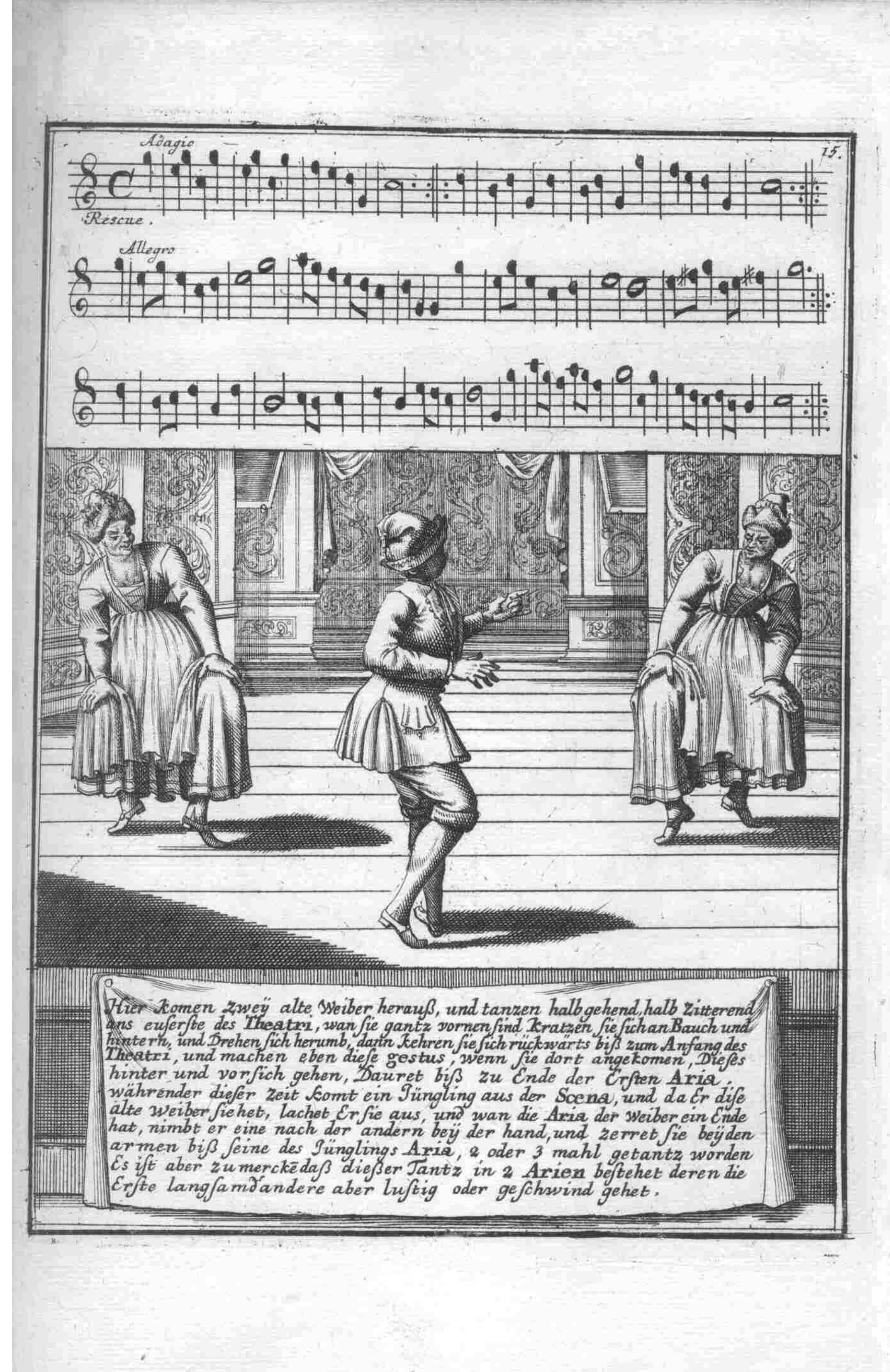
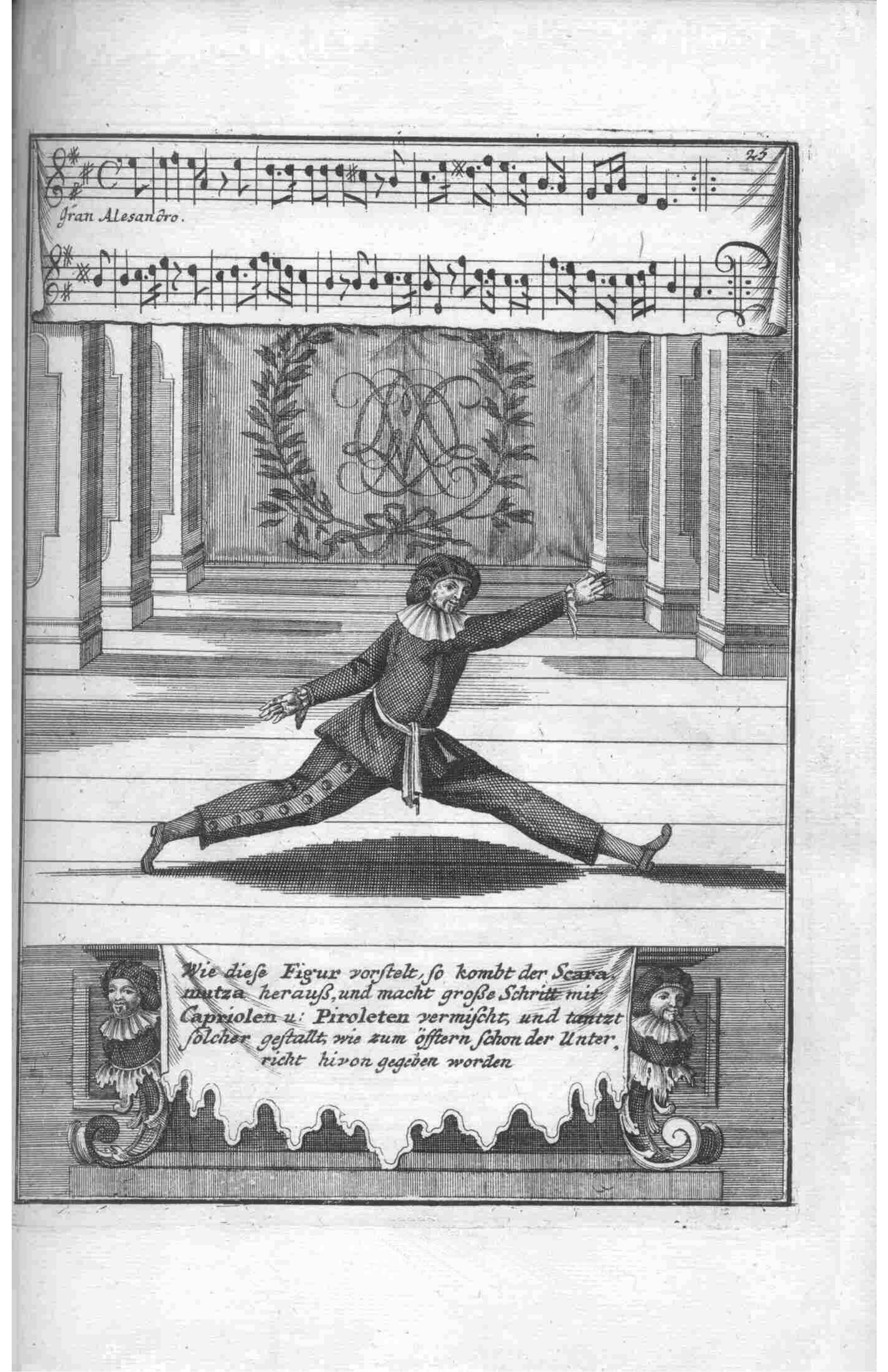
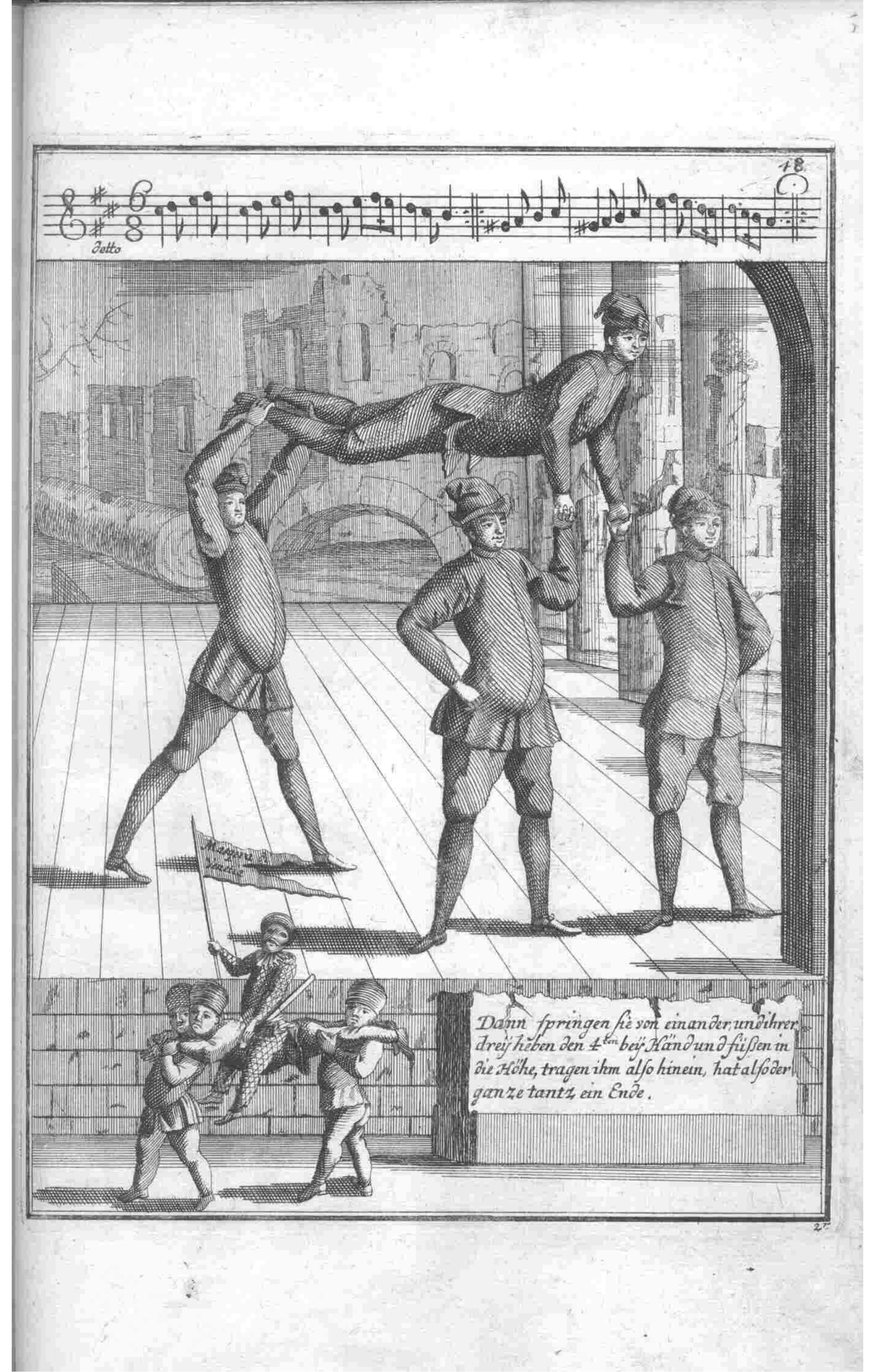
A theatrical stage scene in which five figures demonstrate acrobatic movement. At center, a man in dark breeches and fitted jacket supports a woman horizontally in the air, her body extended and parallel to the stage floor, arms and legs arranged with balletic grace. Two other men in similar dress stand watching, one with hand on hip in a pose of casual observation. A fourth figure, also male, is captured mid-leap or flight at the upper left of the composition. The stage is set within a classical interior with a barrel-vaulted ceiling and arched doorway; a city view is visible through the arch in the background. The floor is rendered in careful perspective. All figures wear the fashionable coat-and-breeches dress of the early 18th century. The engraving includes musical notation at the top—a short melodic line in treble clef—and a German verse caption below describing the movements.
The dancing
The acrobatic lift is the visual focus: the supporting male dancer stands with legs bent in a deep plié, arms extended to control the lifted female dancer's torso and limbs. The woman's body is completely horizontal, suggesting considerable strength and control on the man's part and trained flexibility on hers. The two standing observers adopt the relaxed, elegant posture typical of court dancers of the period—one with one leg straight and the other slightly bent, hand at hip. The leaping figure at upper left is caught mid-flight, legs raised and body arched. All five demonstrate the balletic frame and turnout expected of trained theatrical dancers.
The dance depicted
This is a theatrical acrobatic dance, likely partner adagio, from the early 18th-century Italian theatrical tradition. The image demonstrates the technical sophistication of stage dance in this period: the horizontal lift shows that male dancers were expected to possess considerable strength, and female dancers both flexibility and the ability to maintain a graceful, extended line while airborne. The supporting male's posture—deep plié, controlled arms—and the woman's extended, balletic alignment suggest this was a formal, trained discipline rather than improvised acrobatics. The presence of musical notation ties the movement to a specific composition, indicating this was choreographed stage work set to music.
How it was made
This is a copper-plate engraving, a technique that allows for fine linear detail and precise spatial composition. The careful use of hatching and cross-hatching creates volume in the figures' clothing and shadow in the architectural space, while the parallel lines of the floor establish perspective. Engraving was labor-intensive and expensive, making this work a significant production artifact—not a casual sketch but a formal documentation intended for circulation among dance practitioners, choreographers, and patrons. The inclusion of notation and caption marks this as an instructional or demonstration plate.
About this work
This plate is one of 100 engravings from Gregorio Lambranzi's *Nuova e curiosa scuola de' balli theatrali* (Nuremberg, 1716), the most comprehensive and visually detailed choreographic manual of its era. Lambranzi was documenting the vocabulary of Italian theatrical dance—the theatrical style that would evolve into ballet. Each plate pairs a musical notation with a carefully staged figure or group, demonstrating specific movements, lifts, and scenic compositions for dancers and choreographers to learn from. This particular plate focuses on the acrobatic partner work that was a prestigious element of theatrical dance in the early 18th century: the ability of a male dancer to support and manipulate a female dancer's body in the air while maintaining perfect balletic alignment. The work is foundational to our understanding of how trained stage dancers of the Italian and German courts moved before the French ballet vocabulary became standardized.
How to look at it
Attend first to the moment of suspension: the engraver has frozen the exact point of the lift, showing the male dancer's deep plié and the female dancer's horizontal extension. This choice emphasizes the technical feat—the moment of maximum difficulty and maximum visual impact. Notice how the woman's body maintains a continuous line from fingertips to toes, and how the man's arms frame and control her weight. The two standing observers establish scale and theatrical context: they are not part of the action but witnesses to it, as an audience or fellow dancers would be. The musical notation at the top anchors the movement to a specific piece of music and reminds us that this acrobatic display was choreographed and set to rhythm, not improvised. The perspective of the floor and the architectural setting place the dancers firmly on a stage, distinguishing this as theatrical performance rather than social dancing.
The artist
Gregorio Lambranzi was an Italian dance master and theorist active in the early 18th century. Little is known of his biography, but his *Nuova e curiosa scuola de' balli theatrali* (New and Curious School of Theatrical Dances), published in Nuremberg in 1716, represents the most ambitious attempt of the period to document theatrical dance vocabulary through image and notation. The work was illustrated by an unknown engraver of high skill. Lambranzi's method—pairing musical notation with detailed, naturalistic engravings of costumed dancers in staged settings—set his manual apart from other dance treatises of the era, which relied either on abstract symbolic notation or on written description alone. The *Scuola* suggests Lambranzi was writing for dance masters and professional dancers rather than for courtiers learning social dance, and the technical sophistication of the movements depicted supports this.
The period
In the early 18th century, theatrical dance was undergoing rapid formalization and professionalization. Italian commedia dell'arte troupes were incorporating increasingly acrobatic and virtuosic dance into their performances. Simultaneously, French court ballet was codifying its vocabulary under the influence of Louis XIV's court and the Paris Opéra. Lambranzi's *Scuola* represents a middle moment—Italian theatrical practice documented at the moment just before French ballet vocabulary became the international standard. The emphasis on partnering, acrobatics, and male strength in this plate reflects the theatrical tradition's values: dancers were expected to be athletes and acrobats as well as graceful movers. The publication in Nuremberg, a major printing center, rather than in Italy, suggests the work was intended for a German and Central European audience of dance practitioners.
Where it lives
This plate is from the *Nuova e curiosa scuola de' balli theatrali*, a bound volume of 100 copper-plate engravings published in Nuremberg in 1716. The work was intended as an instructional manual for dance masters and professional dancers. The Library of Congress holds copies of this edition.
Dance in this work
Questions about this work
Is this ballet?
Not quite, though it is a direct ancestor of ballet. This is Italian theatrical dance from the early 18th century, performed by professional dancers in theatrical settings. It uses balletic principles—turnout, extended lines, control—but belongs to a different tradition than French court ballet. Within a generation, the French ballet vocabulary would become the standard across Europe, and this Italian tradition would largely disappear.
Could a male dancer actually do this?
Yes. The male dancers of the Italian theatrical tradition were trained athletes with considerable strength and core control. The plié shown in the image distributes the weight through the legs and uses the floor for support. Still, this was a virtuosic feat and a sign of exceptional training and partnership. The fact that Lambranzi chose to document it suggests it was admired but not routine.
What is the music at the top?
A short melodic phrase in treble clef, likely a minuet or other court dance rhythm adapted for theatrical use. Lambranzi pairs each movement diagram with a specific piece of music, indicating that the steps and lifts were choreographed to musical phrases, not improvised. The notation is not detailed enough to play from, but it identifies the piece and its meter.
Who were these dancers?
Lambranzi does not identify the dancers in his manual. They are likely professional performers from Italian or German theatrical companies—commedia dell'arte troupes or opera houses—where acrobatic skill was highly valued. The elegant dress and precise movement suggest trained professionals, not amateurs or social dancers.
More Notation/Choreography artwork