43 works in this view — arrow keys or swipe to move between them.
Dance in Art
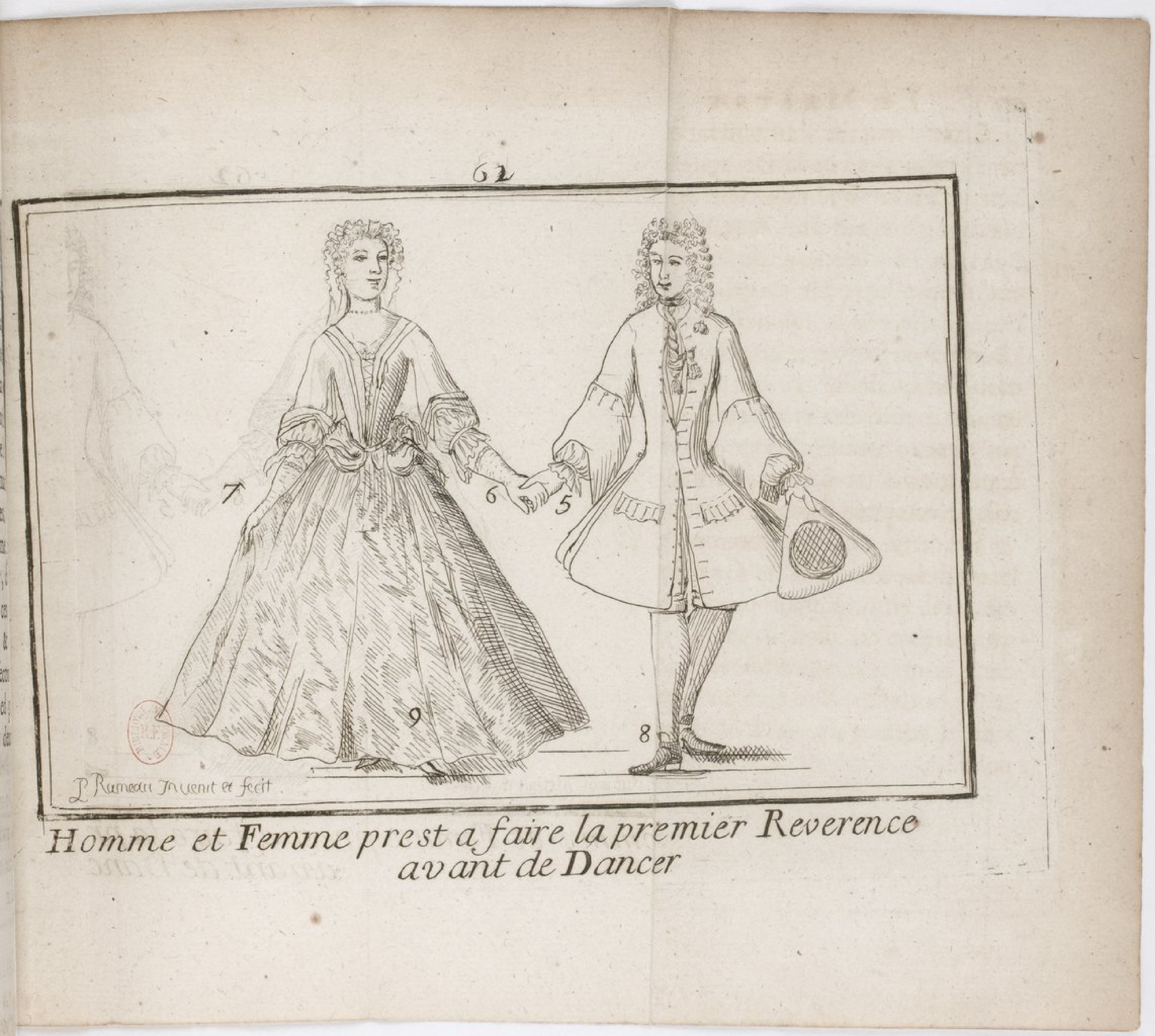
Couple about to make the First Reverence before Dancing
Pierre Rameau
- Medium:
- Engraving
- Dance:
- Notation/Choreography
- Era:
- 1700s (Enlightenment/Minuet Era)
- Collection:
- Le Maître à danser (1725)
- Source:
- Library of Congress
- Rights:
- Public domain — free to use, share and adapt.
- Recorded as:
- Public Domain
Rameau's *Maître à danser* was the first major publication to systematize dance instruction through anatomical illustration and numbered reference, making it a cornerstone text in the history of dance pedagogy and notation. The reverence itself—shown here—was the sine qua non of polite society dancing from the Renaissance through the 18th century; understanding how it was taught reveals the values embedded in courtly bodies and social hierarchy. For dancers and historians, this image is evidence of how early modern dance was deliberately constructed, standardized, and transmitted across Europe.
What you are looking at
An engraving depicts a man and woman in formal dress, positioned facing each other and slightly angled toward the viewer's left. The woman stands on the left wearing an elaborate gown with a fitted bodice, full skirt with deep pleats or godets, and long sleeves; her hair is styled up with curls and topped with what appears to be a small ornament. The man on the right wears a coat with a knee-length skirt, breeches, stockings, and heeled shoes; his hair is long and curled in the fashion of the period. Both figures are shown holding each other's hands at waist height in a formal gesture. The composition is spare, with no background setting beyond a simple ground line and frame, focusing entirely on the bodies and their positioning. Numbered reference marks (6, 7, 8, 9) appear beside different parts of the figures, suggesting this is an instructional illustration.
The dancing
Both dancers stand upright with composed posture. Their hands are joined at the center of the composition in what appears to be a symmetric, formal hold—thumbs visible, suggesting a specific hand position rather than a casual grip. The woman's body is turned slightly toward her right, her left arm extended across her body, while the man faces similarly with his right arm extended. Both maintain vertical alignment at the spine, with weight distributed evenly on both feet. The numbered annotations indicate this is teaching a specific technique: the positioning of hands, arms, and overall frame for the prescribed opening gesture.
The dance depicted
This is a representation of the *première révérence* (first reverence or bow/curtsy) as taught in early 18th-century French court dancing. Rameau's *Le Maître à danser* (The Master of Dancing), published in 1725, established standardized instruction for the social minuet and other ballroom dances of the period. The reverence was the mandatory opening gesture before any dance: partners would acknowledge their co-dancers and the assembled company with this formal, reciprocal inclination. The image captures the moment of hand contact and balanced positioning that preceded the actual bow or curtsy—the structural foundation on which all refined social dancing was built.
How it was made
This is an engraving, identifiable by the fine linear hatching and precise line work characteristic of the medium. Engraving allowed for sharp detail and reproducible clarity, making it ideal for instructional books intended for a broad, educated audience. The numbered reference system—visible as circled numbers keyed to body parts—was a standard pedagogical device of the period, allowing the text to refer readers to specific anatomical positions. The technique's precision and reproducibility made this one of the first systematized, visually documented records of ballroom dance technique, designed for circulation among the dancing masters and nobility of France and beyond.
About this work
This engraving is one of the foundational documents of codified ballroom dancing. It comes from Pierre Rameau's *Le Maître à danser*, the first comprehensive treatise to standardize the teaching of the minuet and related social dances through detailed written description and numbered anatomical illustration. Rather than depicting a moment of exuberant movement, it freezes the prerequisite gesture—the first reverence—that etiquette demanded before dance could begin. The image records not virtuosity or emotion, but decorum: the precise alignment of bodies, the formal handhold, the composed deportment that signaled refinement and social standing. This was the grammar of dance in the Enlightenment ballroom.
How to look at it
Attend to the stillness of the image: this is not a step or a leap, but the structuring pose that precedes movement. Notice the symmetry and reciprocity of the two figures—they are mirrored in their restraint and alignment, suggesting that courtly dancing was fundamentally about hierarchical balance and mutual acknowledgment. The numbered marks invite the eye to decompose the body into anatomical components (hand position, elbow height, foot placement), teaching you to see the reverence as a technical system rather than a spontaneous gesture. This is the grammar of refinement made visible.
The artist
Pierre Rameau (c. 1674–after 1735) was a French dancing master working in Paris during the reign of Louis XV. He is known primarily for *Le Maître à danser* (1725), which remained influential as a pedagogical text throughout the 18th century. Rameau was part of a tradition of dancing masters who published instructional treatises combining written rules, anatomical illustration, and choreographic notation. His systematic approach to documenting bodily position and movement—using numbered reference marks and geometric clarity—influenced later dance notation systems and established a model for how dance could be preserved and transmitted through print.
The period
In the early 18th century, the minuet was the preeminent social dance of the European aristocracy, and mastery of it was a marker of breeding and education. The reign of Louis XIV had established France as the arbiter of courtly taste, and French dancing masters like Rameau codified practices that spread across Europe. This was also an era of Enlightenment empiricism: the impulse to systematize knowledge, measure the body, and make learning reproducible through illustration. Rameau's treatise reflects this broader cultural moment—a belief that refined movement could be analyzed, written down, and taught to anyone with access to a book and a dancing master willing to follow its precepts.
Where it lives
This engraving is from *Le Maître à danser* (The Master of Dancing), published in Paris in 1725 by Pierre Rameau. It is housed in the Library of Congress. The book was one of the most important and widely distributed dance instruction manuals of the 18th century, with copies held in major libraries across Europe and North America.
Dance in this work
Questions about this work
What is a 'reverence' in ballroom dancing?
A reverence was a formal bow (by men) or curtsy (by women) used to greet partners and acknowledge the assembled company before beginning a social dance. It was mandatory etiquette and demonstrated courtesy and refinement. By the early 18th century, the reverence had become a standardized, teachable gesture with precise rules of arm position, weight distribution, and depth of inclination.
Why are there numbers marked on the figures?
The numbered marks (visible as circled integers) are keyed to detailed written explanations elsewhere in Rameau's text. This annotation system allowed readers to understand exactly which body part the text was discussing and how it should be positioned. It was a pioneering use of visual reference marks in instructional illustration.
Was the minuet the only dance Rameau taught?
No, but the minuet was the centerpiece of *Le Maître à danser*. Rameau also described courantes, bourrées, rigaudons, and other social dances of the period. However, the minuet was considered the foundation and the most important dance for anyone wishing to move in polite society.
How did this book spread across Europe?
*Le Maître à danser* was published in Paris and circulated among the educated elite and professional dancing masters. Its systematic approach and detailed illustrations made it valuable to anyone teaching social dance. It was translated, reprinted, and plagiarized throughout the 18th century, making it one of the most influential dance manuals ever published.
More Notation/Choreography artwork