36 works in this view — arrow keys or swipe to move between them.
Dance in Art
Acrobatic — Plate 11
Gregorio Lambranzi
- Medium:
- Copper-plate engraving
- Dance:
- Notation/Choreography
- Era:
- 1700s (Enlightenment/Minuet Era)
- Collection:
- Nuova e curiosa scuola de' balli theatrali (1716)
- Source:
- Library of Congress
- Rights:
- Public domain — free to use, share and adapt.
- Recorded as:
- Public Domain
Lambranzi's manual is one of the few surviving records of actual choreography and movement quality from before the 19th-century development of ballet notation. This plate uniquely captures an acrobatic aerial movement in a period when most dance was social and grounded; it proves that theatrical virtuosity at that level existed and was valued. For historians of training, pedagogy, and the physical demands placed on early modern performers, the image is essential evidence.
What you are looking at
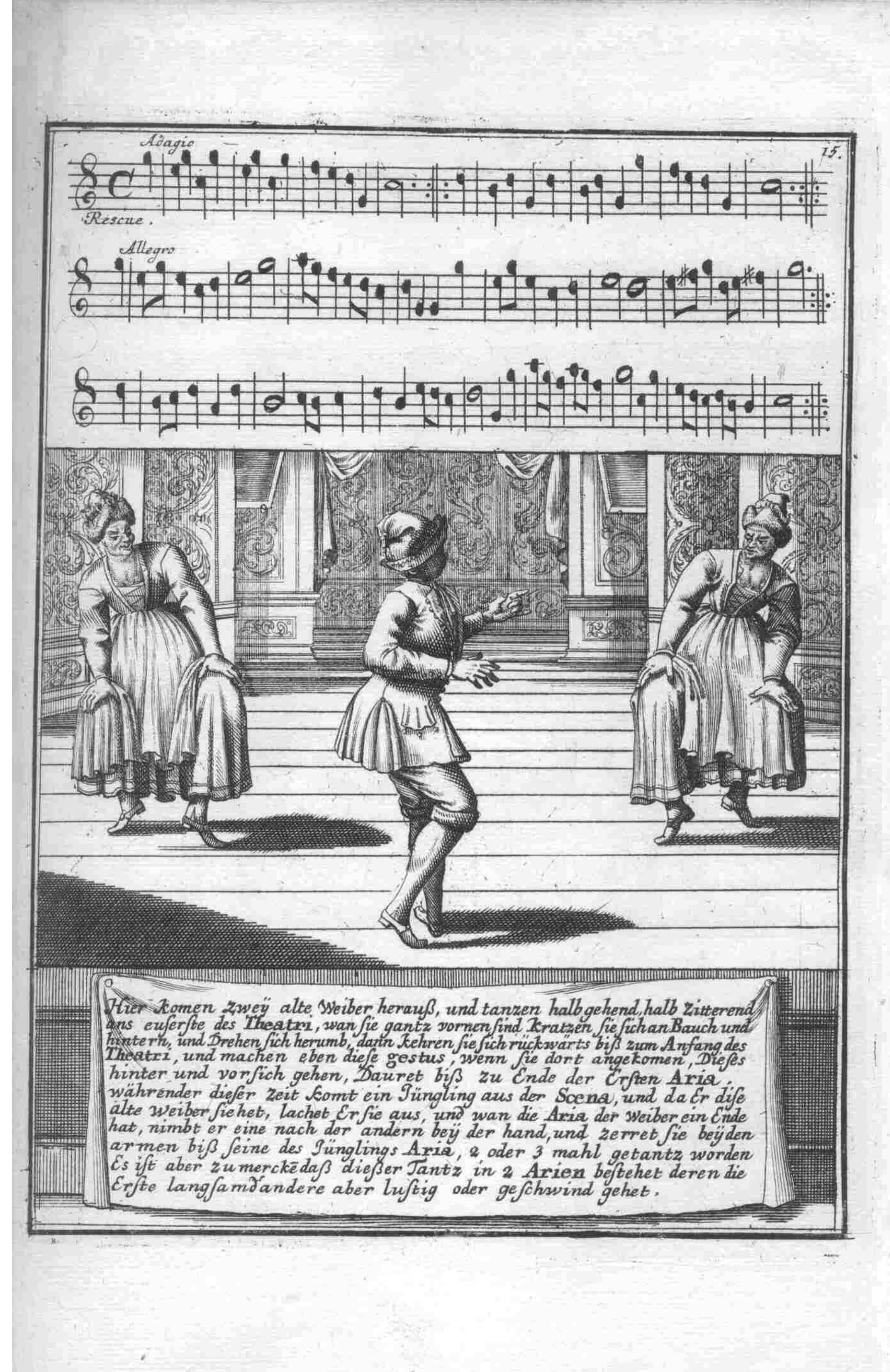
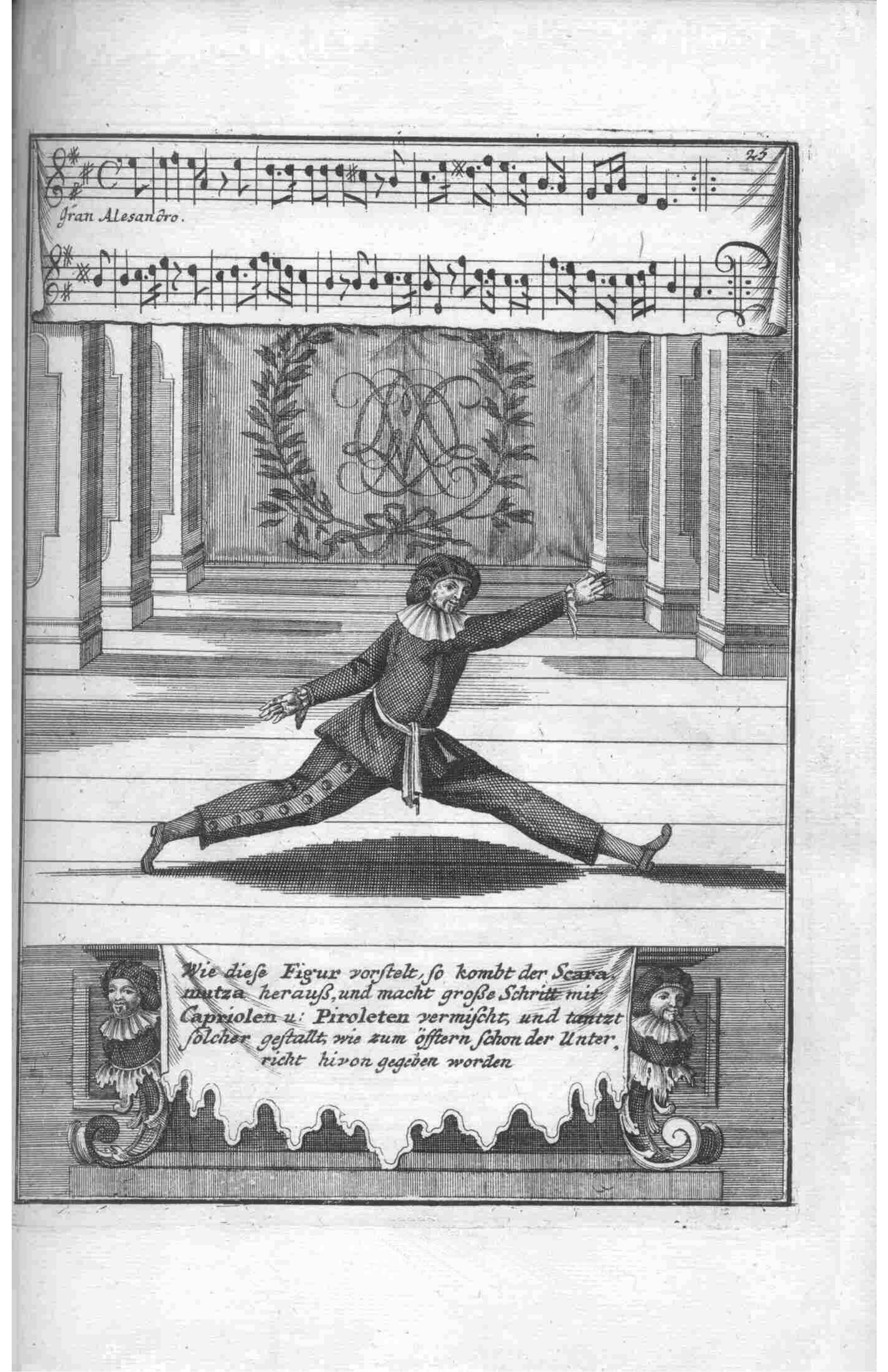
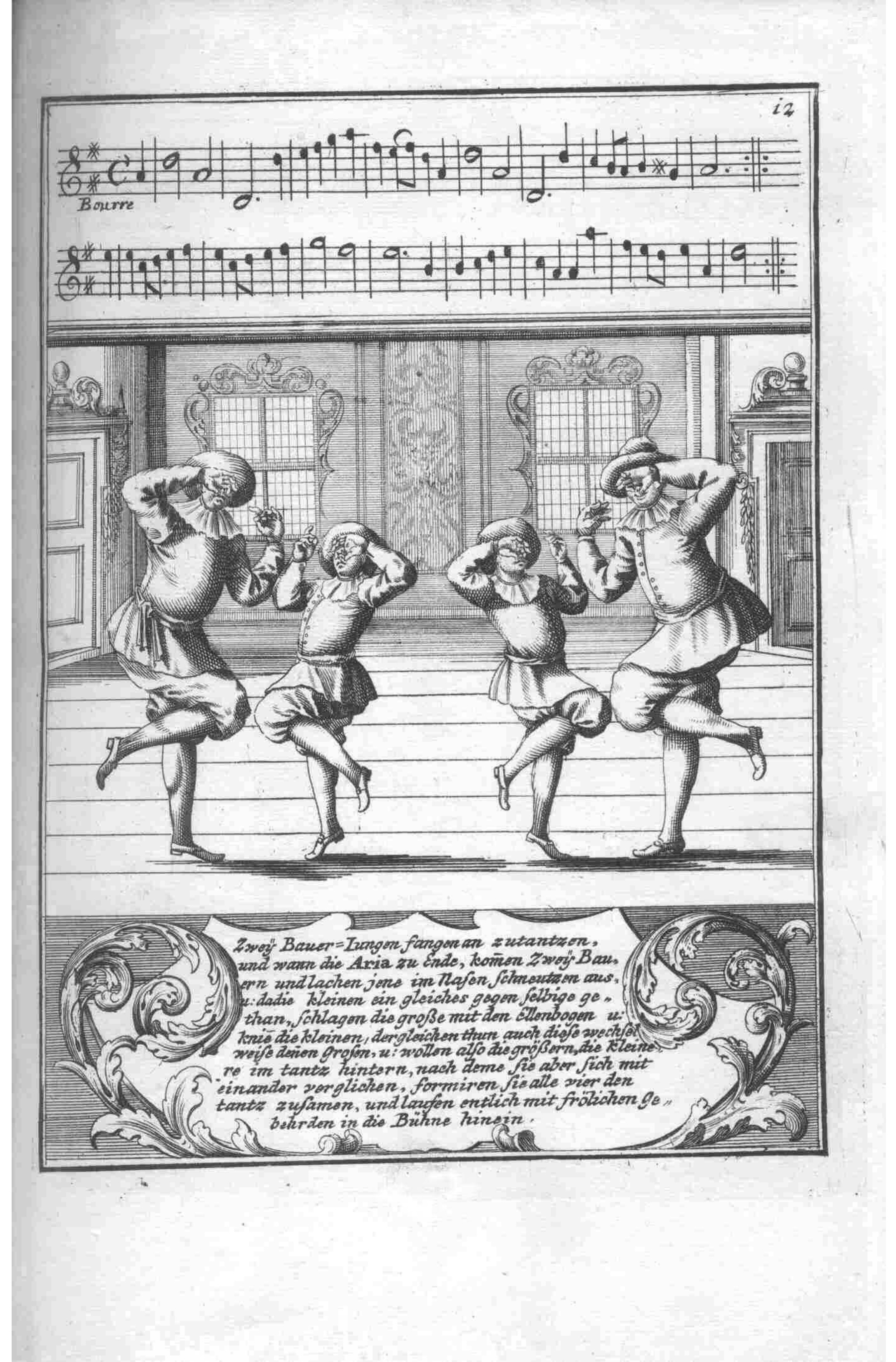
A copper-plate engraving shows four figures in theatrical costume performing an acrobatic leap indoors on a wooden stage. The setting is a grand room with a coffered ceiling, tall latticed windows with decorative pediments, and classical architectural elements. Two adult figures at the sides face inward with their arms raised high, watching two younger performers (likely child dancers) in the center who are captured mid-air in a synchronized backward somersault or flip. All figures wear period dress with voluminous skirts and white collars. The stage floor is shown in linear perspective receding toward the back wall. The engraving is finely detailed, with careful cross-hatching to create shadow and volume. Below the musical notation at top and the scene itself, a German-language caption in an ornamental cartouche provides context.
The dancing
Two child performers are suspended in near-perfect synchronicity, their bodies fully inverted and bent backward in an aerial somersault—a caper or aerial step executed with extraordinary control. Their limbs are extended and articulated; both appear weightless. The two adult figures flanking them have their arms raised high and back, shoulders braced, suggesting they are either supporting the action, directing it, or reacting to it in amazement. All four dancers stand on a single line across the stage, creating a symmetrical composition. The physical mastery demanded by this feat—particularly the precise coordination of two bodies in mid-air—is unmistakable.
The dance depicted
This is an illustration of Italian theatrical dance as practiced in the early 18th century, specifically an acrobatic aerial step from the commedia dell'arte or court ballet tradition. The caper (a jump with a twist or inversion) was a virtuosic element of trained theatrical performance, distinct from social dancing. The image documents the physical vocabulary available to professional dancers of the period: the two child performers demonstrate that such feats required early training and bodies conditioned to extraordinary flexibility and spatial awareness. The adult figures may be dance masters or other performers; their presence emphasizes that this is professional stagecraft rather than amateur display. The notation at top would specify the music accompanying this movement, integrating the leap into a choreographed sequence.
How it was made
This is a copper-plate engraving, a technique requiring painstaking incision of fine lines into a polished copper surface with a pointed tool (burrin). The engraver has used parallel lines (cross-hatching) to build tone and suggest three-dimensional form—fabric drape, musculature, architectural shadow—in grayscale. Engraving allowed for fine detail and sharp definition, making it ideal for technical illustration of complex movement. The plate could be printed repeatedly, making this image widely reproducible; as part of a published manual, it reached theater professionals, dance masters, and educated patrons across European courts and cities. The precision of line and the clarity of spatial geometry underscore the *method* of theatrical dance—these are not folk movements but learned, reproducible techniques.
About this work
This plate from Gregorio Lambranzi's *Nuova e curiosa scuola de' balli theatrali* (Nuremberg, 1716) is a primary document of early 18th-century professional theatrical dance. Lambranzi's treatise was one of the most influential choreographic manuals of its era, pairing musical notation with detailed costume-figure engravings to document the vocabulary of court ballet and commedia dell'arte. Each plate isolates a single movement or short combination, making the work a kind of visual dictionary for performers and dance masters. This particular plate celebrates acrobatic virtuosity—the ability to execute a perfectly synchronized double aerial somersault—as a mark of the professional dancer's skill and training.
The work belongs in a dance history collection because it preserves not just the *idea* of a movement but its embodied form: the precise angle of the back, the position of the limbs, the sense of suspension. For anyone training in historical theatrical technique or seeking to understand what early 18th-century audiences expected of a professional performer, this image is an irreplaceable visual reference. It also documents the class and gender dimensions of theater: the performance is executed by children, suggesting that such training was specialized and demanding, and the symmetrical display of two bodies inverts the typical hierarchy of a featured solo dancer.
How to look at it
Notice first the *suspension*: the engraver has chosen the moment when both child dancers are at the apex of their leap, fully inverted, weight momentarily neutralized. This freezes what would be the most difficult and impressive instant—not the takeoff or the landing, but the peak of the arc. Look at how the artist renders the fabric: the skirts fall straight downward despite the inverted bodies, an anatomical impossibility that suggests the engraver prioritized clarity of the body's position over realistic draping. The symmetry of the composition—two matched figures, two adult witnesses—is a hallmark of early 18th-century theatrical design; asymmetry would come later. Finally, observe the setting: the architectural precision (ruled lines for perspective, careful hatching on the walls) asserts that this is *stage* space, professional and controlled, not street or court. The dance exists within a frame.
The artist
Gregorio Lambranzi (c. 1680–after 1730) was an Italian dance master and choreographer active primarily in Nuremberg. He is known almost entirely through his *Nuova e curiosa scuola de' balli theatrali* (New and Curious School of Theatrical Dances), first published in Nuremberg in 1716 in German and Latin editions, with an Italian edition following. The treatise contains 52 engraved plates by an unnamed engraver(s), each showing one dance or movement in costume and setting. Lambranzi drew on the commedia dell'arte tradition and court ballet practice, positioning his work as a complete pedagogical system for theatrical performers. The manual was reprinted and circulated widely in the 18th century and remains a foundation text for historical dance reconstruction. Little is known of Lambranzi's own performance career or biography; his legacy rests entirely on this single published work, suggesting he may have been primarily a didact rather than a celebrated performer.
The period
In the early 18th century, dance existed in a state of disciplinary flux. Court ballet was declining as the dominant form of aristocratic entertainment, but professional theatrical dance was expanding, particularly through traveling companies and permanent court orchestras. Italy remained the birthplace of new choreographic vocabulary; French court dance was codifying what would become classical ballet technique. The appearance of detailed choreographic manuals like Lambranzi's reflects a new pedagogical impulse: the desire to systematize dance, make it transmissible, and preserve it in print. This was also the period of the Enlightenment, when *observation* and *documentation* became modes of knowledge. Lambranzi's decision to pair music notation with engraved figures signals that dance was being treated as a subject worthy of the same systematic study as music or architecture. The emphasis on virtuosic acrobatics in several of his plates (this is one of at least three featuring aerial work) shows that 'turn-of-the-century theatrical audiences still expected dancers to display extraordinary physical feats; the later 19th-century association of virtuosity with *ballet* alone was not yet established.
Where it lives
This plate is from the *Nuova e curiosa scuola de' balli theatrali*, a complete treatise published in Nuremberg in 1716 by Gregorio Lambranzi with engravings by an unidentified master. The Library of Congress holds copies of the 1716 German and Latin editions. The treatise survives in multiple 18th-century editions and remains in print in facsimile and scholarly reconstructions, making it one of the most accessible primary sources for early modern dance.
Dance in this work
Questions about this work
Is this really what dancers could do in 1716?
Yes, and Lambranzi documents several other acrobatic feats—backflips, cartwheels, and leaps with body rotations. These were hallmarks of professional theatrical performance, especially in commedia dell'arte companies. Such training began in childhood and required years of conditioning. By the mid-18th century, as court ballet became more codified and formal, such acrobatic displays became less fashionable, and the classical ballet technique we know today moved toward turned-out positions and a different aesthetic of virtuosity.
What is the music notation at the top for?
The notation at top shows the melody and rhythm accompanying this movement. Lambranzi's purpose was to integrate dance and music at the notational level—to show that each step or movement had a precise temporal and musical correspondence. This reflects the court ballet tradition, in which choreography and composition were inseparable. A dance master consulting this plate would know not just what the figures should do but how long the movement should take and what music to use.
Why are there children dancing with adults?
Child performers were common in early 18th-century theater, especially in roles requiring flexibility, agility, or a visual contrast (small bodies paired with adults for comic effect). Here, the children's smaller frames may have made the aerial maneuver more visually striking or easier to execute. Children in professional companies were trained apprentices, often purchased or bound into service; their presence on stage was not unusual or controversial by the standards of the time, though working conditions were harsh.
Could women do this kind of dance?
The historical record is incomplete, but professional female performers (actresses, dancers, singers) did exist in Italy and other parts of Europe by 1716. However, acrobatic feats like this were more commonly documented for male and child performers. The voluminous skirts visible here—on all four figures—would have constrained certain movements, though trained dancers adapted. Lambranzi's manual is one of the few sources that might tell us; the prevalence of male and child figures in his plates may reflect actual performance demographics or engraver convention.
More Notation/Choreography artwork