31 works in this view — arrow keys or swipe to move between them.
Dance in Art
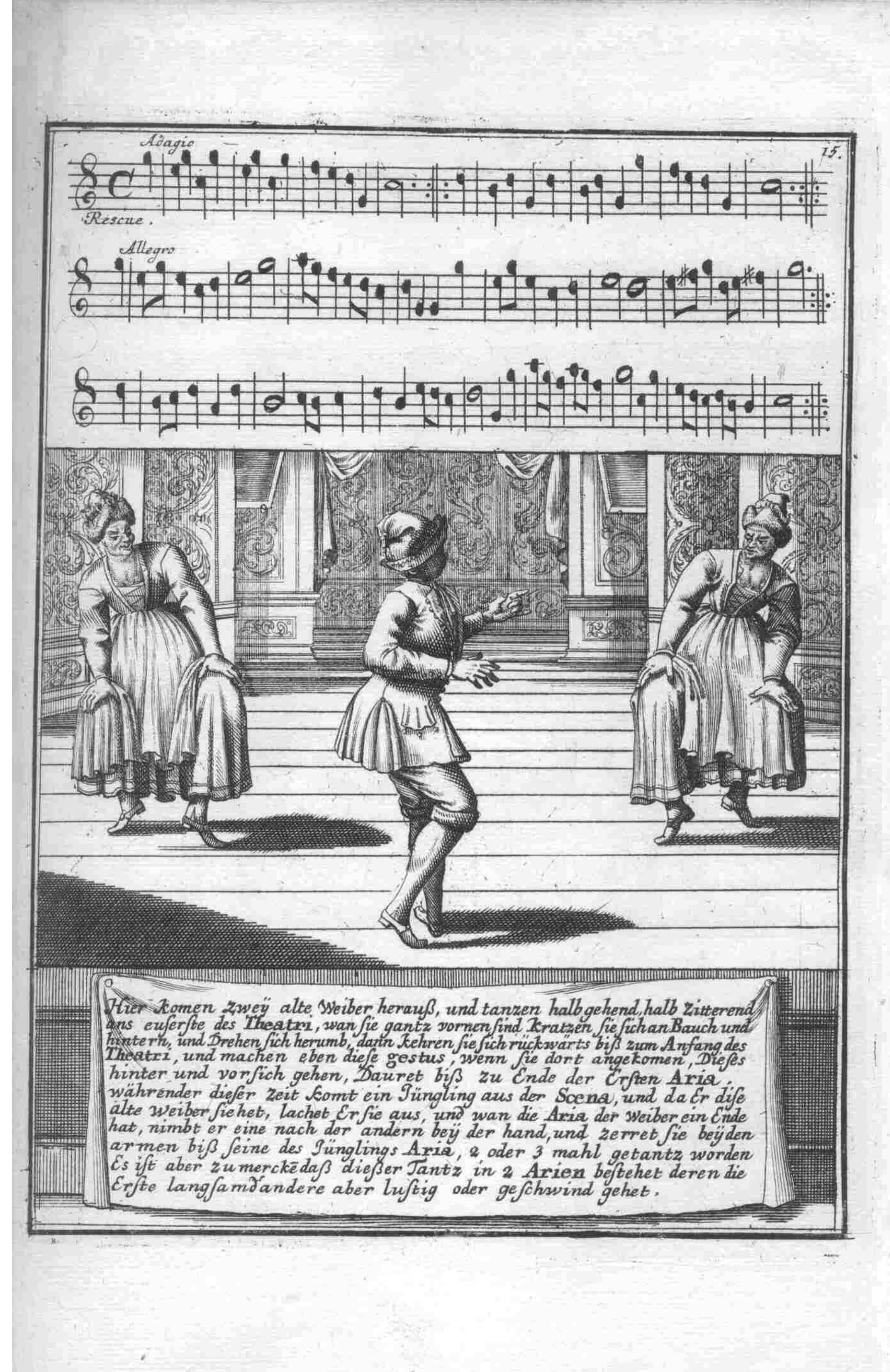
Comic Character — Plate 16
Gregorio Lambranzi
- Medium:
- Copper-plate engraving
- Dance:
- Notation/Choreography
- Era:
- 1700s (Enlightenment/Minuet Era)
- Collection:
- Nuova e curiosa scuola de' balli theatrali (1716)
- Source:
- Library of Congress
- Rights:
- Public domain — free to use, share and adapt.
- Recorded as:
- Public Domain
Lambranzi's manual preserves performance knowledge that would otherwise be lost—the postures, gestures, and dramatic types of popular theatrical dance in a period when most such material was transmitted orally or through ephemeral live performance. For dancers and historians, this plate is rare documentary evidence of how character dance was actually embodied, staged, and understood in the early 18th century, showing that theatrical movement encompassed comedy, grotesque physicality, and social burlesque alongside the refined dances of the ballroom.
What you are looking at
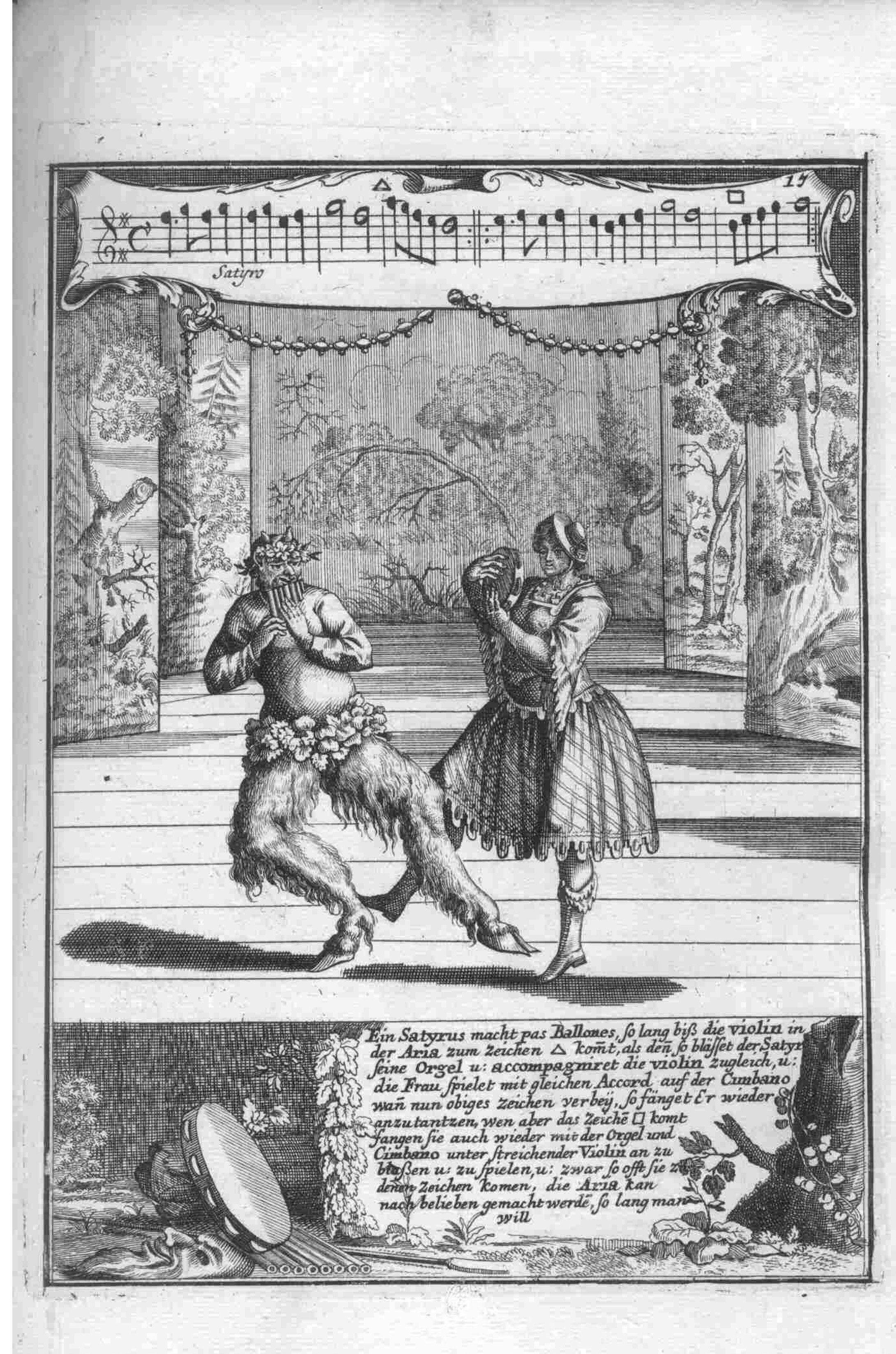
A satyr and a woman in theatrical dress perform a comic duet on a shallow stage framed by heavy curtains and dense woodland backdrop. The satyr—a shaggy, hirsute figure wearing a flower garland around his middle—plays pan pipes while capering with bent knees and splayed legs in an exaggerated, lewd posture. The woman, in an elaborate dress with a decorative hat and feathered plume, faces him with one arm raised and the other at her hip, her body angled in dynamic response to his antics. The stage is set with draped swags overhead, framed by faux-marble piers, and the entire scene is rendered in the meticulous cross-hatching of a copper-plate engraving. Musical notation appears at the top; German verse explaining the scene is printed below the image in a decorative cartouche.
The dancing
The satyr occupies the left-center, his weight forward on bent legs in a deep plié or squat, torso leaning, one arm raised to the pan pipes. The woman stands nearly upright in counterpoint, her frame more restrained but clearly engaged—shoulders back, one arm extended, suggesting responsive partnership rather than passive observation. The spatial relationship between them is close and charged; their bodies are angled toward each other across a narrow stage. Both figures occupy the same plane, and their relative heights and the satyr's exaggerated posture suggest a physical comedy rooted in contrast.
The dance depicted
This is a theatrical comic interlude from the commedia dell'arte or commedia-influenced tradition, showing a satyr (a stock comic or grotesque figure from classical mythology and Renaissance theatre) in a musical duet with a woman of higher social station. The satyr's pose and gestures—the bent-legged squat, the pan pipes, the flowers—reference classical satyr imagery and bawdy carnival or festive performance traditions. This is not ballroom dance or court dance but rather theatrical character dance or burlesque performance, likely improvised or choreographed for popular entertainment. The engraving documents the visual and postural conventions of early 18th-century theatrical comedy, in which the satyr's grotesque body and exaggerated stance would have been instantly recognizable to audiences and performers.
How it was made
Copper-plate engraving, a printmaking technique that allowed for fine detail, wide circulation, and reproducibility. The close parallel hatching and careful modeling of fabric, flesh, and foliage demonstrate skilled execution; the process required both a trained hand and a considerable investment in time and materials. Engravings of this type were bound into dance manuals and theatrical instruction books for consumption by professional dancers, choreographers, nobles, and wealthy amateurs—circulating knowledge of character types, poses, and stage practice across Europe. The pairing of musical notation with the figure suggests the engraving served as both visual record and practical teaching tool.
About this work
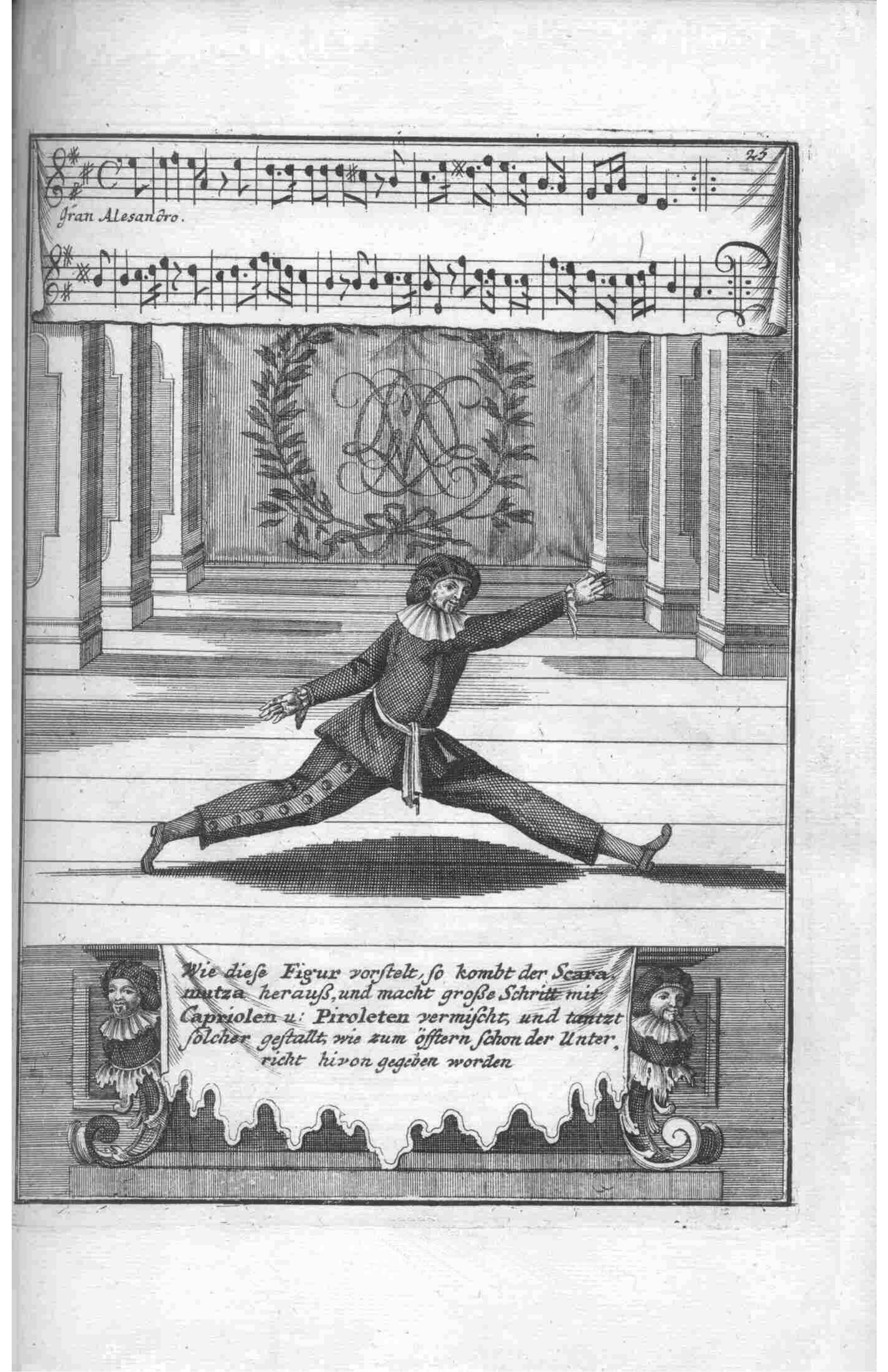
This is Plate 16 from Gregorio Lambranzi's *Nuova e curiosa scuola de' balli theatrali* (*New and Curious School of Theatrical Dances*), published in Nuremberg in 1716—one of the era's most influential manuals of theatrical dance and character performance. Each plate pairs a notated musical phrase with a single costumed figure or small group in a theatrical gesture or position, accompanied by German verses describing the figure's action and meaning. Lambranzi's collection documents not the elite court ballet or formal ballroom dances that survive in other historical records, but rather the character dances, comic routines, and improvised theatrical movement that filled popular stages and carnival celebrations. This particular plate captures a satyr-and-woman comedy number, showcasing the grotesque physicality, sexual tension, and visual wit that characterized theatrical entertainment in the age of commedia dell'arte.
How to look at it
Attend to the satyr's posture first: the deep squat, the splayed legs, the forward lean all signal exaggeration and grotesquerie—this is not the upright carriage of a minuet or gavotte, but a deliberately ungainly, animalistic pose. Notice how the woman's body forms a counterpoint: more restrained, more vertical, her raised arm a response to his music and his provocation. The flowers around his waist and the pan pipes in his hands are props that carry meaning—references to classical satyr imagery and to the pastoral comedies that audiences would have recognized instantly. The stage setting, with its faux-marble piers and draped swags, locates this as a theatrical moment, not a ballroom scene. The musical notation at the top is not merely decorative; it documents the melody that would have accompanied this pose and gesture. Read the engraving as a moment frozen in a known performance tradition: the viewer is meant to recognize the satyr type and understand the sexual and comic register of the scene.
The artist
Gregorio Lambranzi (fl. early 18th century) was a dancer, choreographer, and dance master based in Nuremberg. He is known almost entirely through the *Nuova e curiosa scuola*, a two-volume manual published in 1716 and reissued in expanded form in 1728. The work contains 212 engraved plates depicting individual dances, character types, and theatrical scenes—a comprehensive visual record of the repertory of a professional dance master's studio. Lambranzi's approach was practical and visual rather than theoretical; he documented actual performance through the medium of engraving, creating what may be the most detailed surviving record of theatrical and popular dance practice in early 18th-century Europe.
The period
In the early 18th century, European theatrical and popular dance existed in two worlds that often overlapped. The court ballet and formal ballroom dances of the aristocracy were increasingly documented in notation and treatises. Simultaneously, the stages of opera houses, carnival celebrations, and popular theatres hosted character dances, commedia dell'arte scenarios, and comic improvisation—a world that left few written records. Lambranzi's manual bridges this gap, capturing both refined ballroom forms and the grotesque, comic, and physically exuberant character dances performed by professional dancers for popular audiences. The satyr figure, with roots in classical mythology and Renaissance pastoral tradition, was a persistent character type in theatrical performance, often deployed for sexual comedy and physical humor. The engraving medium was itself relatively new as a tool for documenting dance; earlier dance treatises used textual notation or schematic diagrams. Lambranzi's use of detailed, naturalistic engravings was a major innovation, prioritizing visual clarity and bodily representation as the primary means of transmitting choreographic knowledge.
Where it lives
This plate is drawn from the *Nuova e curiosa scuola de' balli theatrali*, a two-volume dance manual published in Nuremberg in 1716 by Gregorio Lambranzi and engraved by various artisans. The work survives in libraries and special collections across Europe and North America. The Library of Congress holds a copy, and this engraving is drawn from that or a comparable institutional holding.
Dance in this work
Questions about this work
What is a satyr doing in a dance manual?
The satyr was a stock character in Renaissance and Baroque theatre, especially in commedia dell'arte and carnival performance. Lambranzi included character dances and theatrical types alongside court dances; the satyr-and-woman scene is a theatrical interlude or comic number, not a ballroom dance. It documents the wide range of movement and character work that professional dancers were expected to master.
How do we know what the music sounded like?
The notation at the top of the plate is musical staff notation, readable to anyone trained in the period's notational conventions. The melody would have been relatively simple, likely in a common rhythm or dance meter. The engraving pairs the visual gesture with the musical phrase, suggesting that the two were meant to be learned and performed together.
Is this ballet?
No. This is theatrical character dance or commedia-influenced performance—popular theatrical entertainment rather than court ballet. Ballet in this period was a more formal, codified practice; character dances were often improvised or loosely choreographed, rooted in popular and carnival traditions. Lambranzi's manual documents both, but this particular plate represents the less 'respectable' world of popular theatre.
Who would have used this manual?
Professional dancers, choreographers, dance masters, and wealthy amateurs who could afford to buy or access a copy. The manual was a teaching and reference tool, showing performers the poses, gestures, and character types they could deploy on stage. It also served as a record of fashionable and entertaining movement for a literate, theatrical audience.
More Notation/Choreography artwork