31 works in this view — arrow keys or swipe to move between them.
Dance in Art
The Faust Quadrille
Coote
- Dance:
- Quadrille
- Era:
- Late 1800s (Victorian Ballroom)
- Source:
- Victoria and Albert Museum
- Rights:
- Rights vary by item — check the source record before reusing this image. Source record ↗
- Recorded as:
- Check V&A creditLine
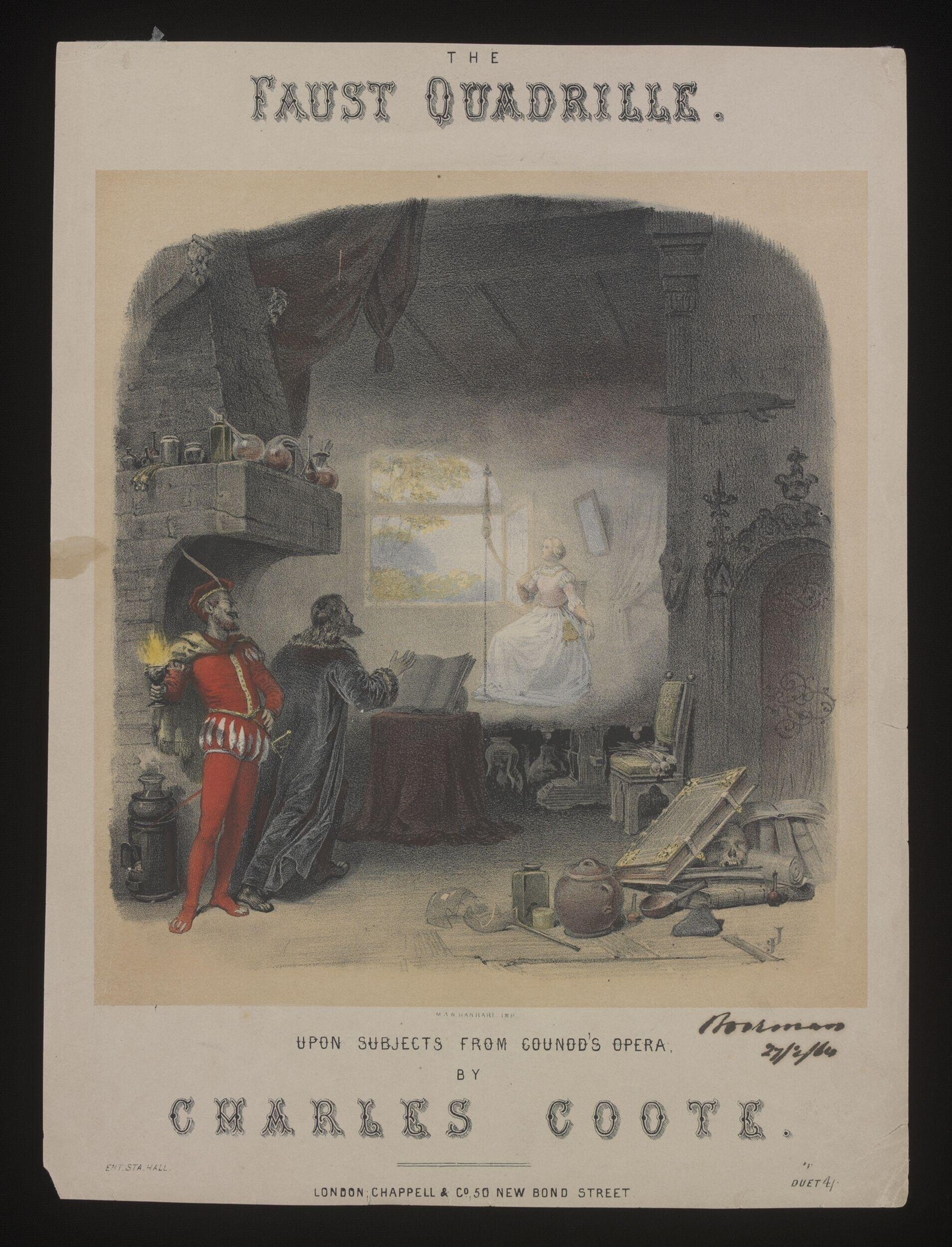
The image reveals the 19th-century appetite for operatic spectacle in visual form and shows how dance and movement were translated, simplified, and sold to the public through cheap theatrical prints. It also demonstrates the period's collapse of boundaries between ballroom dance (the quadrille) and theatrical dance (the ethereal, ghostly body): the title promises one thing (social dance), but the image delivers another (supernatural pantomime), reflecting how opera drew on and reimagined the forms and bodies of dance.
What you are looking at
A Gothic interior—vaulted stone ceiling, crenellated tower, heavy drapery—frames a supernatural encounter. In the center, a luminous female figure in white drapery materializes or dances, her body lifted and ethereal. To the left, a man in brilliant red military dress and a companion in dark clothing gaze upon her; scattered at the foreground are the mundane objects of a scholar's study—books, an inkwell, a compass—now abandoned. The contrast between the solid stone architecture and the hovering spirit, between earthly dress and unearthly light, creates a moment of intense theatrical drama. This is the apparition scene from Gounod's opera Faust, where Marguerite's ghost or vision appears to haunt the title character.
The dancing
The central female figure hovers with arms extended and body in a posture of ethereal grace—neither fully grounded nor entirely disembodied, but suspended between states. Her white drapery clings to an elongated silhouette. The two men below are static observers: the man in red (Faust) stands in profile with theatrical absorption, while his companion adopts a pose of astonishment or reverence. The bodies do not touch or engage in partner interaction; instead, all movement and energy emanates from the woman, who is the sole focus of physical expressivity.
The dance depicted
This depicts a moment of operatic spectacle rather than ballroom quadrille, despite the work's title. The image illustrates the supernatural visitation scene from Gounod's *Faust* (première 1859), where the title refers to the quadrille that opens the opera's Walpurgis Night scene. The floating female figure suggests the vocabulary of Romantic ballet and pantomime—the grammar of the ethereal and otherworldly—rather than any structured social dance. The artist has captured not a dance in the ballroom sense but the dance of a ghost or spirit, rendered as an isolated apparition suspended above the material world.
How it was made
This is a color-printed engraving or lithograph, likely from a mid-to-late 19th-century theatrical print series. The hand-coloring—particularly the brilliant red military coat, the white drapery's luminosity, and the atmospheric gray of the stone—suggests the work was produced as a commercial theatrical souvenir or illustration, made for circulation among opera-goers and collectors. The technique allows for crisp detail in costume and architecture while building atmospheric effect through tonal gradation and light; the ghostly central figure is rendered in pale pigment against darker surrounds, creating visual hierarchy and drama. Such prints were inexpensive and widely distributed, making them primary documents of 19th-century stage practice and public understanding of operatic spectacle.
About this work
This is an illustration of a scene from Charles Gounod's opera *Faust* (1859), created by Charles Coote. The work belongs to a category of theatrical ephemera—popular prints documenting operatic moments—that reveal how 19th-century audiences understood and consumed spectacular dance and gesture on stage. Though the work's title references the quadrille (a historical ballroom form), the image does not depict social dance; instead, it captures the opera's most visually arresting supernatural moment, where spectral movement and Romantic ballet aesthetics replace the structured lines and social formality of the quadrille. The work is significant as a document of how visual artists translated operatic choreography into print for mass consumption.
How to look at it
Notice the sharp compositional divide: the rational, grounded world of the scholar (red coat, books, instruments) below, and the ethereal, weightless apparition above. The artist has chosen the moment of vision itself—not action, but apparition—and rendered it through the contrast between solid architecture and immaterial light. The white-draped figure hovers in a posture neither standing nor lying, a formal vocabulary inherited from Romantic ballet and 18th-century pantomime. The print's technique—hand-colored engraving—allows the spectral figure to glow against the darker surrounds, translating theatrical lighting effects (spotlight on the ghost) into the grammar of the print.
The artist
Charles Coote was a mid-19th-century illustrator and printmaker specializing in theatrical subjects. His works were part of a prolific industry of operatic illustration, produced for a mass market of theatre-goers and collectors. Coote's hand was competent in narrative and costume detail, though his primary aim was legibility and commercial appeal rather than artistic innovation. His prints were likely sold as souvenirs at the theatre or through print shops, making them accessible to a broad, non-elite audience.
The period
Gounod's *Faust* premiered in 1859 and became one of the most frequently performed operas of the 19th century. The work synthesized Romantic opera's taste for the supernatural and spectral with grand opera's visual splendor and dance spectacles. The Walpurgis Night scene (which includes the quadrille referenced in Coote's title) was celebrated for its choreographic variety and erotic energy—a dramatic contrast to the opera's tragic themes. The 1860s-1880s saw an explosion in color theatrical prints, made affordable by advances in lithographic printing, which transformed opera from an elite experience into a visual commodity available to the urban middle class. Coote's work sits within this culture of theatrical mass production.
Where it lives
The work belongs to the Victoria and Albert Museum's collection of theatrical prints and ephemera. Such prints were produced in large quantities as souvenir merchandise and popular entertainment, making them widely available in the 19th century. This example survives as a record of both operatic practice and mass culture.
Dance in this work
Questions about this work
Why is this called 'The Faust Quadrille' when there is no quadrille in the image?
Gounod's opera *Faust* contains a famous Walpurgis Night scene in which a quadrille is danced. Coote's print illustrates another moment from the same opera—the supernatural visitation scene—but uses the opera's title to identify the source. Publishers often simplified or reused titles for commercial appeal, and operatic prints frequently drew on the most famous scenes or formal elements (like the quadrille) from an opera's reputation, even if they depicted a different moment.
Is this actually a depiction of social dance or the quadrille?
No. The image shows theatrical pantomime and operatic spectacle—a ghost or spirit appearing to the hero. While the work is titled after the opera's quadrille scene, the actual movement depicted is ethereal, balletic, and supernatural, not the geometric, social form of the ballroom quadrille. This confusion between title and content is typical of 19th-century theatrical prints, which often advertised themselves by an opera's most famous scene or formal element rather than the specific moment illustrated.
What does the print tell us about how the opera was staged?
It shows that the supernatural scenes in *Faust* relied on visual contrast, atmospheric lighting, and the ethereal, weightless body language of Romantic ballet to convey the ghostly or divine. The costume detail (the red military coat, the white drapery) and the dramatic composition suggest that the opera's power derived from spectacle—light, color, architectural drama, and the balletic body—rather than narrative clarity alone. Such prints are primary documents of 19th-century staging practice and the visual vocabulary of operatic performance.
More Quadrille artwork