34 works in this view — arrow keys or swipe to move between them.
Dance in Art
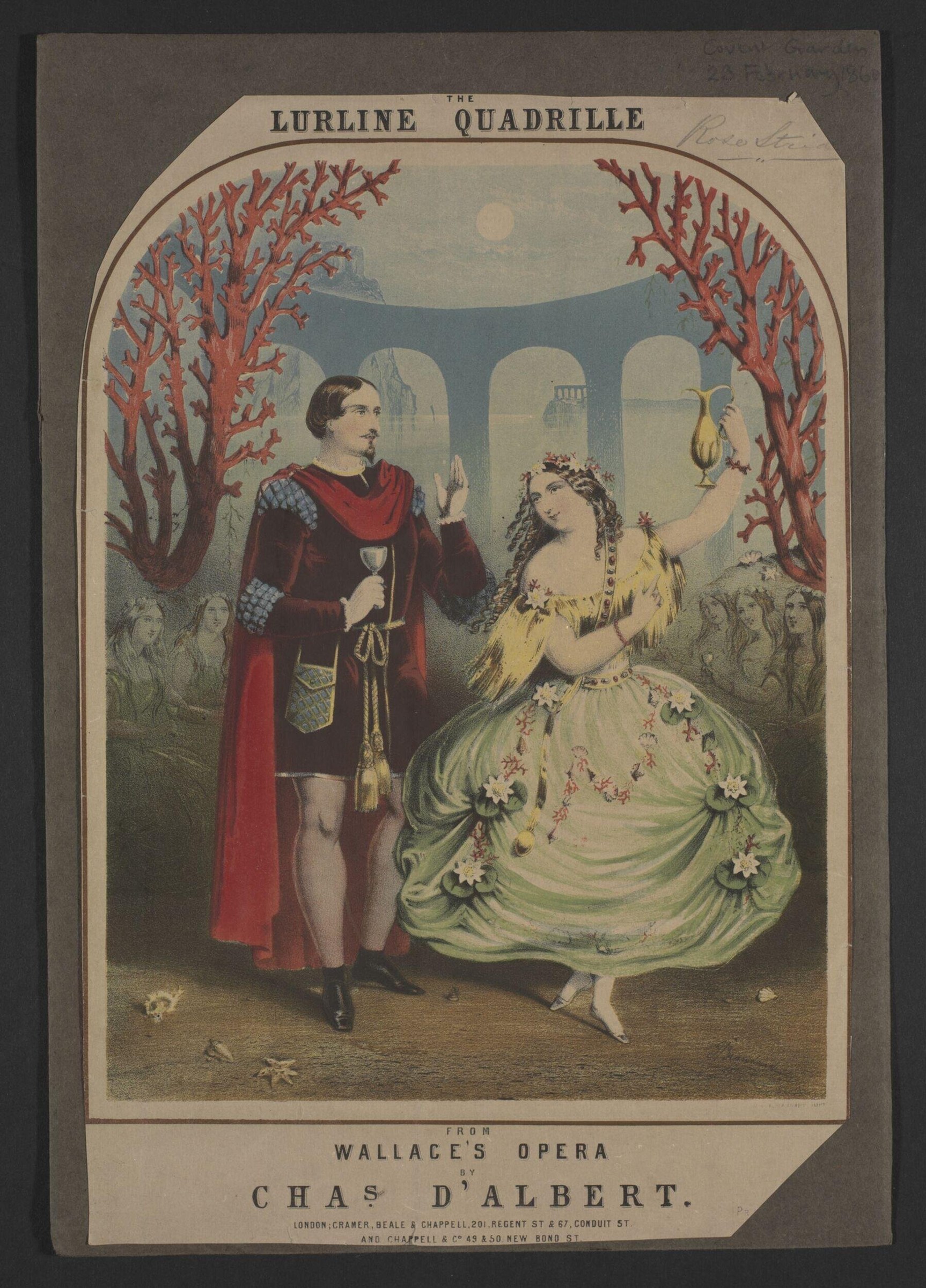
The Lurline Quadrille
Hart-Talbot Printers
- Dance:
- Quadrille
- Era:
- Mid 1800s (Polka Era)
- Source:
- Victoria and Albert Museum
- Rights:
- Rights vary by item — check the source record before reusing this image. Source record ↗
- Recorded as:
- Check V&A creditLine
The Lurline Quadrille documents the crucial Victorian moment when ballroom dance was becoming simultaneously more theatrical and more narrative—when the quadrille, originally a geometric social dance, began to be staged as musical theatre with elaborate costumes and backdrops. For dance historians, it shows how choreography and storytelling merged in popular entertainment, and how prints and images became the primary way most people encountered fashionable dance. For theatre historians, it reveals the investment in dance as visual spectacle and the machinery of theatrical publicity in the mid-nineteenth century.
What you are looking at
A man and woman in ornate costume occupy the centre of a romantic garden setting. He wears a deep red tunic with blue-checked sleeves and a scarlet cape, holding a chalice; she is dressed in a pale yellow gown adorned with white flowers and a wreath in her hair, reaching upward with one arm in a graceful gesture. They stand beneath a vaulted stone archway framed by two vivid coral-red trees with bare branches. Behind them, a moonlit landscape with classical buildings is visible through the arches. In the middle distance, small figures of courtiers or attendants are rendered in grey, witnessing the scene. The foreground is a bare sandy or earthen stage; delicate flowers are scattered on the ground. The whole composition has the decorative, chromolithographic quality of mid-nineteenth-century theatrical scenography.
The dancing
The man stands in profile, weight on one leg, with his other foot advanced; his body is upright and formal. The woman leans slightly toward him, her weight similarly grounded, with her free arm raised in an open, expressive gesture—reaching or offering—while her other arm remains at her side. Neither figure is in a closed ballroom hold. Their postures suggest a moment of dramatic encounter rather than the mechanical execution of a set dance pattern; the woman's raised arm and inclined torso convey theatrical emotion rather than technical precision.
The dance depicted
This is a quadrille, as stated in the title and confirmed by the theatrical context. The quadrille was a four-couple social dance that dominated fashionable ballrooms from the 1840s onwards, often structured around narrative tableaux. This particular image appears to represent a scene from a theatrical version of the quadrille—either a performed stage quadrille or a quadrille printed for a theatrical audience—rather than a social-dance instruction. The gestures and costumes suggest a story quadrille set to operatic or romantic music, where the dance figures were interspersed with dramatic action and character interaction.
How it was made
This is a chromolithographic print, a technique that allowed the reproduction of coloured theatrical imagery in quantity for popular consumption. The process of chromolithography required separate stone blocks for each colour—red, blue, yellow, flesh tones, and neutrals—which explains the clean colour separation and the careful hand-tinting visible in the costumes. The technique was ideal for theatre publicity and souvenir prints, making such images accessible to audiences beyond those who attended performances. The presence of the publisher's imprint (Chappell & Co., London) indicates this was a commercial print circulating among a broad audience.
About this work
The Lurline Quadrille is a chromolithographic scene print from Wallace's Opera, depicting a moment of romantic encounter dressed in the visual language of mid-Victorian theatrical spectacle. The quadrille itself—a four-couple ballroom dance that had become a staple of both fashionable drawing rooms and theatrical entertainment—is here presented not as technique to be learned but as theatre to be witnessed. The print conflates dance with operatic drama: the quadrille is the frame, but the moment captured is one of narrative emotion and character interaction. This reflects a broader Victorian fascination with story-dances and quadrilles d'action, in which classical dance steps were woven into staged romantic plots with elaborate scenery, costumes, and dramatic gestures.
As a commercial print emanating from a London music publisher, the work testifies to the Victorian appetite for theatrical dance imagery as parlour decoration and cultural memory. It operated simultaneously as a record of theatrical performance, a souvenir of attendance, and a dream of participation—audiences purchased such prints to remember what they had seen or to imagine themselves in ballroom settings of similar elegance and romance.
How to look at it
Observe the frozen gesture: the woman's raised arm and inclined body are not a ballroom position but a theatrical pose—a moment of narrative address. The man's chalice, his formal stance, and the operatic setting all cue the viewer that this is drama, not social dancing instruction. The print captures not the mechanical execution of a quadrille step but the climactic moment of a story, in which dance becomes the vehicle for emotion and character. Notice also the witnesses in the background—the small grey figures watching the central pair—which situates this not as a private ballroom dance but as public, theatrical performance.
The artist
Hart-Talbot Printers were a London engraving and printing firm active in the mid-nineteenth century. The firm specialised in theatrical prints, chromolithographic reproductions of scenes from popular operas and musical theatre productions. These prints were typically issued in series or sets, sold as affordable souvenirs to theatre audiences and as wall decorations for homes and public establishments. The firm's work represents the industrial production of theatrical imagery—standardised, colourful, and designed for mass consumption—which was integral to Victorian visual culture and the marketing of theatrical entertainment.
The period
The 1860s saw the quadrille at the height of its theatrical popularity. What had begun as a French court dance in the eighteenth century had by the 1840s become the dominant ballroom dance of European and American high society, and by the 1850s it had migrated to the stage, where it was elaborated with pantomime, scenery, and costume into something approaching ballet or musical theatre. The quadrille d'action—a story-quadrille—allowed choreographers to embed classical dance steps within dramatic narratives. Wallace's Opera, for which this image was made, was part of the wave of Victorian musical theatre that treated dance as a form of theatrical spectacle rather than mere ballroom accomplishment. The chromolithographic print itself represents the mass-production and circulation of theatrical imagery, making dance an object of visual consumption for audiences who could not or did not attend live performance.
Where it lives
The work is held in the Victoria and Albert Museum collection, catalogued as an artwork by Hart-Talbot Printers. It is a commercial chromolithographic print issued by Chappell & Co., a London music and theatre publisher, making it a piece of ephemeral theatrical merchandise rather than fine art—though it entered a museum collection as a document of Victorian visual and theatrical culture.
Dance in this work
Questions about this work
What is a quadrille?
A quadrille is a four-couple ballroom dance, typically arranged in a square formation, with a sequence of geometric figures performed to music. Originating in eighteenth-century France, it became the most fashionable ballroom dance of the nineteenth century. From the 1840s onwards, story-quadrilles or quadrilles d'action began to appear on stage, incorporating pantomime and elaborate scenery into the dance structure.
Is this a dance instruction print?
No. The theatrical setting, costumes, scenery, and the dramatic gesture of the woman indicate this is a scene from a performed theatrical quadrille, not an instructional diagram. It was created to commemorate or advertise a theatrical performance and to be viewed as theatrical imagery, not as a teaching tool.
What is chromolithography?
Chromolithography is a colour printing technique developed in the early nineteenth century that uses multiple stone blocks, each inked with a different colour, to produce a coloured image. It was cheaper and faster than hand-colouring and allowed large numbers of coloured prints to be made, making theatrical and popular imagery affordable for ordinary consumers.
Who was Wallace?
William Vincent Wallace (1812–1865) was an Irish composer and conductor known for his operas, which were popular throughout the nineteenth century. Lurline, to which this quadrille belongs, was one of his best-known works, first performed in London in 1860. The opera blended Romantic plot, elaborate scenery, and dance, making it ideal material for story-quadrilles.
More Quadrille artwork