38 works in this view — arrow keys or swipe to move between them.
Dance in Art
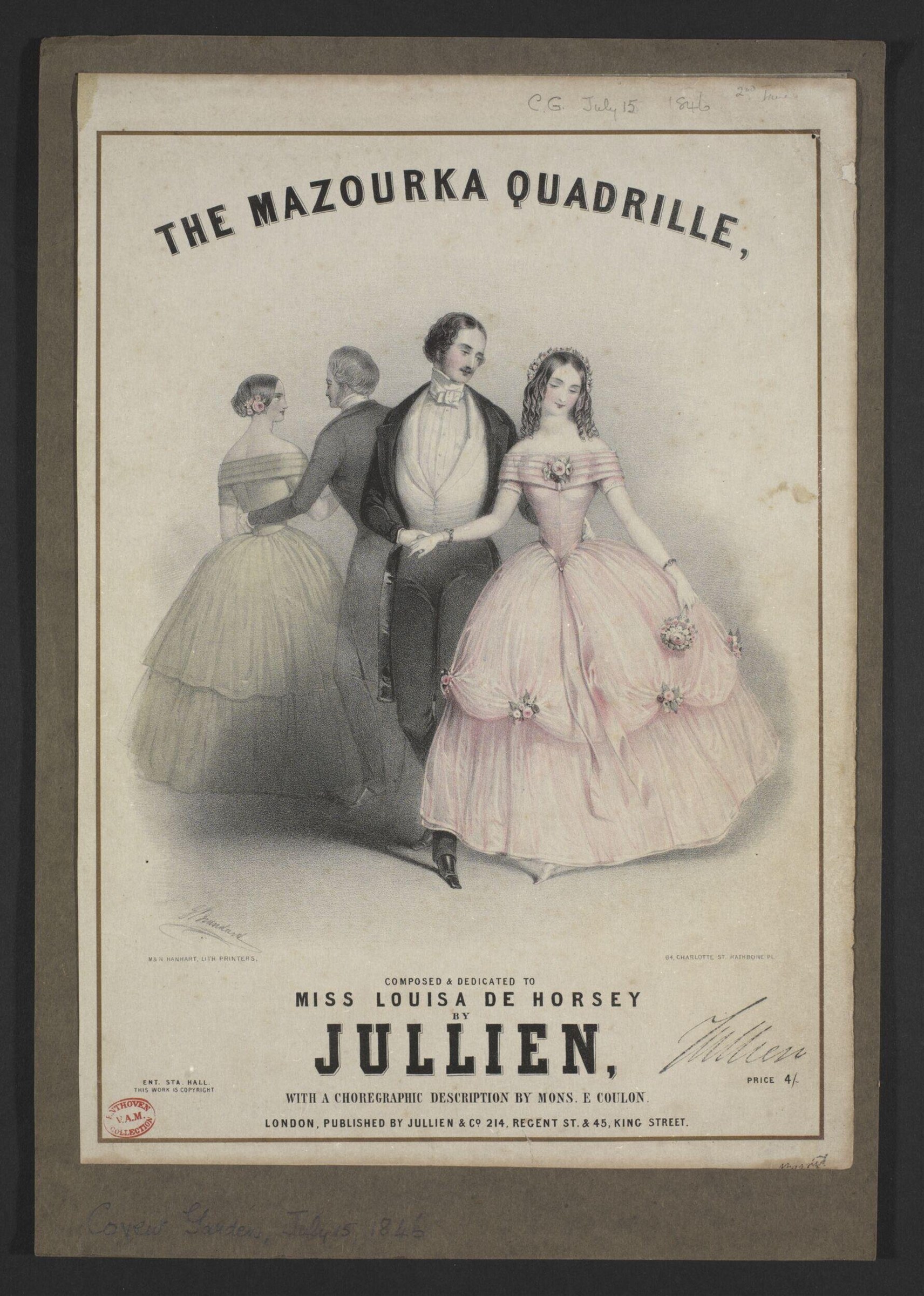
The Mazourka Quadrille
Jullien & Co
- Dance:
- Quadrille
- Source:
- Victoria and Albert Museum
- Rights:
- Rights vary by item — check the source record before reusing this image. Source record ↗
- Recorded as:
- Check V&A creditLine
For dance historians, this print documents a crucial moment in European social dance: the quadrille's dominance in the ballroom, the incorporation of international dance styles into hybrid forms, and the role of commercial publication in standardizing and spreading dance practice. For material culture historians, it is evidence of how dance instruction and fashion dissemination were intertwined through mass-market lithography. For anyone interested in 19th-century gender and courtship, it visualizes the ritual codes and physical restraint that governed heterosexual encounter in Victorian society.
What you are looking at
A fashionable social scene of four figures in mid-19th-century dress, arranged in the moment before or during a dance. The composition places a gentleman in dark coat and light trousers at the center, flanked by three women in voluminous ball gowns. The woman on the right, in pale pink silk with off-shoulder neckline, faces forward with an expression of engagement; she wears a corsage and jeweled ornament at her bodice. To her left, a second woman in cream or grey silk is shown from behind, her dark hair arranged in fashionable ringlets. A third woman appears partially obscured on the far left. The setting is indeterminate—no floor, walls, or furnishings are rendered; the figures float against a plain background, emphasizing their dress and posture. The lithographic technique renders the fabrics with delicate gradation, capturing the texture and volume of the silk skirts with their characteristic bell shape and decorative details. Light falls evenly across the scene, with subtle shading to model form.
The dancing
The central male figure stands upright with formal posture, his right arm extended toward the woman in pink in a gesture of greeting or invitation characteristic of ballroom protocol. The woman in pink responds with an open, receptive stance, her arms relaxed at her sides, her body angled toward the gentleman. The composition suggests the moment of acknowledgment or positioning before the dance begins rather than active movement. All three women display the characteristic silhouette of the 1840s–1850s: tightly corseted waists, sloping shoulders, and expansive skirts supported by multiple petticoats. Their bodies are upright and formal, conveying the restraint and etiquette expected in ballroom settings.
The dance depicted
The image is titled *The Mazourka Quadrille* and documents a social ballroom dance of the mid-19th century. The quadrille—a figure dance for four couples arranged in a square formation—was the dominant social dance of the ballroom during this period. The inclusion of 'mazourka' in the title suggests a variation or medley that incorporated steps, rhythmic figures, or musical elements from the Polish mazurka. This was common practice: dance masters and composers created hybrid forms that blended the formal structure of the quadrille with the characteristic rhythms and spirited character of other dances. The image shows the preparatory moment of social interaction rather than the execution of specific steps, reflecting the ballroom convention of formal introduction and positioning before the music began.
How it was made
This is a hand-colored lithograph, a process that allowed for mass production of dance instruction and fashionable entertainment imagery in the mid-19th century. The base stone print was executed in black, then tinted by hand with watercolor or pigment—evident in the delicate gradations of pink in the central woman's gown and the subtle modeling of fabrics. The technique was economical enough for commercial publication while maintaining fine detail in faces and costume. The imprint line and publisher information at the base ('JULLIEN & CO, 214, REGENT ST. & 45, KING STREET, LONDON') identifies this as a commercial print for a mass audience: dancers, dance pupils, fashionable society, and those learning steps from illustrated instruction books.
About this work
This is a commercial dance print documenting the social world of mid-19th-century ballroom dance. Published by the London firm Jullien & Co, it records both the *Mazourka Quadrille*—a fashionable variation on the quadrille, the dominant social dance form of the Victorian era—and the dress conventions, deportment, and ritual of ballroom courtship. The image is not a representation of a specific performance or composition but rather a visual guide to the appearance, posture, and social framing of a popular dance form. As such it belongs to a large body of commercial dance instruction material, fashion imagery, and social documentation that circulated through print culture in this period.
The work is significant because it captures the ballroom dance as a site of social interaction and courtship ritual, not merely as physical movement. The frozen moment of introduction—the gentleman's extended hand, the woman's poised response—encodes the rules of Victorian social dance and the gender dynamics of formal heterosexual partnership. The elaborate dress, the formal posture, and the careful composition all emphasize that ballroom dance was an occasion for the display of wealth, refinement, and social status as much as for movement.
How to look at it
The image should be read as a moment of social ritual rather than active dance movement. Notice how the composition centers on the gesture of introduction—the man's posture of offer, the woman's receptive stance—rather than on the execution of steps. The careful attention to dress is not incidental: the corseting, the volume of skirts, the jewelry and coiffure tell you that this is a formal occasion and that the body on display is as much a subject as the dance itself. The blank background throws all attention onto the figures and their mutual orientation, emphasizing the social choreography—the rules governing who stands where, how bodies orient to one another—that was as rigidly codified as the steps themselves. The hand-coloring, applied after printing, shows the particular work of making the image both decorative and instructive: the pink and cream silks are rendered in fashionable colors that would have been recognizable to contemporary viewers as markers of taste and status.
The artist
Jullien & Co was a London-based music and dance publisher active throughout the 19th century, known for publishing dance instruction manuals, sheet music, and decorative prints for a fashionable clientele. The firm was founded by Louis Antoine Jullien, a French-born conductor and composer who became prominent in London's musical and ballroom world. Beyond their commercial activity as publishers, they commissioned or produced lithographs documenting fashionable dances and ballroom scenes, serving simultaneously as instruction material and as aspirational fashion imagery for the middle and upper-middle classes. The hand-colored lithograph technique was their standard medium for such work.
The period
The mid-19th century was the peak era of the quadrille in European and American ballrooms. Originating in France in the late 18th century, the quadrille had become the standard social dance by the 1830s and remained so through the 1870s. Dance masters continually created new variations and medleys, incorporating elements from other popular dances—the mazurka, polka, waltz, and galop—to maintain novelty and interest. The mazourka itself, imported from Poland, had become fashionable in European ballrooms from the 1830s onward and was often combined with other forms. This was also the era of the expansion of commercial dance instruction: printed manuals with engraved figures demonstrating steps, decorated prints for the drawing room, and sheet music for home performance were all major publishing enterprises. The lithographic process made such material affordable and widely circulated, creating a standardized visual and kinetic culture of ballroom dancing across urban Europe and North America.
Where it lives
The work is held in the Victoria and Albert Museum collection. It is catalogued as a print from the museum's holdings of 19th-century dance and theatrical imagery. The object is a commercial publication rather than a unique work; multiple impressions of this print exist in other collections and archives.
Dance in this work
Questions about this work
What is a quadrille and how does it differ from a waltz?
The quadrille is a figure dance for four couples (eight people) arranged in a square formation, with prescribed sequences of steps and turns that all couples execute in unison. It is highly structured and choreographed, with figures that repeat in patterns. The waltz, by contrast, is danced by couples in closed hold, moving continuously in a rotating three-beat pattern around the ballroom floor. The quadrille required coordination among multiple couples and was often led by a caller or conductor; the waltz was more intimate and partner-focused. In the mid-19th century, both were fashionable, but the quadrille dominated formal balls and was considered more respectable by conservative society.
What does 'mazourka quadrille' mean?
It refers to a quadrille variation that incorporated rhythmic or musical elements from the mazourka, a spirited Polish dance in 3/4 time. Dance masters of the period frequently created medleys and hybrids, combining the formal structure of the quadrille with steps, figures, or musical characteristics from other popular dances. A 'mazourka quadrille' would have retained the four-couple formation and basic structure of the quadrille while incorporating some of the sharper rhythmic accents or character of the mazurka.
Why do the women's skirts look so enormous?
The voluminous skirts of the 1840s–1850s were achieved through multiple layers of stiffened petticoats and, later, cage crinolines—structures of steel hoops inserted into the hem and waist of underskirts. This silhouette was fashionable, expensive, and a marker of status: it required money for fabric and construction, and mobility in such garments was limited, signaling that the wearer did not perform manual labor. For ballroom dancing, the full skirt was essential; it was part of the visual and kinetic aesthetic. The skirt's volume and stiffness affected how a woman moved and turned, and the way fabric caught the light and moved through space was part of the spectacle of the dance.
How do we know how to dance a quadrille if we only have an image?
This image alone does not teach the steps; it is preparatory imagery showing posture and dress rather than active movement. It would have been paired with written instruction manuals (which Jullien & Co published) that described the figures in detail, sometimes with additional engraved diagrams showing the paths of couples through the dance. Many 19th-century dance manuals survive and describe quadrilles in step-by-step detail. This print functioned as advertisement, fashion imagery, and motivational material for the ballroom public, while instruction came through other formats.
More Quadrille artwork