39 works in this view — arrow keys or swipe to move between them.
Dance in Art
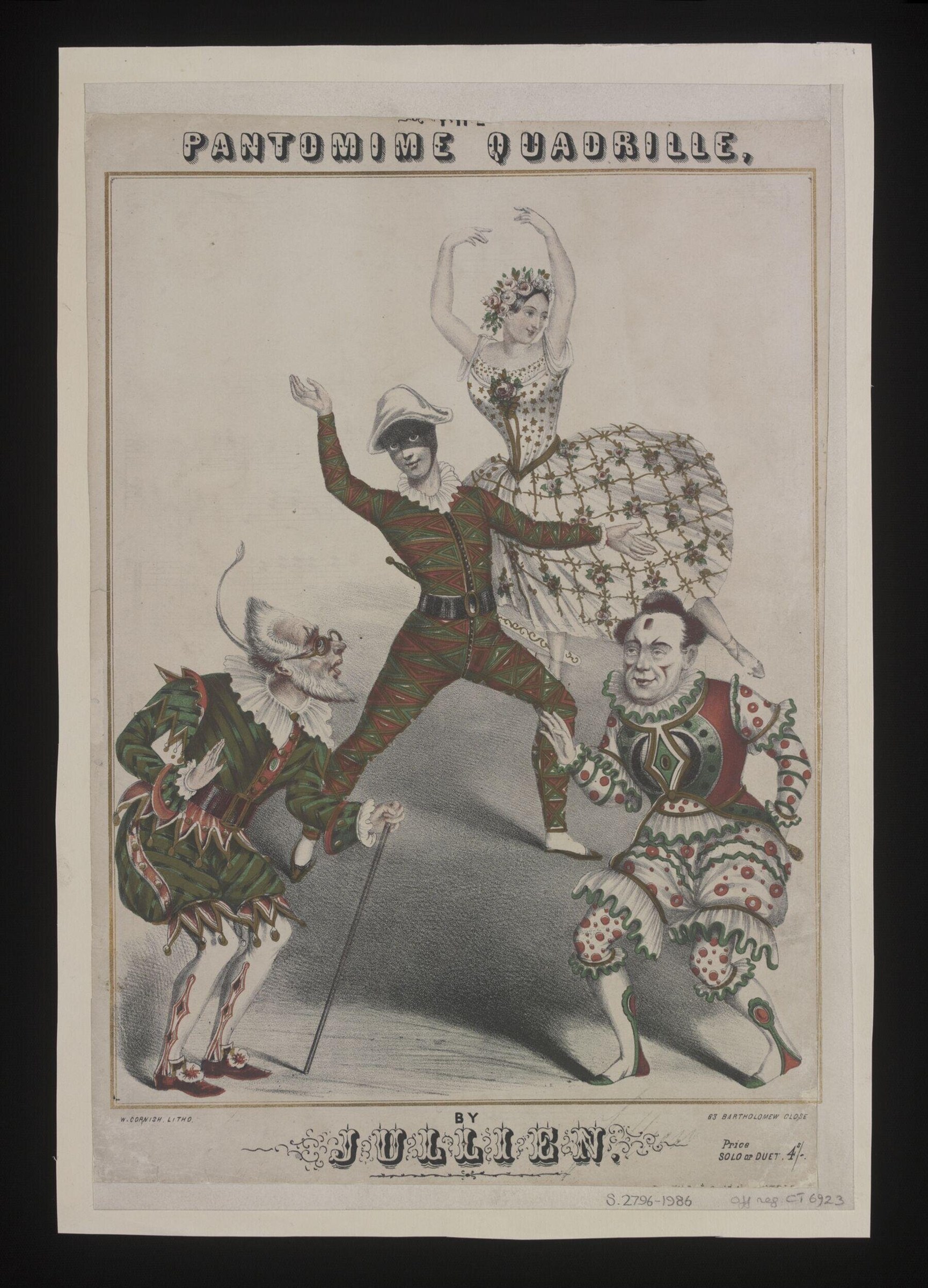
The Pantomime Quadrille
W. Cornish
- Dance:
- Quadrille
- Source:
- Victoria and Albert Museum
- Rights:
- Rights vary by item — check the source record before reusing this image. Source record ↗
- Recorded as:
- Check V&A creditLine
Pantomime Quadrille reveals the deep cultural reach of the quadrille beyond the ballroom: it was popular enough by the mid-19th century that theatrical producers could assume audiences would recognize and enjoy its burlesque. The print also documents a method of dance transmission through theatre, caricature, and print—how movement vocabularies were circulated, consumed, and transformed in popular culture long before film.
What you are looking at
A theatrical scene populated by four performers in jewelled, ornate costumes dominated by deep greens and reds. A woman in the upper center, crowned with flowers and wearing a patterned bodice, poses with arms raised and body arched—the focal point of the composition. She wears a full skirt with elaborate lattice or trellis patterning. Below and around her stand three male figures: at left, a performer in a plumed hat and fitted coat with white collar holds a sword; at right, a squat figure with exaggerated features in a densely patterned costume watches; and center-left, a figure in a cockerel or rooster mask and suit with prominent feathering. The stage floor is lightly indicated with shadow beneath the woman's raised heel. The print is hand-colored with pale grounds and jewel tones, framed by a gold line border. The title *The Pantomime Quadrille* appears in large letters at the top; the artist credit "By J. Pollain" and price "4/" at the foot.
The dancing
The central female figure dominates through her vertical height, raised arms, and lifted gaze—a classical pose of exaltation or display rather than active partnering. Her body is symmetrically composed, balanced on one leg with an arched back and arms held high in a frame that reads as theatrical rather than social dance. The three male figures are positioned lower and around her: one static and armed, one grotesquely squatting, one masked. None of them hold or touch her; they are placed as attendants or satirical supporting actors rather than partners in a paired or group formation typical of ballroom dance.
The dance depicted
The image shows a *pantomime* version of the quadrille, not a ballroom quadrille danced in the conventional social manner. Pantomime—a form of dramatic performance heavy on visual spectacle, burlesque, and stock comic characters—commandeered fashionable ballroom dances of the Victorian era and remade them as theatrical sight-gags. This print satirizes the form: the woman's exaggerated theatrical pose, the masked and grotesque male characters, and the title's explicit claim that this is a pantomime, not a genuine dance lesson or social occasion. The quadrille structure (typically four couples, geometric patterns) has been collapsed into caricature. The work documents how the quadrille was recycled and mocked in popular theatre.
How it was made
This is a hand-colored engraving or lithograph, likely produced for mass circulation. The crisp outlines, linear detail (especially in the costume patterning), and even tone suggest line-engraving; the soft areas of shadow and the watercolor-like hand coloring are characteristic of prints made for popular theatrical audiences. The care taken with costume detail and the title's prominence at top indicate this was promotional material for a specific stage production—recognizable enough for a theatregoer to purchase as a souvenir or advertisement. The production method and audience (general public, not connoisseurs) confirms its status as theatrical ephemera.
About this work
This is a satirical theatrical print documenting the *Pantomime Quadrille*—a stage burlesque of the fashionable ballroom quadrille, one of the most popular social dances of the 19th century. Rather than show actual quadrille technique or social ballroom dancing, the artist captures a moment of theatrical absurdity: a woman in an impossible, exaggerated pose of exaltation, surrounded by masked, grotesquely costumed male buffoons. The print is a record of how elite ballroom dances were democratized and parodied in popular theatre, converted from social spectacle into comedy. It is also evidence of how widely the quadrille had penetrated Victorian culture—popular enough to warrant stage mockery and commercial prints for mass sale.
How to look at it
Attend to the pose: the woman's vertical, symmetrical, almost balletic arabesque is exaggerated well beyond any quadrille position and reads as theatrical display and self-presentation rather than dance step. The masked and grotesque male figures are caricatures designed to mock or parody stereotyped theatrical types (the soldier, the clown, the fool). The artist has frozen a moment of theatrical excess rather than a moment of ballroom technique. The ornate, jewelled costumes—far too elaborate for a genuine dance—signal burlesque and costume drama. The title's placement and prominence confirm that this is meant to be recognized as *pantomime*, not authentic dance.
The artist
J. Pollain is credited as the artist on this print. Pollain was active as a printmaker and illustrator in the mid-19th century, producing theatrical prints, chromolithographs, and hand-colored lithographs for the popular market. Such prints were made quickly and in quantity for theatrical promotion and mass consumption; Pollain's work exemplifies the commercial print trade that supported London's theatre world.
The period
The quadrille dominated European and American ballrooms from the 1830s through the 1880s, having arrived from France as the fashionable replacement for the cotillion. It was a figure dance for four couples, with geometric patterns and a prescribed sequence, making it both formal and playful. By mid-century, as ballroom dancing became more widespread and less exclusive, quadrille variations entered popular entertainment: ballroom demonstrations, theatre dances, and caricatures in prints and periodicals. Pantomime—a British theatrical form blending narrative, music, dance, burlesque, and spectacle—thrived especially at Christmas and drew on current fashions and social phenomena for comic material. A pantomime quadrille would have been timely satire, poking fun at both the formality of the dance and its ubiquity in fashionable life.
Where it lives
This work is held by the Victoria and Albert Museum, London, a major collection of theatrical prints, designs, and popular visual culture from the 19th century. The catalogue source is listed as 'va' (V&A shorthand). As a chromolithograph or hand-colored print, it belongs to the category of theatrical ephemera and promotional materials that documented London's entertainment industry.
Dance in this work
Questions about this work
What is the quadrille?
The quadrille was a formal figure dance for four couples (eight dancers), organized into geometric patterns and prescribed steps, very popular in ballrooms from the 1830s to 1880s. It required space, coordination, and social confidence, making it a marker of fashionable, educated society. This print mocks that formality by translating it into theatrical farce.
What is pantomime?
Pantomime is a British theatrical tradition mixing narrative, music, slapstick comedy, spectacular sets, and dance. It was especially popular at Christmas and often based on fairy tales or classical stories. Pantomime regularly burlesqued contemporary fashion, social types, and popular dances—making it a record of what mid-Victorians found both fashionable and absurd.
Why would a stage show parody a ballroom dance?
By mid-century, the quadrille was ubiquitous enough in respectable society that theatre audiences would immediately recognize it. Pantomime thrived on mockery of fashionable pretension, so transforming an orderly, formal ballroom dance into grotesque theatrical spectacle was natural comedy. It suggests the quadrille was seen as both earnest and risible—a fit target for burlesque.
Who is the central figure?
She is likely a principal player in the pantomime—possibly a fairy, a society woman, or a comic heroine. Her pose and costume (jewels, flowers, elaborate patterning) mark her as the visual focus and likely the highest-status character onstage. The male figures around her, especially the masked and grotesque ones, are supporting players or comic foils.
More Quadrille artwork