46 works in this view — arrow keys or swipe to move between them.
Dance in Art
The Mazourka Quadrille
Jullien & Co
- Dance:
- Quadrille
- Source:
- Victoria and Albert Museum
- Rights:
- Rights vary by item — check the source record before reusing this image. Source record ↗
- Recorded as:
- Check V&A creditLine
This work is a rare surviving example of commercial dance ephemera from the height of the quadrille's popularity, capturing the visual codes—dress, posture, deportment—that signaled participation in fashionable society. It demonstrates how 19th-century dance was commodified and circulated through print, music, and instruction manuals, making it accessible to a middle-class audience aspiring to genteel accomplishment. The image also preserves the silhouette and styling conventions of the 1840s-1850s, when the quadrille dominated the ballroom and dancing was central to courtship, social advancement, and leisure.
What you are looking at
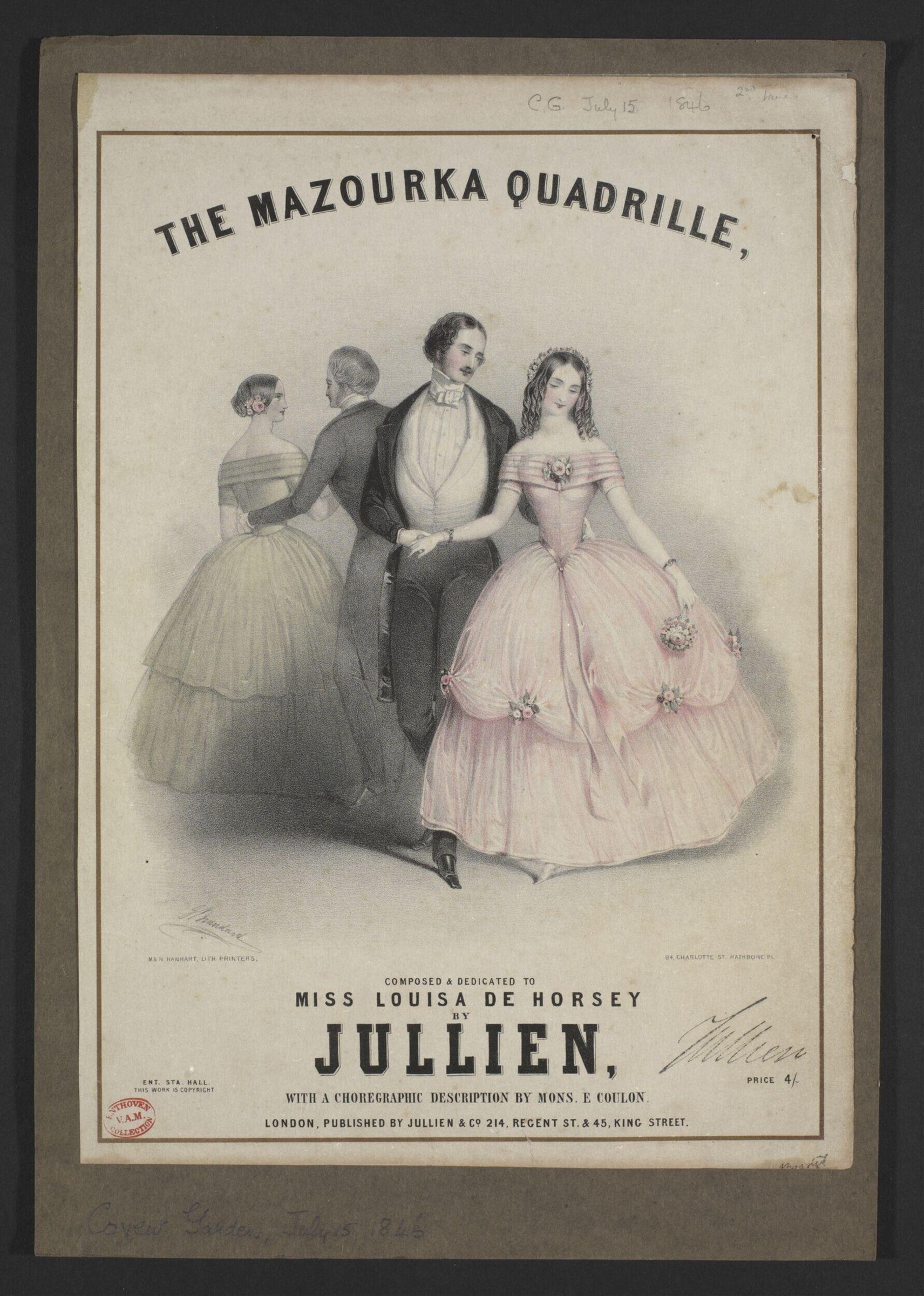
This is a lithograph title page for a dance manual or score, showing four fashionably dressed figures arranged in a theatrical group against a plain background. Three women in ball gowns dominate the composition: two flank a central male figure, while a fourth woman is partially visible in profile on the left. The two prominent women wear voluminous skirts of pale pink and white, constructed with deep pleats and decorated with jeweled rosettes or brooches arranged in horizontal rows across the fabric—a characteristic silhouette of the 1840s-1850s. Their shoulders are bare or draped, and their hair is dressed in long ringlets. The man between them wears formal evening dress: a dark coat, white waistcoat, and bow tie. The woman on the left, shown from behind, wears a paler gown and turns her head away from the group. The setting is undefined—no floor, room, or architectural detail situates them in any specific place. The composition is intimate and posed rather than depicting active movement, suggesting this is an idealized or decorative representation of a dance or social scene rather than documentary evidence of motion.
The dancing
The figures are arranged in a nearly symmetrical grouping typical of fashion plates and theatrical publicity. The central male figure stands with one arm extended, likely held by the women on either side, though the exact hold is unclear—the hands are not clearly delineated in the engraving. The women stand upright with their weight distributed in their full skirts, their arms engaged but their bodies relatively static. No dancers' frames or partnering holds are distinctly rendered; the postures are those of standing conversation or formal presentation rather than active stepping or turning. The grouping suggests a parlor scene or a moment of introduction rather than the locomotive energy of actual dance.
The dance depicted
The title explicitly identifies this as a quadrille, one of the most popular social dances of the 19th century. The Mazourka Quadrille likely combines elements of the mazurka (a Polish triple-meter dance) with the quadrille format (a square-set social dance for four couples). Quadrilles were performed at balls and formal assemblies throughout Europe and America from the 1840s onward. However, the image itself does not capture the dance in motion; it functions as a title page or cover illustration for a musical score or dance instruction booklet. The choreographic detail—the specific figures, steps, and formations—would be conveyed through the text and musical notation within the publication, not through this decorative composition. The elegance of the figures and the formality of their dress confirm that this represents an upper-class or aristocratic social dance context.
How it was made
This is a hand-colored lithograph, a printing process that allowed for relatively inexpensive mass production of popular imagery in the 19th century. The technique of lithography—drawing on stone with a greasy crayon and then chemically treating the surface to accept ink—was ideal for reproducing detailed linear work and enabled the subtle tonal gradations visible in the faces, hair, and drapery. The hand coloring, applied after printing, adds the pale pink of the gowns and the delicate shading of skin tones. Lithography was the standard commercial medium for music covers, dance instruction manuals, and theatrical ephemera of this era. The publisher information at the base (Jullien & Co, London, Regent Street and King Street) indicates this was produced as a commercial product for sale to the dancing public, suggesting wide circulation among middle and upper-class households.
About this work
This is a lithographic title page or cover for a dance instruction manual or musical score for the Mazourka Quadrille, composed and dedicated to Miss Louisa de Horsey, published by Jullien & Co in London. The image shows the formal dress and social context of mid-19th-century ballroom dancing—specifically the elegant silhouettes and partnering conventions of the quadrille, the era's most fashionable group dance. While it does not depict the dance in motion, it serves as a valuable historical document of how the dance was framed and marketed to the public: as a mark of gentility, refinement, and social aspiration. The decorative, fashion-plate style was typical of the commercial materials that accompanied published dances, functioning as both aesthetic object and practical instructional aid.
How to look at it
This is not a record of a moment of dancing but an advertisement and invitation. Attention should be paid to the costume details—the construction of the skirts, the positioning of jewelry, the cut of the man's coat—which are rendered with the precision of a fashion plate, emphasizing that this is a display of status and taste. The static, posed quality of the figures (no one is stepping, turning, or in mid-movement) is itself significant: it reflects the ballroom etiquette of the era, where dancers maintained formal, upright posture and the movement of the quadrille was a measured unfolding of synchronized figures rather than a blur of activity. The composition emphasizes the social grouping—the four-person unit typical of a quadrille—and the gender dynamics: two women, one man, and a watching or waiting figure. The decorative style and the professional engraving signal that this is a commercial product made for a paying audience.
The artist
Jullien & Co was a music and dance publishing firm based in London in the 19th century, notable for producing popular quadrilles, waltzes, and other fashionable dances for the drawing-room and ballroom market. The firm capitalized on the demand for publishable dance music suitable for home performance and instruction. While the artist who created the lithograph is not named on this title page (a common practice for commercial illustration work), the image exemplifies the house style of fashionable London dance publishing: elegant, decorous, and aimed at affluent amateur dancers and music lovers. The dedication to Miss Louisa de Horsey suggests commission by or for a patron of some social standing.
The period
The 1840s-1850s were the apogee of the quadrille in Europe and America. The dance had originated in France in the late 18th century but reached its height of popularity during the reign of Queen Victoria, when it became the central social dance of the British ballroom and was exported throughout the English-speaking world. The period saw an explosion of quadrille variations—the Mazourka Quadrille, the Lancers Quadrille, the Caledonians, and countless others—each combining elements of national dances (mazurka, polka, ecossaise) with the quadrille's basic structure. Publishing firms competed to produce new quadrilles, often dedicated to notable aristocratic or society figures, as gifts or as tokens of patronage. The fashion for such music and instruction manuals reflects the importance of dance as a leisure activity and a marker of social status during the Victorian era.
Where it lives
The work is held in the Victoria and Albert Museum collection (indicated by the catalogue reference at top left). It is one of many examples of 19th-century dance ephemera—sheet music covers, dance cards, instruction manuals—that the V&A acquired as part of its mandate to collect applied arts and commercial design. Such objects were often bound into volumes or preserved as loose prints, and they constitute a valuable primary source for social and material history.
Dance in this work
Questions about this work
What is a Mazourka Quadrille?
A mazourka quadrille is a hybrid dance form combining the structure of the quadrille (a four-couple square dance) with rhythmic or stylistic elements of the mazurka, a Polish dance popular in 19th-century ballrooms. Composers created numerous such variations, each with a distinctive name, and published them as fashionable entertainment for drawing rooms and balls. The mazourka quadrille would have consisted of five or six figures, each lasting eight bars of music, arranged for four couples to perform together.
Why is this image useful even though no one is actually dancing?
This title page is valuable precisely because it documents the visual culture surrounding dance in the 19th century. It shows how quadrilles were marketed and consumed by the public, what dress was considered appropriate, and how the dance was positioned in relation to fashion, social refinement, and leisure. It also confirms the identity of the work (through the title) and links it to a specific publisher and moment, making it a primary source for dance history and material culture.
Who was Miss Louisa de Horsey?
The catalogue record does not indicate. However, the dedication suggests she was a woman of some social standing in mid-19th-century London—likely a patron, aristocrat, or notable society figure to whom the composer or publisher wished to pay compliment. It was common practice to dedicate published dances and music to titled or fashionable women, both as flattery and as a form of advertisement.
How would someone learn this dance from this publication?
This image is only the title page or cover. The publication would have contained a musical score (so the piece could be played on the piano), a written choreographic description (explaining the figures and movements of each section), and possibly diagrams showing the floor patterns for the four couples. Dancers would have learned from both the written description and by hearing and watching the music performed.
More Quadrille artwork