45 works in this view — arrow keys or swipe to move between them.
Dance in Art
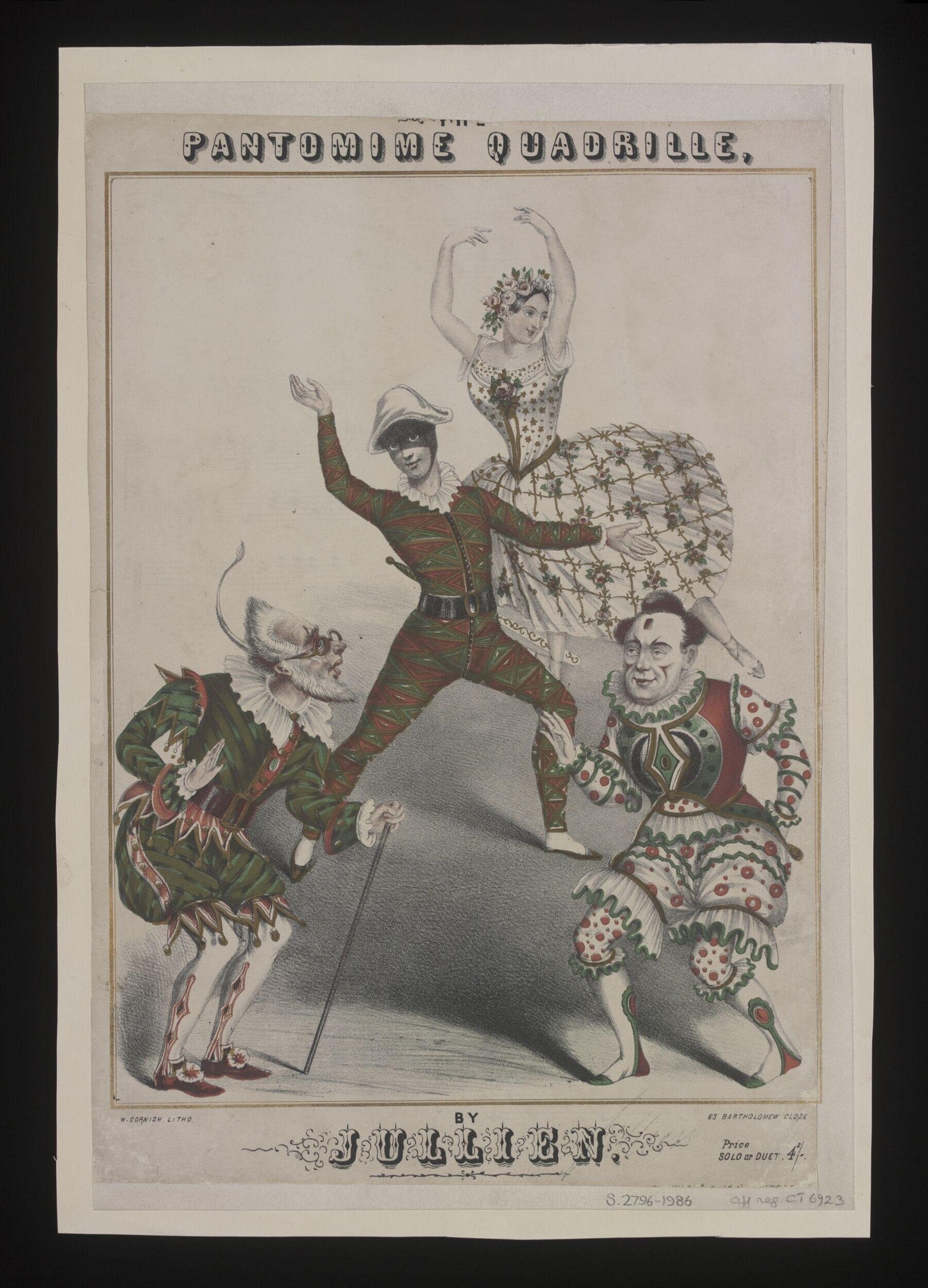
The Pantomime Quadrille
W. Cornish
- Dance:
- Quadrille
- Source:
- Victoria and Albert Museum
- Rights:
- Rights vary by item — check the source record before reusing this image. Source record ↗
- Recorded as:
- Check V&A creditLine
This image documents the theatrical pantomime quadrille, a performance form that has largely left no other record. It shows how 19th-century performers transformed a social dance into acrobatic theater, and it captures the specific moment—the climactic human pyramid—that audiences paid to see. For anyone studying how social dances moved between ballroom and stage, or how Victorian entertainment deployed the body, this print is direct visual evidence.
What you are looking at
A theatrical print depicting four figures in elaborate costume arranged in a dynamic pyramidal composition. At the apex stands a woman in a white muslin dress with a flowered headdress, arms raised above her head in a graceful arch, her body leaning back slightly. Below her, a second female figure in a polka-dotted dress and bonnet reaches upward with one arm while the other steadies her position. Two male figures in green and red patterned harlequinade costumes anchor the base—one on the left gestures outward with splayed fingers, the other on the right kneels and grins broadly toward the viewer. A small white dog wearing a jester's costume sits at the lower left. The setting is theatrical and abstract, with no background detail beyond a subtle shadow beneath the group. The hand-colored engraving employs green, red, and flesh tones against the pale paper.
The dancing
The composition stacks four human figures and one animal in a stunt-like formation rather than a ballroom hold. The uppermost woman demonstrates extreme flexibility, arching backward with both arms extended overhead in a pose requiring significant extension and control. The second woman maintains a modified standing position, one arm raised for balance or partnering. The two men below assume theatrical poses—one with arms spread wide, one in an exaggerated kneeling position with an expression of comic surprise. This is acrobatic in conception: the weight relationships and the vertical stacking suggest this is not a social dance but a choreographed theatrical stunt or 'turn.'
The dance depicted
The catalogue identifies this as a pantomime quadrille, a theatrical hybrid form that blended the social structure of the quadrille with comic pantomime. The image shows not a dance in its typical ballroom sense but a climactic acrobatic moment designed for entertainment and visual spectacle. The four main figures and the costumed dog suggest the theatrical exaggeration and comic character-work central to 19th-century pantomime. The elevation and gymnastic arrangement—the backward arch, the stacking, the extreme poses—confirm that this depicts pantomime choreography rather than social dance, even though the quadrille structure would have provided the basic framework for the piece's progression.
How it was made
This is a hand-colored engraving, established from the fine linear work, the use of stipple and cross-hatching for shadow, and the selective application of watercolor or gouache to areas of costume and flesh. The technique allowed for narrative clarity and theatrical detail—every sequin, ruffle, and facial expression remains legible despite the scale. The printed outline could be distributed widely and colored by hand or in a workshop, making it accessible to a broad audience interested in theatrical scenes. The date is unknown, but the style and subject suggest mid-19th-century production.
About this work
This is a theatrical print documenting a spectacle moment from a pantomime quadrille, a Victorian-era theatrical form that married the social dance structure of the quadrille with acrobatic comedy and visual wit. It is not a record of how people danced socially, but rather of how professional performers on stage transformed dance conventions into entertainment. The print captures the vertical ambition of mid-19th-century theatrical design—the stacking of bodies, the exaggerated gestures, the inclusion of a costumed animal—all hallmarks of pantomime as a visual and kinetic spectacle.
The work belongs to a body of theatrical prints documenting performance rather than ballroom etiquette. It shows how the quadrille—a dance form that dominated both social and theatrical spaces—could be inflected into comic theater through costume, acrobatic arrangement, and character work. For dance historians, it is evidence of how popular social forms fed theatrical innovation, and how pantomime used the quadrille's recognizable structure as a vehicle for comedy and physical display.
How to look at it
Observe the vertical stacking and the impossible poses: the artist has frozen a moment of physical risk and effort. Notice how the woman's backward arch places her weight entirely in the hands and bodies of the figures below—this is not a ballroom formation but a trust exercise and acrobatic stunt. The theatrical costume—the harlequinade patterns, the jester's dog, the exaggerated facial expressions—confirms that this is entertainment, not etiquette. The print format and hand-coloring suggest this was a souvenir of a specific performance, meant to be kept or shared as a record of what the pantomime looked like.
The artist
W. Cornish is recorded as the artist, but no further biographical information is available in standard references. The signature and publisher marks suggest a mid-19th-century theatrical print publisher's shop, where engravers might have specialized in theatrical scenery, costume designs, and performance documentation. Cornish may have been an in-house illustrator or a freelance artist commissioned to document a specific London pantomime production.
The period
The pantomime quadrille emerged in the early 19th century as an extension of the quadrille craze that swept European ballrooms after 1815. By the 1830s–1860s, London theaters had adopted the quadrille as a framework for comic set pieces, inserting pantomime characters and acrobatic business into the familiar four-figure formation. This coincided with the height of English pantomime as a visual spectacle art form, where dance, acrobatics, costume, and comedy converged. The theatrical use of the quadrille also reflects broader mid-Victorian interest in motion, spectacle, and the display of flexible, trained bodies—concerns visible across circus, theater, and early photography.
Where it lives
The work is held in the Victoria and Albert Museum collection. It is identified in the catalogue as part of the museum's theatrical prints and designs collection, a body of material documenting 19th-century London stage production. The accession number and full record details are recorded in the museum's database.
Dance in this work
Questions about this work
Is this a real dance, or theatrical invention?
The pantomime quadrille was both. It used the social dance structure of the quadrille—four dancers, four figures—but inserted comic characters and acrobatic business. On stage, it was a choreographed theatrical piece, not a ballroom dance. This print captures the climactic stunt moment, which would not have been part of a social dancing event.
What was a quadrille and why did it appear in pantomime?
The quadrille was a formation dance for four couples, hugely popular in ballrooms from 1815 onward. Theaters adopted its recognizable structure for comic effect: audiences knew the quadrille, so seeing familiar dancers interrupted by comic characters and acrobatic business would have been surprising and entertaining. It was theatrical sampling of social dance.
Why is the woman arched backward in that position?
This is an acrobatic stunt designed for visual spectacle and applause. The arch demonstrates flexibility and trust—she is supported entirely by the figures below. In Victorian theater, such displays of physical extremity were highly valued as proof of trained skill and as pure visual entertainment.
Who performed pantomime quadrilles?
Professional theater performers and dancers, often trained in acrobatics and character work. Pantomime was the popular entertainment of the era, and quadrille pieces would have been performed by the resident company of a London theater, likely alongside fairy-tale or comic narratives.
More Quadrille artwork