41 works in this view — arrow keys or swipe to move between them.
Dance in Art
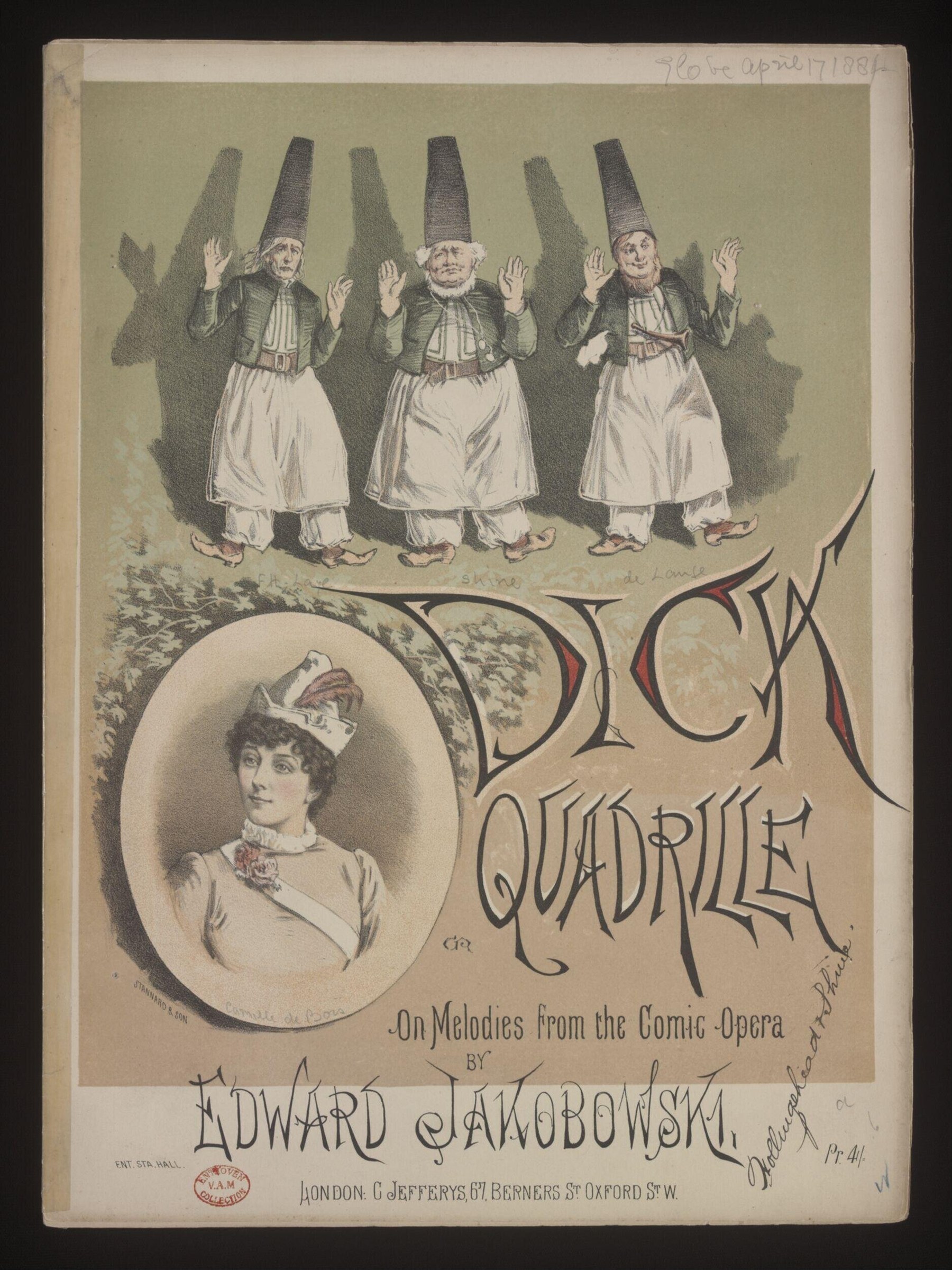
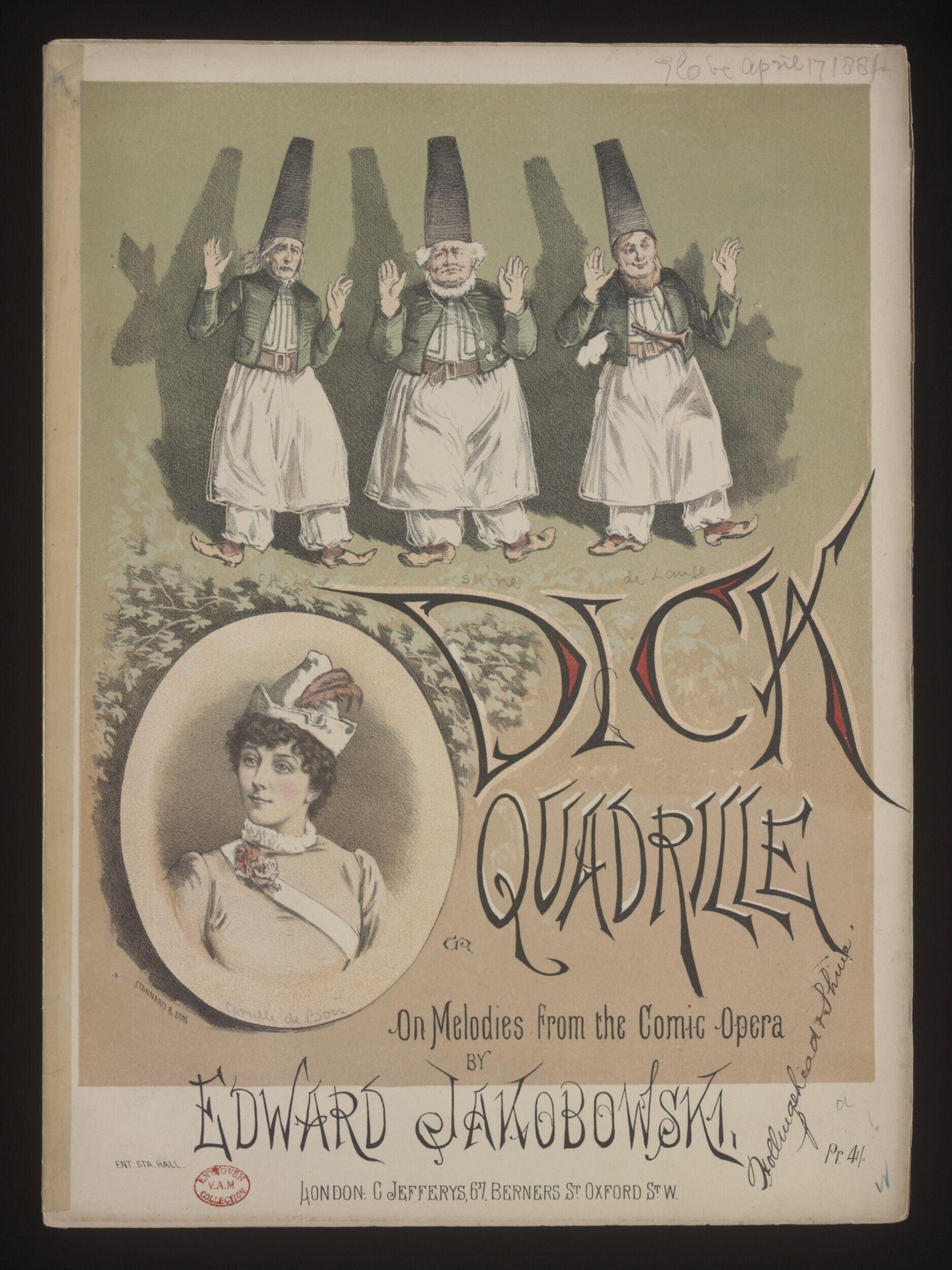
Dick Quadrille
Jakobowski, Edward
- Dance:
- Quadrille
- Era:
- Late 1800s (Victorian Ballroom)
- Source:
- Victoria and Albert Museum
- Rights:
- Rights vary by item — check the source record before reusing this image. Source record ↗
- Recorded as:
- Check V&A creditLine
This cover is evidence of the Quadrille's cultural dominance in the 1880s–1890s—not as a museum piece, but as a living social practice that inspired commercial compositions and theatrical adaptations. For historians of ballroom dance and print culture, it documents how dance was visually marketed to middle-class amateur musicians; for dancers, it shows how Victorian choreographers treated a formal ballroom structure as material for novelty and character variation.
What you are looking at
This is a cover design for a musical score featuring the Quadrille, printed in chromolithograph with hand-finishing. The composition is divided into two registers. The upper half shows three figures in elaborate costume standing against a dark background of tall vertical forms that suggest architectural or theatrical flats. These dancers wear tall conical headdresses and cream-coloured skirts with coordinating waistcoats, their arms raised in animated gestures of celebration or welcome. Below them, set within a decorative oval frame, is a portrait of a woman in profile wearing a formal dress and an ornate plumed headdress, identified as the dedicatee or principal subject. The title "Dick Quadrille" is integrated into the design in ornamental lettering, with the subtitle "On Melodies from the Comic-Opera" and the composer's name "Edward Jakobowski" placed at the foot. The overall design is ornate and theatrical, typical of Victorian music publishing.
The dancing
The three upper figures stand in a line, facing forward with raised arms held at shoulder height or higher, palms open. Their posture is upright and formal, with no indication of ballroom frame or partnering. The raised arms and open palms suggest celebratory or presenting gestures rather than the contained arm positions of ballroom dance. The figures appear stationary or posed rather than captured mid-movement. The lower portrait shows a woman in profile, her upper body turned away from the viewer, no dancing posture evident.
The dance depicted
The work is identified as a Quadrille, a highly popular ballroom dance of the 19th century typically performed by four couples in a square formation or by larger groups in a contradance formation. The Quadrille was a standard of Victorian social dancing and frequently provided the basis for comic-opera variations and character dances. However, the figures shown here do not demonstrate the characteristic frame, partnering, or movement quality of ballroom quadrille; their raised arms and celebratory postures suggest this may be a stylised or theatrical interpretation, possibly a novelty number for comic opera rather than a faithful depiction of ballroom technique.
How it was made
This is a chromolithographic cover design with hand-colouring, a print technology that allowed multiple ink layers to create rich colour effects while remaining economical for mass production. Chromolithography dominated music publishing in the 1880s–1890s because it could produce visually striking covers in colour without the cost of hand-painting each copy. The technique allowed for fine detail in the figures and ornamental lettering visible here, and the process would have made this cover widely distributed to music retailers and the homes of amateur musicians. The combination of printed image and hand-finishing suggests high-end production for a commercially successful composition.
About this work
This is a chromolithographed cover for a published piano score of a Quadrille set to melodies from a comic opera, composed by Edward Jakobowski and issued by the London music publisher Jeffreys in the late 1880s. It represents Victorian ballroom culture at the height of the Quadrille's popularity and illustrates how the dance was adapted and dramatised for theatrical consumption. The image sits at the intersection of dance instruction, musical entertainment, and commercial print culture—it is part archive of what people danced, and part evidence of how the dance was marketed and imagined.
The work matters because it documents the visual conventions by which Victorian ballroom dance was presented to a broad public through popular music publishing. It shows how a canonical ballroom form could be elaborated and reimagined in theatrical dress, and preserves the visual identity of a dance that has left few other documentary traces.
How to look at it
Pay attention to the distinction between the lower portrait—a static, formal dedicatory image—and the upper scene, which freezes a moment of animated theatrical celebration rather than ballroom movement. The raised arms and open palms are a code for joy and display, not for ballroom partnering or technique. Notice how the tall conical headdresses and distinctive costumes mark these as theatrical or comic-operatic characters rather than respectable ballroom dancers. The design tells you that this is entertainment about the Quadrille, not the Quadrille itself.
The artist
Edward Jakobowski (1858–1929) was a British composer of light operas, comic operas, and popular songs. He worked prolifically for the theatre and music-hall in London during the 1880s and 1890s, and his works were published by major music houses including Jeffreys. He is known for compositions that blended operatic form with accessible melody, designed for amateur performance and dancing. His dance-inspired compositions reflect the permeability between theatrical and ballroom worlds in late Victorian entertainment.
The period
The Quadrille was at its peak of social prestige in the 1880s–1890s, having dominated ballroom culture since the 1830s. By the time this cover was printed, the dance was so established that it could be treated as a recognised form for comic operatic variation and novelty numbers, while still being a standard of any respectable ball. The theatrical and musical elaboration of the Quadrille in this period shows how ballroom forms were constantly refreshed and repackaged for entertainment. Chromolithographic music publishing was itself at its peak, offering illustrated covers as part of the appeal of sheet music as a domestic commodity.
Where it lives
The work is held in the Victoria and Albert Museum collection. It is catalogued as a printed cover for a published musical composition, the type of object that would have been disseminated through music retail and domestic musical practice in the Victorian period.
Dance in this work
Questions about this work
What exactly is a Quadrille?
A Quadrille is a ballroom dance for four couples arranged in a square, consisting of five figures performed in sequence to a set of musical phrases. It was the dominant social dance of the 19th century and was standard at all formal balls. The music was usually lively and marchlike, in 2/4 or 6/8 time.
Why don't these figures look like they're actually dancing?
Because this is a theatrical or comic interpretation of the Quadrille, not a depiction of how the dance was actually performed in ballrooms. The raised arms and costume suggest stage characters or comic-opera performers. The cover is advertising a novelty or entertainment version of the dance, not documenting ballroom technique.
Who was Edward Jakobowski?
Jakobowski (1858–1929) was a British composer of light operas and comic operas popular in London theatres and music halls. He specialised in accessible, tuneful compositions designed for theatrical and amateur musical performance, and published extensively through Jeffreys and other music publishers.
What does 'comic opera' mean in this context?
Comic opera was a theatrical form combining spoken dialogue, sung numbers, and dancing, designed for entertainment and often treating contemporary social life or romantic themes in a light or satirical manner. By the 1880s, comic opera was hugely popular and generated commercial sheet music for home consumption.
More Quadrille artwork