35 works in this view — arrow keys or swipe to move between them.
Dance in Art
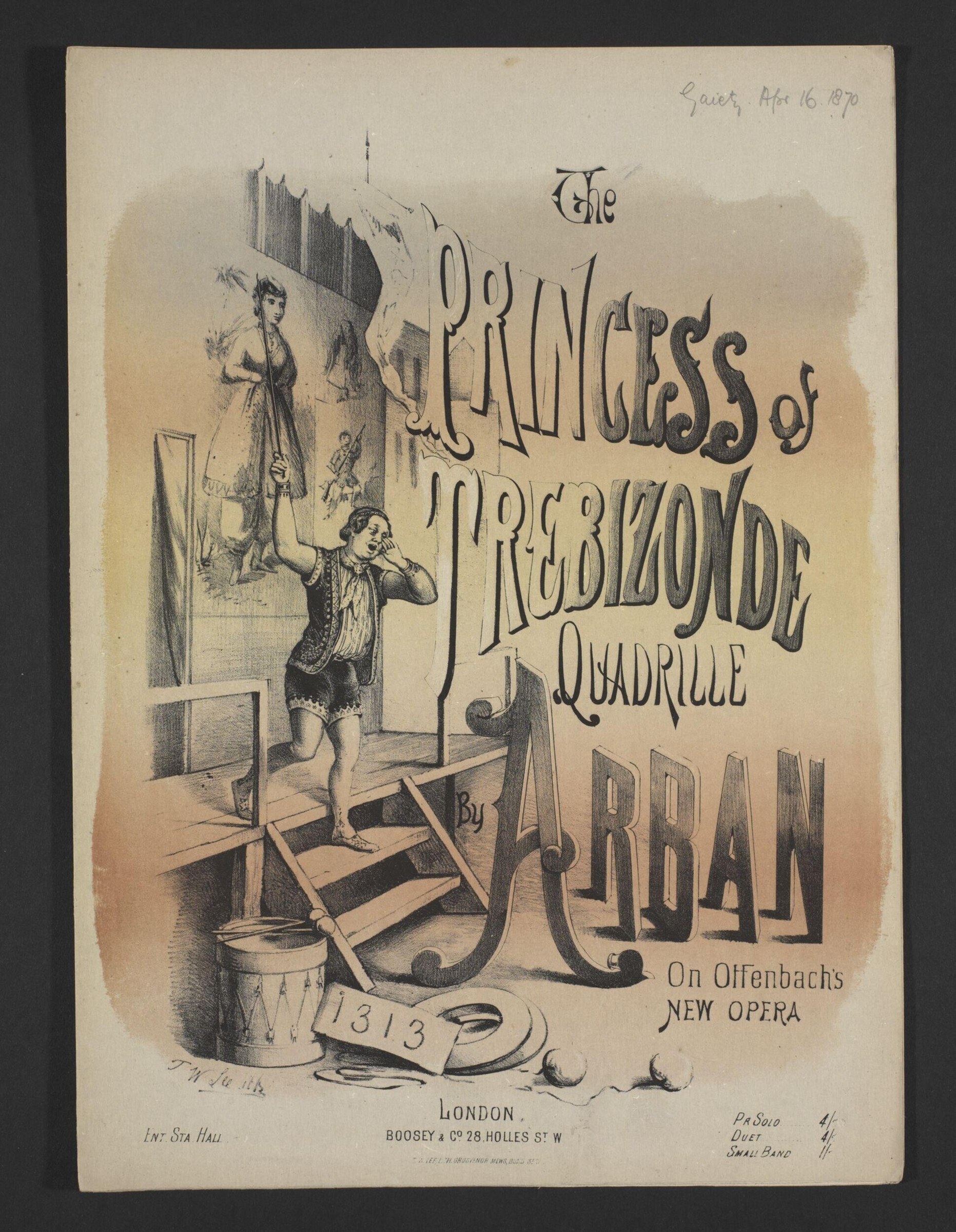
The Princess of Trebizonde Quadrille
Lee, Thomas Wales
- Dance:
- Quadrille
- Era:
- Late 1800s (Victorian Ballroom)
- Source:
- Victoria and Albert Museum
- Rights:
- Rights vary by item — check the source record before reusing this image. Source record ↗
- Recorded as:
- Check V&A creditLine
This work provides direct visual evidence of how ballet technique was performed and presented within the context of operatic entertainment in the 1860s, capturing the formal classical vocabulary in an otherwise popular, comedic theatrical genre. It also demonstrates the role of commercial lithography in circulating dance imagery to a mass audience.
What you are looking at
This is a color lithograph cover for sheet music showing a theatrical scene from Offenbach's opera *La Princesse de Trébizonde*. A young male dancer in classical costume—short jacket with decorative detail, knee breeches, and stockings—stands in a lunge position on a wooden stage, one leg extended forward with bent knee, the other supporting his weight behind. His arms are raised in a classical pose. Behind him, three female figures in long dresses are visible through a doorway or window frame in the upstage wall; they appear to be watching or participating in the scene. The stage is sparse, with a few props including what appears to be a drum marked "313" in the foreground lower left. The lithograph is hand-colored in soft sepia and cream tones with darker pen linework, giving it the appearance of a delicate sketch rendered in stone.
The dancing
The lead male dancer holds a classical fifth position or attitude derrière with a clear vertical line through his supporting leg, displaying the formal turn-out and lifted carriage expected of theatrical ballet technique. His arms frame the movement in a controlled, classical manner. The three background figures wear long skirts typical of mid-19th-century dress and appear to be in static poses rather than active movement, suggesting they are secondary to the main dancer's solo. The composition isolates the male dancer as the focal point of the action.
The dance depicted
This is a scene from Offenbach's 1864 opera-bouffe, depicting a moment of classical ballet movement within a theatrical context rather than a ballroom dance. The quadrille referenced in the title refers to the operatic piece or scene type rather than to the dance being performed in this particular image. The male dancer's technique and costume identify this as theatrical ballet of the mid-19th century, not social dance. The image documents how ballet was integrated into popular opera productions of the period.
How it was made
This is a hand-colored lithograph, a commercial printing technique that allowed rapid reproduction of theatrical imagery for sheet-music promotion and wider circulation. The soft, delicate coloring and detailed pen work suggest printing by a London firm—Boosey & Co is credited at the base. Lithography's relative affordability and speed made it the standard medium for theatrical publicity and musical scores in the mid-19th century, allowing images of stage performers to reach a broad audience of middle-class theater-goers and music students.
About this work
This is a promotional lithograph for a vocal score of Offenbach's operetta, capturing a moment of classical ballet technique within the theatrical context of popular opera. It documents the high visibility of ballet within operetta during the Second Empire and early Victorian periods, when dance scenes were a standard attraction in comic operas performed across Europe. The image preserves both the choreographic conventions of mid-19th-century classical ballet and the production design of a specific, historically documented performance piece.
How to look at it
Observe the dancer's weight distribution and the precision of his position: the supporting leg is fully turned out and elongated, the extended leg is cleanly lifted with a bent knee characteristic of ballet vocabulary. The stillness of the pose—a moment frozen mid-movement—demonstrates the classical ideal of balance and control. Notice also how the artist has positioned the three watching figures to frame and validate the solo dancer's importance; the composition declares this to be a performance moment worth witnessing. The stage details (the sparse props, the framing door) establish the theatrical setting while keeping focus on the body.
The artist
Thomas Wales Lee was a London-based commercial artist and lithographer active in the mid-19th century. He specialized in theatrical and musical subjects, producing sheet-music covers and promotional prints for major London publishers including Boosey & Co. His work is representative of the mid-Victorian commercial printmaking trade serving the theater industry.
The period
The 1860s were a period of rapid growth in operetta as a theatrical form, particularly under Offenbach's influence from Paris. Classical ballet was a standard spectacular element in operetta plots, even when the story was comic or contemporary. This was the era of the Industrial Museum and the expansion of mass entertainment; lithography had made theatrical imagery commercially accessible to the growing middle-class audience for opera and operetta. The soloist-centered composition of this image reflects the star system of 19th-century theater, where individual performers—particularly male dancers in comic operas—were celebrated attractions.
Where it lives
This lithograph is held in the Victoria and Albert Museum collection in London, part of their substantial holdings of 19th-century theatrical prints and sheet-music covers. It is catalogued as a commercial print object—specifically, the cover of a published vocal score.
Dance in this work
Questions about this work
Is this a quadrille or a ballet?
It is a ballet scene. The title refers to the name of the operatic piece, not to the dance depicted. The "Quadrille" appears to be an orchestral or choral number in the opera, but what the image shows is a male dancer performing classical ballet technique on stage. The costume, technique, and stage setting all confirm this is theatrical ballet, not the social ballroom dance.
Who was Thomas Wales Lee?
Lee was a commercial printmaker and lithographer working in London during the mid-19th century. He produced promotional graphics and sheet-music covers for major theatrical publishers, particularly Boosey & Co. He represents the working professional printer-designers who supplied the massive demand for theatrical publicity during the height of the operetta craze.
What is Offenbach's *Princess of Trebizonde*?
It is a comic operetta (opéra-bouffe) composed by Jacques Offenbach in 1864. The work is typical of Offenbach's popular theater pieces: a light, satirical comedy with music and dance, featuring spectacular stage effects and dance interludes. *La Princesse de Trébizonde* was performed across Europe and enjoyed considerable commercial success.
Why does a male dancer get a solo in a comic opera?
Male soloists were celebrated attractions in 19th-century opera and operetta, particularly in comedic roles where technical display and wit could generate applause. Ballet interludes and solo dances were standard "turn" moments in operetta, giving star performers a chance to demonstrate their virtuosity apart from the singing.
More Quadrille artwork