49 works in this view — arrow keys or swipe to move between them.
Dance in Art
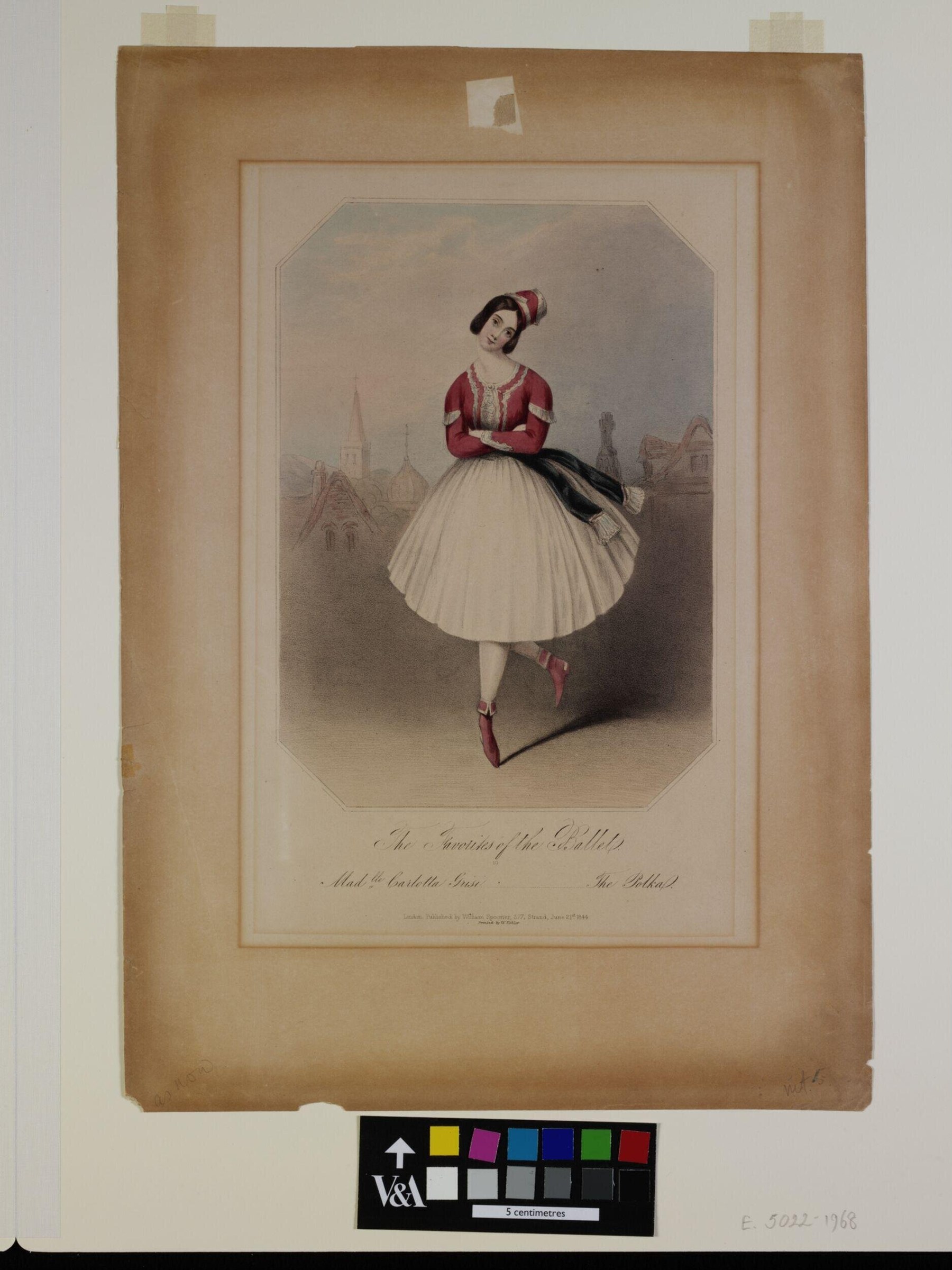
The Favourites of the Ballet. / 10 / Madlle Carlotta Grisi … The Polka.
Spooner, William
- Dance:
- Folk/Country
- Era:
- Mid 1800s (Polka Era)
- Source:
- Victoria and Albert Museum
- Rights:
- Rights vary by item — check the source record before reusing this image. Source record ↗
- Recorded as:
- Check V&A creditLine
This image documents a specific moment in ballet history when European ballroom crazes (the polka) intersected with theatrical performance and when celebrated dancers' likenesses were mass-produced for popular consumption. For dance historians, it shows how the polka—a folk dance—was adapted and elevated into a Romantic ballet context, and for art historians, it exemplifies the commercial engraving industry that served theater and celebrity culture. It also captures the visual language and costume aesthetics of high Romantic ballet at mid-century, before the silhouette and technique of the art form shifted.
What you are looking at
A young woman in theatrical dress stands alone against a soft, atmospheric backdrop of a European city with Gothic architecture—spires and buildings rendered in grey-brown wash. She wears a striking costume of the 1840s: a burgundy or deep rose velvet bodice with short puffed sleeves, a high waist, and a dramatically full white skirt of diaphanous material that extends to mid-calf, caught at the side with a black ribbon or sash. Her feet are shod in burgundy heeled shoes; her dark hair is arranged with a small matching cap or headdress tilted forward. She stands in a composed, refined pose with her weight on one leg, one arm across her body, her gaze directed upward and to the side in the manner of theatrical portraiture. The composition is formal and elegant, framed by a printed border and mounted on tan paper in the manner of a theatrical print or popular engraving.
The dancing
A single figure, poised and stationary rather than captured mid-motion. Her posture is upright and graceful, with her weight shifted onto one leg in a way that suggests the effortless poise expected of a professional dancer. The arm position—one hand at her side, the other held across the body—creates a balletic frame. Her gaze is elevated and contemplative rather than outward or engaging with a partner, suggesting the interiority of Romantic-era theatrical convention. The full, voluminous skirt is the dominant visual element; it fills most of the lower composition and appears to be the costume itself rather than the body moving within it.
The dance depicted
The work is inscribed as belonging to a series titled 'The Favourites of the Ballet' and specifically identifies the subject as Mlle Carlotta Grisi dancing the Polka. Carlotta Grisi (1819–1899) was one of the great ballerinas of the Romantic era and is most famous for creating the role of Giselle. The polka—a Central European folk dance in 2/4 time with a characteristic hop-step rhythm—had only recently entered European ballrooms and concert halls in the 1840s when it became fashionable to incorporate it into theatrical dance. However, this image presents not a folk dance but a dancer in full Romantic ballet costume and posed in balletic manner, suggesting a theatricalized, staged version of the polka performed by a celebrated prima ballerina. The costume and setting indicate concert or theatrical presentation rather than social dancing.
How it was made
This is a hand-colored engraving or lithograph, printed and then tinted with watercolor or gouache by hand—a common and economical method for producing theatrical portraiture in the 1840s. The artist has used stippled or dotted tonal work in the background to create atmospheric depth, while the figure is rendered with finer linear detail and more precise coloring. The technique allowed rapid production and distribution of relatively inexpensive prints, making famous performers' likenesses widely available to an urban middle-class audience. This print belongs to a commercial theatrical series, as indicated by the numbering (10) and the repeated design of border and format, suggesting mass production for popular consumption rather than fine-art circulation.
About this work
This is a theatrical portrait engraving from the 1840s depicting the celebrated Romantic ballerina Carlotta Grisi in a polka costume. It belongs to a series documenting the stars and specialties of the ballet world during a moment of rapid change, when European folk dances were being absorbed into concert and theatrical contexts. The work documents both the visual culture of Romantic ballet—the silhouette of the period, the conventions of pose and display—and the curious phenomenon of the polka craze, which swept European ballrooms and stages in the 1840s. As a mass-produced theatrical print, it is evidence of how widely ballet was consumed and celebrated as a public spectacle, and how industrial printing technology made performers' images accessible to the growing urban middle class.
How to look at it
Observe the costume carefully: it is not a folk dress but a theatrical fancy, combining elements (the full skirt, the refined bodice, the dainty shoes) associated with high Romantic ballet. The pose is neither active nor narrative but presentational—a display of the dancer's person and costume for the viewer's contemplation, the standard convention for theatrical portraiture of the era. Note the atmospheric, theatrical backdrop and the careful attention to the fall and volume of the skirt, which would have been the visual sensation of the performance itself. The upward, inward gaze and the refined composure signal the interiority and ethereality prized in Romantic ballet, in contrast to the more vigorous, grounded quality associated with folk dance.
The artist
William Spooner was an English engraver and lithographer active in the mid-nineteenth century, primarily producing theatrical and celebrity portraiture. He worked in the commercial print industry, creating popular series of theatrical performers for the mass market. His practice was typical of the period: producing hand-colored engravings or lithographs of actors, dancers, and musicians in character or costume, often as part of numbered series marketed to theater-goers and the fashionable public. Such prints were affordable, disposable, and designed for rapid circulation rather than preservation, making them both historically valuable as records of performance culture and materially fragile.
The period
The 1840s were a peak moment for Romantic ballet, a period when the art form was dominated by a small number of celebrated (and carefully marketed) prima ballerinas, including Marie Taglioni, Fanny Elssler, and Carlotta Grisi. The polka, a Czech folk dance, exploded into European fashion around 1844–1845, spreading rapidly from Prague to Vienna to Paris to London. The simultaneous rise of the polka as a ballroom craze and its rapid incorporation into theatrical dance is characteristic of the period: folk or popular forms were aestheticized and theatricalized almost immediately upon becoming fashionable. Meanwhile, the commercial theatrical print industry was at its height, using new printing technologies to produce affordable, colorful portraits of performers for a mass audience—a form of entertainment celebrity culture not unlike modern theater publicity.
Where it lives
This engraving is from the Victoria and Albert Museum collection, one of the world's largest repositories of theatrical prints and design materials. It belongs to a commercial series titled 'The Favourites of the Ballet' of which this is print number 10, indicating production as part of a numbered set marketed to the public. The series documents the stars and signature roles of 1840s ballet and reflects the museum's collecting practice of acquiring popular theatrical imagery alongside fine art.
Dance in this work
Questions about this work
Who was Carlotta Grisi?
Carlotta Grisi (1819–1899) was an Italian-born ballerina and one of the greatest dancers of the Romantic era. She is most celebrated for creating the title role in Giselle (1841), one of the most important Romantic ballets. She was also known for her roles in La Péri, Le Jugement de Paris, and other major works of the period, and was celebrated across Europe for her technical brilliance and dramatic artistry. She retired from dancing in the late 1850s.
What is the polka and why did it become a ballet?
The polka is a Central European (Czech) folk dance in quick 2/4 time, characterized by a hopping, energetic rhythm. It became a fashionable ballroom dance across Europe beginning around 1844. Its rapid popularity led to immediate incorporation into theatrical dance; choreographers created polka variations for ballerinas, and it became a novelty item in concert programs. This reflects a broader pattern in which folk and popular dances were quickly aestheticized and presented on the concert stage.
What does this print tell us about ballet in the 1840s?
The print documents several things: the visual aesthetics and costume of Romantic ballet (the ethereal tutu, the refined silhouette); the cult of celebrity around individual prima ballerinas; the commercial theatrical print industry and mass-market consumption of ballet; and the rapid movement of popular crazes (the polka) from folk or ballroom contexts into theatrical and artistic ones. It shows that ballet was a major form of public entertainment consumed by a growing urban middle class.
Was this an actual performance of a polka dance, or a costume fantasy?
Almost certainly the former, though heavily stylized. Choreographers of the era did create polka variations, and celebrated dancers performed them in concert and theatrical settings. However, this presentation—a lone ballerina in full Romantic ballet costume—bears little resemblance to the energetic, social, hop-based nature of actual folk polka dancing. It represents the polka as filtered through Romantic ballet aesthetics and conventions.
More Folk/Country artwork