35 works in this view — arrow keys or swipe to move between them.
Dance in Art
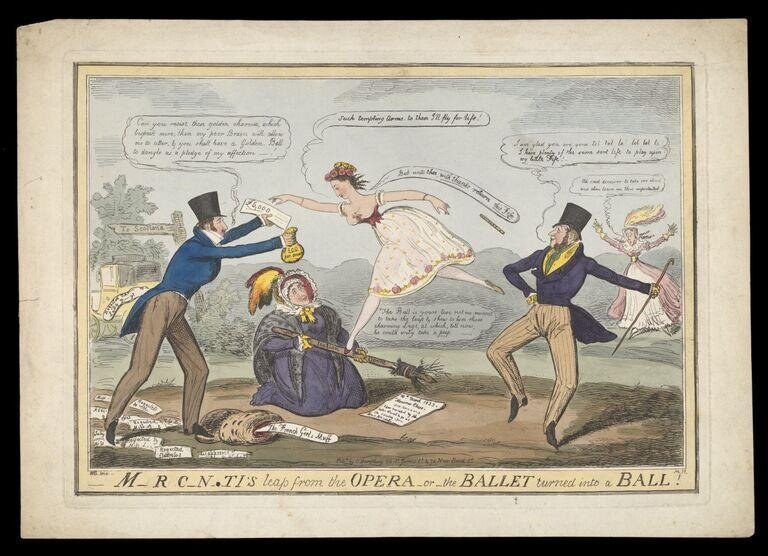
M_rcan_._ti's Leap from the Opera, or the Ballet Turned into a Ball
Cruikshank, Isaac Robert
- Dance:
- Ballroom
- Era:
- Early 1800s (Waltz Revolution)
- Source:
- Victoria and Albert Museum
- Rights:
- Rights vary by item — check the source record before reusing this image. Source record ↗
- Recorded as:
- Check V&A creditLine
This work documents the period when ballet and ballroom dancing occupied sharply distinct social registers—one theatrical and virtuosic, one social and regulated—and shows how that distinction was already a source of fascination and anxiety in popular culture. It provides evidence of how early 19th-century audiences understood female dancers' technical capabilities, especially their capacity for defying gravity, as both marvellous and transgressive.
What you are looking at
This hand-colored satirical engraving depicts a chaotic ballroom scene interrupted by a female figure—identified as a dancer from the opera or ballet—who has apparently leapt into the middle of the gathering. Two male figures in formal dress (blue coat and yellow waistcoat, dark coat with yellow breeches) flank the central female dancer, who is captured mid-leap in a white chemise with raised arms and arched back, her body suspended in an exaggerated aerial pose. A seated woman in dark purple dress and bonnet appears in the lower center, her head turned in reaction. The ground is scattered with fallen papers or documents. The background shows a landscape with trees and sky. Speech bubbles emanate from the figures, containing commentary on the disruption. The composition is framed by a decorative border typical of early 19th-century prints.
The dancing
The central female dancer occupies the height of the composition, her body arched in a dramatic leap with both arms extended outward and upward. Her weight appears fully lifted, with legs extended behind her in flight. The two male figures adopt exaggerated stances—one with arm raised as if to catch her, the other leaning back in theatrical alarm, their elongated limbs emphasizing the grotesque energy of the moment. The seated woman's head registers shock. The poses are not naturalistic but caricatural, exaggerating the extremes of movement to comic effect.
The dance depicted
The work parodies the collision between operatic ballet performance—specifically the spectacular leaps and weightless aerial quality prized in theatrical dancing—and the decorous social conventions of ballroom dancing. The title references a leap (likely inspired by famous female dancers' abilities) that has been transported from the staged opera or ballet into an actual ball. The female figure executes what appears to be a grand jeté or similar elevation, a movement quintessentially associated with Romantic-era ballet spectacle, but the satire lies in its absurd intrusion into polite society. This is social commentary on the cult of ballet virtuosity rather than documentation of actual ballroom practice.
How it was made
This is a hand-colored engraving, a standard medium for satirical social commentary in early 19th-century Britain. The fine line work typical of engraving allows for sharp detail in the figures' expressions and costume, while the hand-coloring (evident in the watercolor washes of blue, yellow, purple, and flesh tones) adds immediacy and visual appeal for circulation among educated readers and collectors. The technique and medium—affordable for mass circulation but executed with skill—placed such prints in the tradition of Gillray and Rowlandson, reaching a broad but literate audience.
About this work
This is a satirical engraving from the Waltz Revolution era that stages a confrontation between Romantic ballet virtuosity and ballroom social order. It captures a moment when operatic ballet spectacle—represented by an impossible aerial leap—violently intrudes upon the choreographed propriety of a fashionable ball. The work is not a record of actual dance practice but a visual joke about the cultural tensions of its moment: the rise of female ballet dancers as celebrated performers whose technical feats (especially elevation) were becoming legendary, set against the rigid conventions of ballroom propriety where women were expected to move with constrained grace. The satirist uses the female dancer's suspended body as the point of disruption, her theatrical body language literally above and beyond the reach of the male figures attempting to control the situation.
How to look at it
Attend first to the central female figure's suspended body: the artist has frozen her at the apex of a leap, her torso arched, arms extended, legs trailing. This is the precise moment of weightlessness that operatic ballet cultivated and celebrated. Note the reactions of the male figures—their gestures of alarm or attempted intervention—which frame this female virtuosity as an intrusion. The fallen papers and the seated woman's shock register the disruption of order. The inscribed speech bubbles and the title invite you to read the joke: a body trained for the stage has landed in the ballroom, and propriety cannot contain it.
The artist
Isaac Robert Cruikshank (1789–1856) was a prolific and commercially successful satirical printmaker, working in the tradition of Gillray and Rowlandson. He produced thousands of hand-colored engravings on topical subjects—politics, social manners, fashion, technology—for distribution by print publishers like Thomas McLean. Cruikshank's work targeted educated urban audiences and relied on visual wordplay, exaggeration, and social observation. He was known for capturing the absurdities of contemporary life with precision and humor.
The period
The 1820s were the height of the Romantic ballet era in Europe, when dancers like Maria Taglioni began to establish the technical vocabulary of pointe work and ethereal weightlessness that defined 19th-century ballet aesthetics. Simultaneously, ballroom dancing was undergoing its own transformation: the waltz was scandalizing conservative society with its close partnering and rotational movement, while the quadrille and cotillion remained the forms that signaled social respectability. This print sits at the intersection of these two dance worlds—one theatrical and aspiring to the impossible, one social and bound by propriety. The female dancer's intrusion into the ballroom may also reflect anxieties about the public visibility and celebrity of female performers, whose bodies and technical feats were becoming objects of public fascination.
Where it lives
The work is recorded as part of the Victoria and Albert Museum collection, sourced from the "va" database. It is a typical example of early 19th-century satirical print culture, the kind of affordable, topical, and disposable publication that circulated widely among educated consumers but has survived in institutional collections.
Dance in this work
Questions about this work
Is this actually about a real incident or a real dancer?
No. This is a satirical fantasy—the title's pun on Mercantius or a similar dancer name is a comic invention. The work uses the exaggerated premise (a theatrical leap literally crashing a ballroom) as a vehicle for commentary on the contrast between staged ballet virtuosity and ballroom propriety. It reflects cultural attitudes and anxieties rather than documenting an actual event.
What does the leap tell us about early 19th-century ballet technique?
The artist understood that elevation and weightlessness were highly valued and technically impressive. The exaggerated height and suspension of the jump, combined with the extended arms and arched back, evoke the vocabulary of Romantic ballet that was emerging in the 1820s—when dancers' ability to appear to defy gravity became central to the aesthetic. The joke works because audiences would recognize this as spectacular and impossible in a ballroom context.
Why are there two male figures reacting so dramatically?
They represent ballroom decorum trying to contain or respond to the transgression. One reaches out as if to catch or control the leaping figure; the other recoils in alarm. Together they frame the female dancer's virtuosity as an intrusion into male-dominated social space, and their theatrical alarm mirrors and mocks her theatrical body.
More Ballroom artwork