48 works in this view — arrow keys or swipe to move between them.
Dance in Art
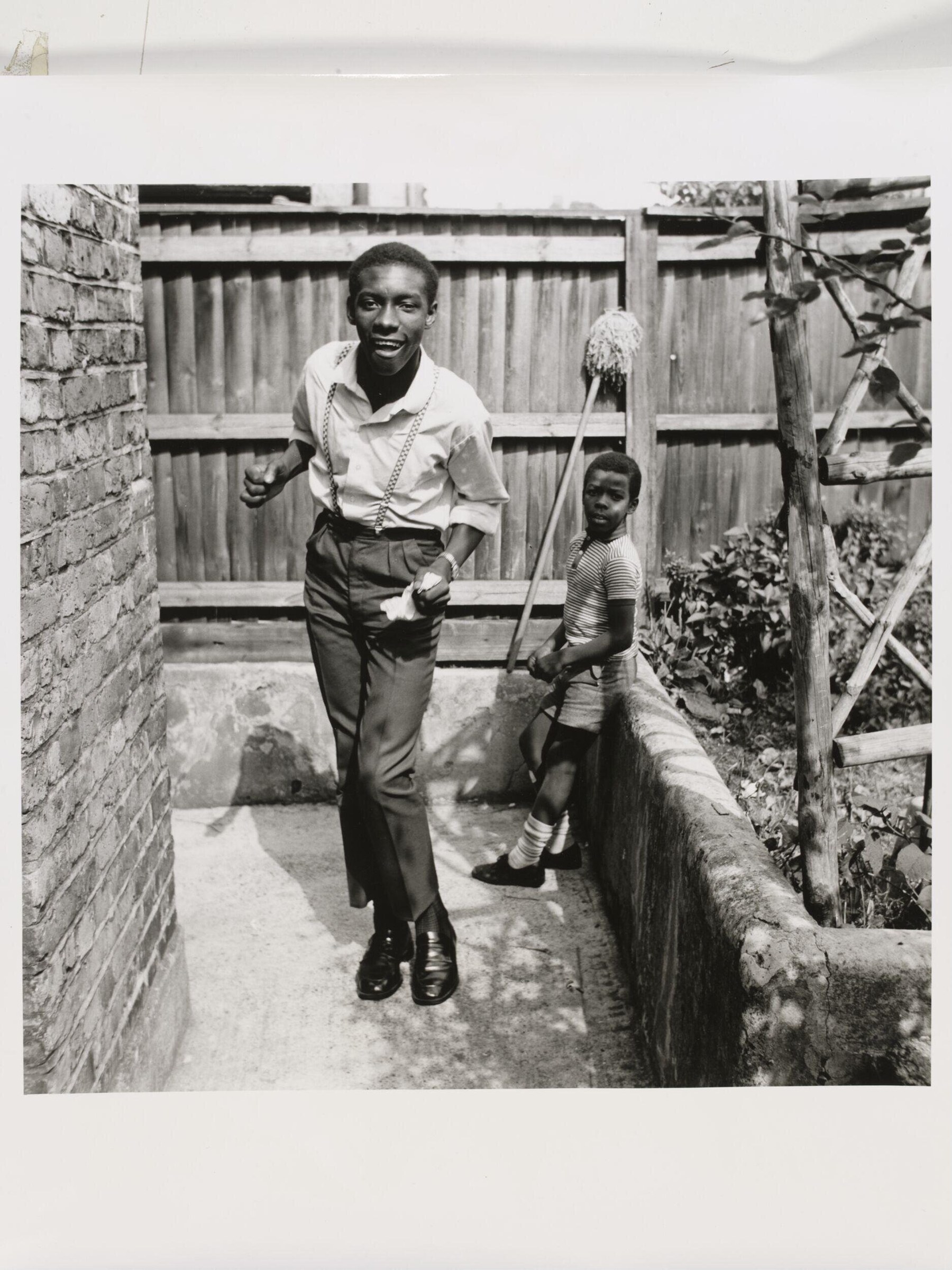
Untitled [Young teenage boy who, just arrived from Jamaica, shows off his latest reggae dance with his younger brother watching, Brixton Hill]
Neil Kenlock
- Dance:
- Folk/Country
- Era:
- 1950-1980 (Rock & Roll / Disco)
- Source:
- Victoria and Albert Museum
- Rights:
- Rights vary by item — check the source record before reusing this image. Source record ↗
- Recorded as:
- Check V&A creditLine
This photograph documents the origins of British Caribbean dance culture at the moment of formation. It shows reggae or early dancehall not as a stage performance but as street knowledge, transmitted between siblings in a working-class yard—a reminder that the most influential dance forms often start in exactly these informal, undocumented spaces. Kenlock's work as a Black British photographer was itself an act of preservation, making visible a community that dominant British institutions had not chosen to record.
What you are looking at
A teenage boy in a white shirt and dark trousers dances in a narrow concrete yard behind a corrugated-metal fence, his body caught mid-movement with a broad smile. He wears a chain necklace and polished dark shoes. A younger boy in a striped shirt stands to his right, watching. The setting is clearly working-class British housing—brick walls visible on the left, makeshift fencing, potted plants and climbing vines suggesting a cramped domestic space. The photograph is black and white, shot in bright daylight that casts clear shadows. The title indicates this was taken on Brixton Hill and records that the dancer had recently arrived from Jamaica, suggesting this captures a moment of cultural transmission and youthful joy in the British Caribbean diaspora.
The dancing
The lead dancer's body is in mid-bounce or step, with bent knees and a relaxed, energetic posture that suggests rhythmic movement rather than balletic form. His arms are away from his body, one extended loosely. His face shows pleasure and engagement with the performance. The younger boy is a static observer, standing upright and watching intently. The older dancer's frame is open and unstructured—this is vernacular, improvised movement rather than codified technique.
The dance depicted
This captures reggae dance or early dancehall movement, likely reflecting the developing Caribbean dance culture in 1960s Britain. The dancer's posture—the bent knees, the relaxed upper body, the bouncing rhythm suggested by the frozen frame—aligns with Jamaican popular dance forms that would develop into modern dancehall. The informal setting and the youth of the performer suggest this is street or yard culture, transmitted between siblings or peer groups rather than taught formally. The photograph documents a moment of cultural continuity and innovation in the early Jamaican diaspora in London.
How it was made
This is a black-and-white photograph, likely gelatin silver print given the era and the V&A provenance. The photographer Neil Kenlock was a pioneering Black British photographer who documented Caribbean and African diaspora communities in London from the 1960s onward. The documentary approach—sharp focus, natural light, a candid moment captured in everyday space—was characteristic of social documentary photography and gave visibility to lives and cultures that were otherwise marginalized in British media and institutional archives.
About this work
Neil Kenlock's photograph captures a teenage boy dancing reggae or proto-dancehall in a Brixton back yard, watched by his younger brother. Taken in 1968, it records a specific moment in the formation of Caribbean-British culture, showing how young people transmitted dance forms from Jamaica into their new home. The image is both intimate (a private family moment) and historically significant (documenting the emergence of a diaspora culture that would shape British music and dance for decades). It belongs in a dance archive because it shows dance as lived practice, learned and performed in everyday spaces by young people navigating migration and belonging.
How to look at it
Watch the lead dancer's bent knees and the suggestion of bounce in the frozen frame—this is not a static pose but a captured moment in continuous rhythmic movement. Notice how his arms are free and his upper body is relaxed, different from the structured balletic forms that dominated the photograph's era. The setting is crucial: this is not a stage or studio, but a cramped domestic space, which tells you this is vernacular, peer-taught dance, not formalized instruction. The younger boy's watching face reminds us that dance learning in diaspora communities often happened exactly this way—through observation and imitation in family spaces.
The artist
Neil Kenlock (1938–2020) was a pioneering Black British photographer who documented Caribbean and Black British communities in London from the 1960s through the 1990s. Beginning as a self-taught photographer, Kenlock created a vital visual archive of diaspora life—families, celebrations, street life, and cultural practice—at a time when British media institutions largely ignored or caricatured Black British existence. His work is held in major institutions including the V&A and the Smithsonian, and he is recognized as a founding figure in Black British photography.
The period
In 1968, Jamaican immigration to Britain was at a significant point. The initial wave had arrived in the 1950s; by the late 1960s, a British-born or British-raised generation was coming of age. Reggae as a musical form was crystallizing in Jamaica during this same period (out of ska and rocksteady), and it was traveling with and through diaspora communities. Dance forms follow music, and what Kenlock captures here is the moment when Jamaican popular dance was being adapted and performed in British yards and streets by young people who were navigating two cultures simultaneously.
Where it lives
The photograph is held in the V&A collection. It comes from a body of work by Kenlock documenting Black British and Caribbean diaspora communities in London, and exemplifies the social documentary photography that formed a crucial visual record of experiences otherwise absent from mainstream British archives.
Dance in this work
Questions about this work
What is reggae dance?
Reggae dance in the late 1960s was the vernacular movement vocabulary that accompanied reggae music, developed in Jamaica and transmitted through diaspora communities. It emphasized flexible knees, relaxed hips, and rhythmic bouncing, contrasting sharply with the rigid postures of ballroom or classical forms. By the 1980s it would evolve into dancehall. What Kenlock captures is an early moment in this form's evolution in Britain.
Who was Neil Kenlock?
Kenlock (1938–2020) was a self-taught Black British photographer whose work documents Caribbean and Black British life in London from the 1960s onward. He created a vital visual archive at a time when mainstream British media did not. His photographs are now in major museum collections including the V&A and the Smithsonian.
Why is this photograph important for dance history?
It documents dance as lived practice in diaspora communities—not on a stage or in a studio, but in a yard, learned peer-to-peer, performed for family. It shows how Caribbean dance forms were adapted and transmitted in Britain. It also documents a photographer's choice to make that practice visible and valuable by recording it.
What does the catalogue record mean by 'just arrived from Jamaica'?
The title indicates the boy had recently migrated from Jamaica to Britain, likely as part of the Caribbean diaspora that was shaping London in the 1960s. His choice to perform reggae in his new home suggests dance as a way of maintaining cultural identity and connection while settling in a new place.
More Folk/Country artwork