25 works in this view — arrow keys or swipe to move between them.
Dance in Art
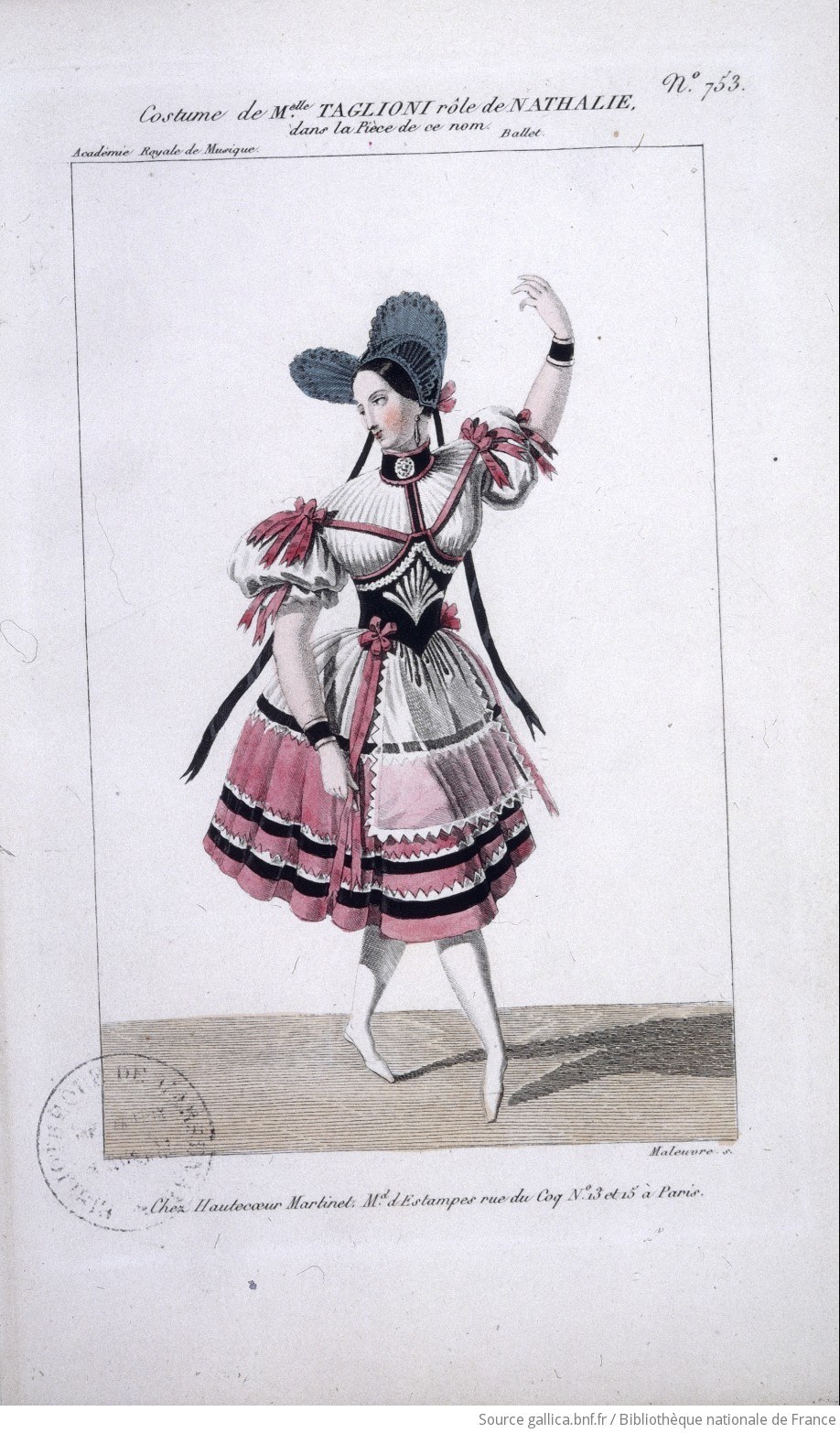
[Nathalie ou la laitière suisse, ballet de Gyrowetz et Carafa : costume de Melle Taglioni (rôle de Nathalie) / gravé par Maleuvre]
Maleuvre, Louis (1785-18.. ; graveur). Graveur
- Era:
- Early 1800s (Waltz Revolution)
- Source:
- Bibliothèque nationale de France (Gallica)
- Rights:
- Public domain — free to use, share and adapt.
- Recorded as:
- domaine public
Taglioni was the dominant ballet figure of the 1830s-40s, and prints of her costumes in specific roles were widely collected and preserved dance history before the advent of photography. This image is primary evidence for how early Romantic ballet costuming worked: the marriage of pointe-work silhouette with narrative dress, and the standardized theatrical representation of national identity through costume detail.
What you are looking at
A young female dancer is shown in a three-quarter frontal pose against a plain ground, captured mid-performance. She wears an elaborate Romantic-era ballet costume: a white muslin bodice with black trim and decorative bows at the shoulders and waist, paired with a tiered skirt of white and pink silk with scalloped black edging and ribbons. A large fanned headdress in blue-grey dominates her silhouette, and she wears a black choker with a circular ornament at the throat. Her right arm is raised expressively at shoulder height with hand extended upward; her left arm hangs at her side. She stands on the balls of her feet in a pose suggesting elevation or imminent movement. The engraving's fine crosshatching and delicate hand-coloring render the translucent quality of the fabrics and the subtle modeling of her pale figure against the white paper.
The dancing
A single dancer poised in what appears to be a moment of suspension or elevation, supported on the balls of her feet in the manner of pointe work or a preparatory movement toward it. Her upper body is held upright and graceful, with one arm raised in an open, lyrical gesture and the other at rest. The pose suggests a trained classical dancer; the positioning of the feet and the elongated carriage of the torso are consistent with the vocabulary of early-19th-century ballet technique.
The dance depicted
This is a costume study for the role of Nathalie in the ballet *Nathalie, ou la Laitière Suisse* (*Nathalie, or the Swiss Milkmaid*), composed by Wenzel Gyr and choreographed by Antonio Carafa. The ballet, which premiered in the early 19th century, was part of the Romantic ballet repertory and belonged to the fashion for rustic and exoticized character dances. The garment shown here blends ballet convention—the fitted bodice, the lifted stance, the translucent skirt—with elements of Swiss folk costume (the headdress and ribbons), a common theatrical device of the era for introducing national color to a ballet narrative.
How it was made
This is a hand-colored engraving, presumably made from a design documenting a stage costume. The delicate line work and tonal modeling are characteristic of early-19th-century theatrical costume prints, which served as records for performers and as promotional imagery distributed in Paris. The engraver Louis Maleuvre specialized in this genre; such prints circulated among dancers and in theater archives, allowing roles to be reconstructed and designs transmitted across performances and venues. The technique allowed fine detail in fabric texture and trim while remaining affordable to produce and distribute.
About this work
This is a record of a specific costume worn by the celebrated dancer Marie Taglioni in the role of Nathalie in *Nathalie, ou la Laitière Suisse*, a Romantic-era ballet mixing classical technique with folkloric character. The print serves as both a document of early-19th-century stage design and an artifact of the theatrical distribution system through which ballet was celebrated and remembered before photography. The work belongs to the genre of costume studies, a major category of dance-related visual documentation in this period. It demonstrates the visual language through which Romantic ballet defined its heroines—ethereal, technically refined, and framed within an exoticized narrative.
How to look at it
The artist has chosen to show the dancer at rest in a moment of poise rather than in motion. Observe the use of the headdress as a visual anchor—it is monumentally scaled and formally frontal, creating a portrait-like presentation even within a costume record. Notice how the dancer's upward gaze and raised arm create a narrative quality: she appears to be engaged in a moment of feeling or expression rather than executing a step. This was the Romantic ballet convention—the dancer as sensitive subject, not merely as technician.
The artist
Louis Maleuvre (1785–c.1840s) was a prolific engraver specializing in theatrical imagery and stage costume documentation. He worked for the major Parisian publishers and produced hundreds of designs capturing the repertory of the Opéra and the principal dancers of the period. His output was part of the commercial infrastructure of celebrity and fandom that surrounded Romantic ballet.
The period
This print dates to the height of Romantic ballet in the 1830s, when Marie Taglioni revolutionized the art through her technique, her introduction of pointe work to mainstream performance, and her iconic embodiment of the ethereal Romantic heroine. Ballet design of this era drew heavily on the picturesque and the folkloric—the Swiss milkmaid trope appears in multiple ballets of the period. Lithography and color engraving were the primary vehicles for disseminating images of dancers and dances to a broad public, creating a visual culture parallel to the theater itself.
Where it lives
This engraving is held by the Bibliothèque nationale de France and has been digitized in the Gallica online collection. It is catalogued as a theatrical costume print and appears to be part of the extensive documentation of the Paris Opéra repertory produced during the Romantic era.
Dance in this work
Questions about this work
Who was Marie Taglioni?
Taglioni (1804–1884) was a Swedish-Italian dancer who became the preeminent ballerina of the Romantic era. She was the first to achieve widespread fame dancing en pointe; her technical innovations and her image as an ethereal, otherworldly performer defined what Romantic ballet looked like. She danced extensively in Paris and across Europe, and prints of her in famous roles, such as this one, were among the most collected dance images of the 19th century.
What is the Swiss milkmaid role?
The Swiss milkmaid was a stock character in early-19th-century ballet and popular theater, representing rural simplicity, moral virtue, and national color. The costume here—the tiered skirt, the headdress, the ribbons—are stage conventions for Swissness, not historical accuracy. Such roles allowed ballet to present itself as both technically refined and narratively grounded in contemporary European life.
Why was this engraving made?
Costume prints served multiple purposes: they were records of specific productions, allowing roles to be reconstructed or transmitted to other theaters; they were promotional materials celebrating celebrated performers; and they were collectible souvenirs for theater-goers. Publishing theatrical costume plates was a significant commercial enterprise in Paris during this period.
What does pointe work have to do with this image?
Taglioni was among the first to dance en pointe as a primary vocabulary, not an ornament or novelty. While pointe shoes are not explicitly visible in this engraving, the raised carriage of the dancer and the lightness of the costume suggest the aesthetic that Taglioni introduced: a sense of weightlessness and elevation that pointe work made possible.
More dance artwork