28 works in this view — arrow keys or swipe to move between them.
Dance in Art
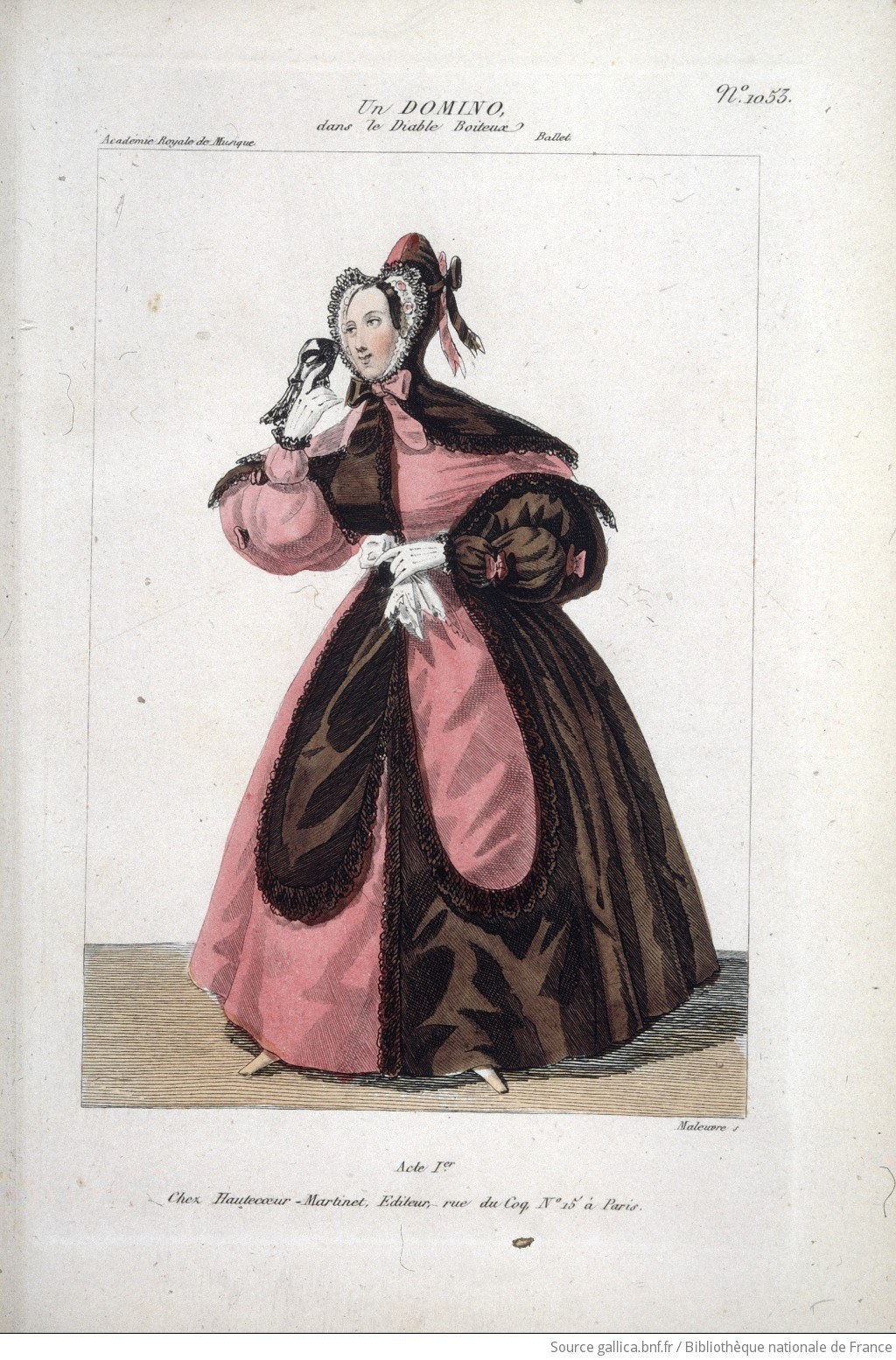
[Le diable boiteux, ballet-pantomime de Coralli, Burat de Gurgy et Casimir Gide : costume d'un Domino / gravé par Maleuvre]
Maleuvre, Louis (1785-18.. ; graveur). Graveur
- Era:
- Mid 1800s (Polka Era)
- Source:
- Bibliothèque nationale de France (Gallica)
- Rights:
- Public domain — free to use, share and adapt.
- Recorded as:
- domaine public
This image is rare evidence of how Romantic ballet costumes were documented, marketed, and circulated in print form—a crucial part of how ballet became a fashionable obsession across Europe. It shows that costume design in this period was not a secondary concern but a primary spectacle, and that the business of theater included the mass production and sale of images that kept the ballet visible and desirable long after performances ended.
What you are looking at
A single female figure stands in three-quarter view against a plain background, wearing an elaborate costume from the 1830s. The domino—a masquerade costume—consists of a voluminous skirt of rose pink silk with dramatic black silk panels that sweep upward in curved, scalloped edges, creating a baroque silhouette. Over this sits a fitted bodice in black with rose-pink trim. A short black cape with ornate embroidered decoration drapes from her shoulders. The figure wears an elaborate headdress: a white lace or gauze bonnet with tall plumes in rose and black, framing her pale, composed face. She holds a small dog or pet animal in her left arm, and white gloves extend to her elbows. The dress and pose suggest a theatrical costume for a masquerade or carnival scene, not street wear.
The dancing
The dancer stands in a relaxed, presentational pose with weight evenly distributed, facing slightly toward the viewer. Her arms are calm—the left cradling the small animal, the right at her side. The posture is dignified and still, designed to display the costume's construction and silhouette rather than to capture motion. There is no indication of footwork, partnering, or active movement; the figure is modeled like a costume plate.
The dance depicted
This is a costume design for *Le Diable Boiteux* (*The Lame Devil*), a ballet-pantomime choreographed collaboratively in 1836. The work became a vehicle for the display of female dancers in increasingly spectacular costumes and technical feats. The domino was a masquerade disguise worn in the work, likely during a scene of social satire or seduction. The image does not show active dancing but rather documents the spectacular dress that framed and enabled the spectacle of the Romantic ballet stage.
How it was made
This is a hand-colored engraving by Louis Maleuvre, a reproductive engraver active in Paris. The fine linear work of the engraving gives sharp definition to the embroidery, lace, and trim of the costume, while hand coloring—visible in the rose pink, black, and flesh tones—has been applied afterward. As a reproductive print, this was likely published and distributed in Paris to publicize the ballet and allow the fashionable public to study the costumes worn on stage. Such prints were sold individually or in series and reached a far wider audience than attendance at the theater.
About this work
This engraving documents a costume from one of the most popular ballets of the 1830s Romantic era. It is neither a performance scene nor a portrait, but a technical costume plate—a hybrid of theatrical documentation and fashion publication. *Le Diable Boiteux* was a commercial success built on visual spectacle, elaborate machinery, and the virtuosity of its dancers; this image of the domino captures the visual fantasy that drew audiences to the stage. The work belongs in a dance gallery because it reveals how nineteenth-century ballet publicity worked: costumes were marketed as objects of desire, and prints like this one shaped how the public understood and remembered performances they had seen or hoped to see.
How to look at it
Attend to the construction of the costume: the way the black panels are cut and attached to create visual drama, the proportions of the voluminous skirt relative to the narrow bodice, and the height and ornament of the headdress. These elements are exaggerated and theatrical—no street costume would be cut this way. The print technique itself is worth observing: the engraved line gives the costume precision and definition, while the hand coloring creates richness and depth. Notice that the figure is posed frontally and statically, designed to show the dress from its most advantageous angle rather than to suggest motion or character.
The artist
Louis Maleuvre (1785–1860s) was a reproductive engraver working in Paris during the Restoration and Romantic periods. He specialized in theatrical costume plates and fashion engravings, producing work for publication that translated the visual splendor of the stage into portable, collectible prints. His technique was precise and his output prolific; he was one of many skilled engravers whose labor made theatrical imagery accessible to the non-theater-going public.
The period
In the 1830s, ballet was undergoing rapid transformation. The Romantic movement had shifted focus from narrative and virtuosic male dancing to the ethereal spectacle of the female dancer. Ballets became increasingly dependent on visual effects—elaborate scenery, magical transformations, and ever more spectacular costumes. *Le Diable Boiteux* premiered in 1836 and was part of a wave of successes that made ballet a dominant form of theatrical entertainment in Paris. At the same time, reproductive printing technology allowed theaters to monetize the visual appeal of their productions, selling costume prints, playbills, and souvenir images to a fashionable public hungry for images of dancers and their dress.
Where it lives
This engraving is held in the Bibliothèque nationale de France (Gallica digital collection), France's national library, where theatrical prints and costume designs from the period are widely preserved. It is identified as part of the Archives of the Académie Royale de Musique (the Paris Opéra), indicating it was an official or semi-official document of the theater.
Dance in this work
Questions about this work
What is a domino?
A domino was a masquerade costume—a hooded cape or full-dress disguise worn to balls and theatrical scenes of revelry. It derives from Venetian Carnival tradition. In ballet, dominoes allowed dancers to appear disguised or unrecognized, creating dramatic irony and enabling scenes of social confusion or romantic intrigue.
Who danced in *Le Diable Boiteux*?
The ballet premiered in 1836 at the Académie Royale de Musique (Paris Opéra). It was choreographed collaboratively by Jean Coralli, Casimir Gide, and Burat de Gurgy. The work was designed as a vehicle for the company's leading female dancers, who performed roles in multiple acts and transformations.
Why would a theater sell prints of costumes?
Costume prints served multiple purposes: they advertised upcoming performances, allowed fashionable audiences to study the styles worn on stage (sometimes influencing actual fashion), and generated revenue as collectible souvenirs. Selling images of dancers and costumes was part of the theatrical business model by the 1830s.
How do we know this is from *Le Diable Boiteux*?
The title and attribution are printed on the engraving itself, at the top and bottom. The notation 'Acte 1er' indicates this costume appeared in Act 1. The archive cataloguing confirms it comes from the Opéra's collection of materials related to this production.
More dance artwork