27 works in this view — arrow keys or swipe to move between them.
Dance in Art
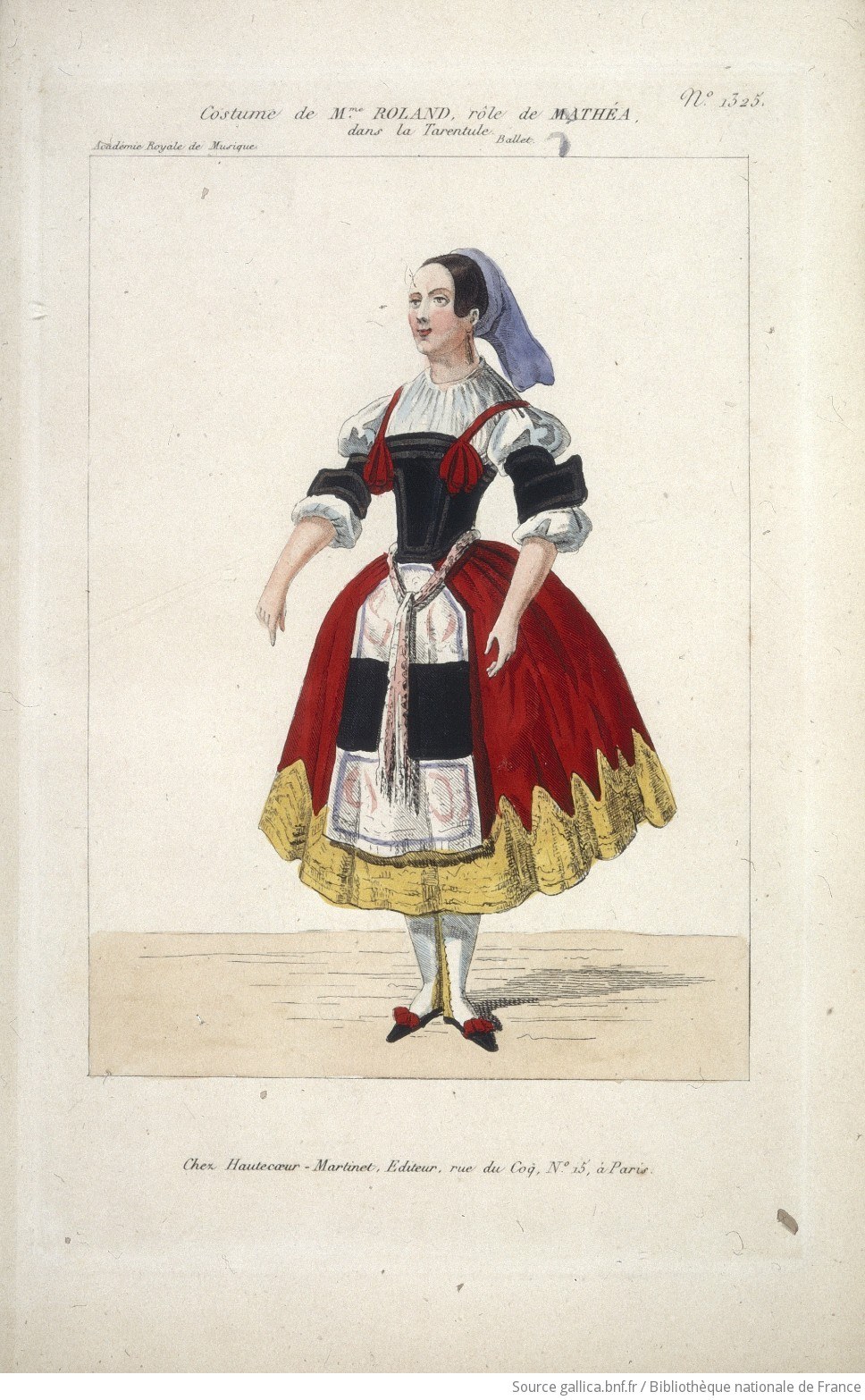
[La Tarentule, ballet de Coralli, Scribe et Gide : costume de Mme Roland (rôle de Mathéa)]
Unknown artist
- Era:
- Mid 1800s (Polka Era)
- Source:
- Bibliothèque nationale de France (Gallica)
- Rights:
- Public domain — free to use, share and adapt.
- Recorded as:
- domaine public
Costume plates like this are among the most direct surviving records of how Romantic ballets looked in performance: they document the precise cut, color, and construction of costumes worn by celebrated dancers in canonical works, information rarely available from written descriptions or later retellings. *La Tarentule* was a significant work in the Romantic ballet repertory, and this print preserves evidence of the role and the visual language through which Romantic ballet coded character and nationality—knowledge that informs modern reconstruction and historical scholarship.
What you are looking at
A single female figure in theatrical costume stands in a three-quarter pose against a plain cream background, looking toward the viewer's left. She wears a black corseted bodice with red bows at the shoulders, a white gathered chemise visible at neck and elbow, and a voluminous skirt composed of a white underskirt and a striking outer skirt in red wool with a deep gold or yellow scalloped hem. A blue-purple headcloth or coif covers her hair, pinned at the back. Her posture is alert but relaxed, with weight distributed evenly on both feet—she wears red heeled shoes with black details. The costume reads as Romantic-era theatrical dress, specifically a peasant or provincial character role. The hand-coloring of this print is delicate; the figure casts a soft shadow on the floor, and every detail of fabric—the sheen of silk, the texture of wool, the crisp white linen—is rendered with precision.
The dancing
A single standing figure in a frontal or near-frontal position, with her gaze directed slightly left and her body relaxed. Both arms rest naturally at her sides; her posture is upright but not rigid, suggesting readiness rather than dramatic tension. The positioning and calm demeanor are typical of theatrical costume plates: the dancer is shown as if pausing, neither in mid-movement nor in formal presentation, but as she might appear entering or exiting a scene. The weight is evenly distributed; there is no indication of balletic turnout or extreme extension, but the alert carriage and the precision of the costume suggest a trained performer.
The dance depicted
This is a costume plate for the character of Mathéa in *La Tarentule* (*The Tarantula*), a ballet created by Coralli with a libretto by Scribe and Gide, first produced at the Académie Royale de Musique (Paris Opera) in 1839. The role was danced by Mme Roland. *La Tarentule* was a Romantic ballet, part of the wave of French Romantic ballet that dominated the 1830s–40s, and it dealt with supernatural and exotic themes—in this case a tarantula bite and its consequences. The costume identifies Mathéa as a young woman of the Neapolitan or southern Italian countryside, coded through the folk-inspired dress: the dark bodice, the ornate skirt with gold-trimmed edge, and the headcloth all suggest a peasant or village character. Romantic ballet often used picturesque national or folk costumes to enhance the exoticism of its narratives.
How it was made
This is a hand-colored engraving or lithograph, established from the image as a print with delicate watercolor or gouache applied over the printed line. The technique allows for precise costume documentation: every seam, hem, ribbon, and fold is clearly delineated, and the hand-coloring preserves the luminosity of the fabrics—the satiny black bodice, the crisp white linen, the deep red wool, the pale blue headcloth. Such prints were standard theatrical documentation of the mid-nineteenth century, distributed to promote new productions, guide costumers, and circulate knowledge of famous roles across Europe. The inscription at the foot—'Chez Hautecœur - Marinet, Éditeur, rue du Cog. N° 18, à Paris'—identifies the publisher and distributor. This is a mass-produced theatrical artifact, evidence of how ballet was commodified and celebrated in the popular print market.
About this work
This is a costume plate documenting the role of Mathéa in *La Tarentule*, a French Romantic ballet from 1839, as performed by the dancer Mme Roland at the Paris Opera. It is one of hundreds of such prints produced in the early nineteenth century to publicize new ballets and the careers of celebrated dancers. The image shows a single standing figure in a vibrant ensemble of peasant-inspired dress typical of Romantic ballet: a black corseted bodice, white linen chemise, and a striking red wool skirt with a scalloped gold hem, completed by a blue headcloth and red heeled shoes. The print is a hand-colored engraving or lithograph, executed with precision and distributed by a Paris publisher. It serves as both a historical document of the role as it was danced and a window into how early Romantic ballet was marketed and celebrated in popular culture.
How to look at it
Attend to the costume as a complete ensemble: notice how each element—the bodice, chemise, skirt, headcloth, shoes—works together to signal the character's identity and social status. The color choices are deliberate: the red and gold of the skirt suggest both peasant festivity and theatrical glamour, while the black bodice codes formality and respectability. The standing pose is a convention of the costume plate: the figure is shown neither in motion nor in the frozen arabesque of a formal portrait, but as a performer might appear in a scene, poised and alert. This was how dancers themselves and audiences understood the role.
The artist
The artist is not recorded in the catalogue. The print was published by Hautecœur-Marinet, a Parisian publisher specializing in theatrical prints and popular imagery, active in the 1830s–40s. Such prints were typically created by competent theatrical illustrators and colorists whose names rarely survives; their work was valued for accuracy and commercial appeal rather than artistic renown.
The period
This print dates to 1839, the height of the French Romantic ballet movement. The 1830s–40s saw the triumph of Romantic ballet in Paris: works like *La Sylphide* (1832) and *Giselle* (1841) defined the aesthetic. Romantic ballet was obsessed with the exotic, the supernatural, and the picturesque—foreign lands, folk traditions, and peasant life featured prominently. Costume was central to this fantasy: ballerinas wore elaborate skirts, exotic headdresses, and elaborate embellishments to signal otherness and drama. At the same time, lithographic and engraved prints became a major medium for circulating images of celebrities and fashionable entertainments. The Paris Opera was the center of European ballet, and prints of its dancers and roles were eagerly collected and traded.
Where it lives
This print is held in the Bibliothèque nationale de France (Gallica digital library), part of the collection of theatrical prints and documents that document the history of French opera and ballet. It is catalogued as a work from the Académie Royale de Musique (Paris Opera) and is one of many such prints in the collection documenting roles, dancers, and costume from the nineteenth century.
Dance in this work
Questions about this work
What was *La Tarentule* about?
The ballet told a story involving a tarantula bite and its supernatural consequences—a typical Romantic ballet premise mixing the exotic, the supernatural, and the picturesque. Mathéa was a young woman of southern Italy, and the ballet used Neapolitan and folk-inspired aesthetics to create an atmosphere of exoticism and danger. The exact plot details vary in surviving accounts, but the role was conceived as a dramatic and virtuosic one for a leading ballerina.
Who was Mme Roland?
Mme Roland was a French dancer performing at the Paris Opera in the 1830s–40s. She was among the leading dancers of the Romantic era and created or performed significant roles in the ballets of Coralli and other choreographers. Beyond what is documented in prints like this one, biographical information about her is limited—a common experience for dancers of the period.
How were these prints made and distributed?
This print was created as an engraving or lithograph and then hand-colored by specialist colorists. It was published and sold by Hautecœur-Marinet, a Parisian publisher, and distributed through print shops, theaters, and to private collectors. Such prints served multiple functions: they promoted new ballets and celebrated famous dancers, they allowed audiences to relive performances at home, and they were prized as fashionable collectibles.
What do the costume details tell us about the role?
The 'folk' costume—the peasant-inspired bodice, colorful skirt, and headcloth—signals that Mathéa was a character of lower social status, from the countryside, and outside the world of court or aristocracy. In Romantic ballet, such costumes were used to create an atmosphere of authenticity and exoticism, allowing the ballerina to explore different social and national identities. The fine materials and elaborate construction show that even 'peasant' roles were performed by stars in expensive, expertly made costumes.
More dance artwork