49 works in this view — arrow keys or swipe to move between them.
Dance in Art
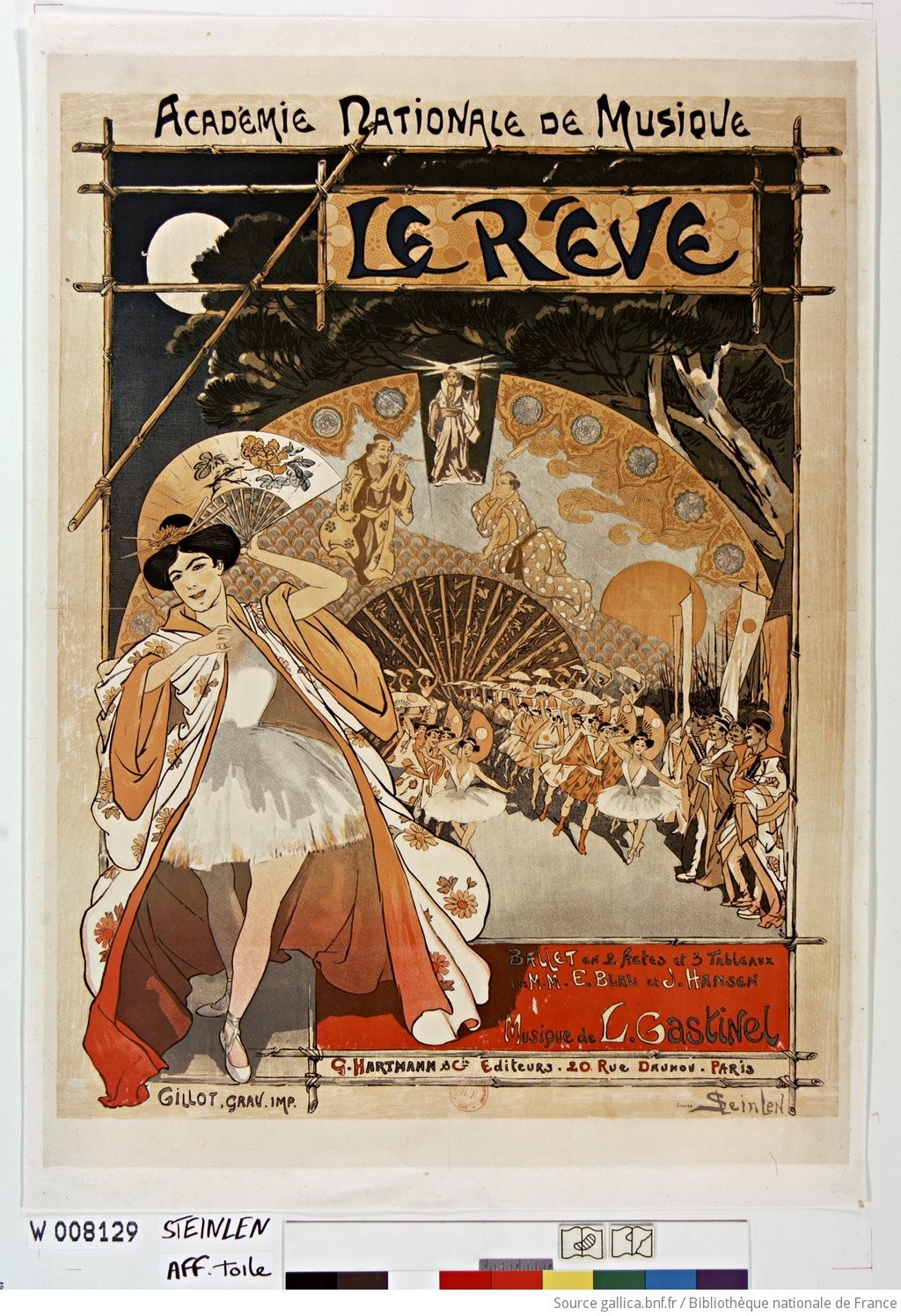
Académie Nationale de Musique. Le Rêve, ballet en 2 actes et trois tableaux de M.M. E. Blal et J. Hansen. Musique de L. Gastinel : [affiche] / Steinlen
Steinlen, Théophile Alexandre (1859-1923). Illustrateur
- Dance:
- Ballet
- Era:
- Late 1800s (Victorian Ballroom)
- Source:
- Bibliothèque nationale de France (Gallica)
- Rights:
- Public domain — free to use, share and adapt.
- Recorded as:
- domaine public
The poster captures a transitional moment in late-nineteenth-century ballet when Romantic ideals were being repackaged through fashionable Symbolist and Orientalist vocabularies. It is also a significant example of Théophile-Alexandre Steinlen's graphic art practice, showing how major poster artists of the period engaged with dance as a subject worthy of sophisticated design.
What you are looking at
This is a poster for a ballet production at the Académie Nationale de Musique, designed by the Swiss-French artist Steinlen. The composition is divided into two scales: a large foreground figure dominates the left side, while a theatrical scene recedes into the background. The foreground shows a woman in an elaborate costume of white tulle skirt and ornate orange-gold silk robe, her body turned in profile with one arm raised to her hair in a pose of reverie or languor. She holds a decorative fan. Behind her, visible through what appears to be an architectural frame (suggested by linear bamboo or wooden supports), is a moonlit scene with a massive fan motif and a crowd of smaller figures in Oriental-inspired dress. The setting evokes a dreamlike, theatrical space with darkened trees framing the upper portion. The color palette is muted—creams, golds, browns, and blacks—creating an intimate, mystical atmosphere typical of fin-de-siècle theatrical design.
The dancing
The principal figure is a single dancer presented in a static, posed attitude rather than caught mid-movement. Her weight appears to rest on both feet, with the body in a three-quarter turn; one arm is raised to head height in a contemplative gesture, while the other hangs naturally at her side, holding the fan. This is a portrait pose rather than a dynamic dance position—the stance is elegant and composed, suggesting the character or mood of the ballet rather than demonstrating technical vocabulary. In the background, numerous smaller figures are arranged in loose groupings, some appearing to stand, some possibly to sit, rendered as silhouettes or sketches rather than articulated dancers.
The dance depicted
This is a poster for *Le Rêve* (The Dream), a two-act, three-tableau ballet with music by Léon Gastinel and libretto by E. Blal and J. Hansen. The work belongs to the Romantic ballet tradition, though produced late enough (1890) to show influences from Symbolist and Orientalist aesthetics. The dancer's pose and costume suggest a character—possibly a dreaming figure or spirit—rather than abstract classical ballet. The moonlit garden setting and the dream narrative indicate this is closer to Romantic ballet's preoccupation with the supernatural and the ethereal than to the technical display of Neoclassical ballet. The Oriental fan and costume elements signal the late-nineteenth-century vogue for exotic settings in ballet.
How it was made
This is a color lithograph, a technique that allowed for tonal subtlety and broad areas of flat color—ideal for poster work. The design exploits lithography's capacity for fine linear detail (visible in the bamboo frame and background figures) alongside bold color blocking. The artist's hand is visible in the fluid line work defining the principal figure's silhouette and drapery. Lithography was the dominant medium for theatrical posters of this period, allowing reproduction in commercial runs while retaining the character of drawing. The poster was published by G. Hartmann Éditeurs in Paris, indicating professional theatrical and commercial circulation.
About this work
This is a theatrical poster promoting a ballet performed at the Paris Opéra in 1890. It represents the Romantic ballet tradition as it existed in the fin-de-siècle period, when the genre was increasingly influenced by Symbolist aesthetics and exoticist fantasy. The poster privileges mood and character over technical display, using a single posed figure to suggest the dreamlike narrative of the work. Steinlen's design epitomizes the integration of fine art and commercial design in this period, treating the poster as a composition worthy of aesthetic attention rather than mere advertisement.
The work belongs in a dance history collection as evidence of how ballet was marketed and conceived at a moment of transition—when Romantic ballet's emphasis on otherworldly female grace persisted, but expressed itself through Symbolist and Oriental idioms rather than the earlier Romantic ballet's Gothic and supernatural machinery. It documents both the aesthetics of a specific production and the visual language used to attract audiences.
How to look at it
The poster asks the viewer to attend to the contrast between the two scales of representation: the large, psychologically charged figure in the foreground and the tiny, dream-like scene behind. Steinlen has chosen a moment of stillness and inwardness—the dancer is not executing steps but embodying a mood. Notice how the pose is classical in its balance and proportion but Symbolist in its expression of inner feeling. The shallow space, created by the linear frame, and the subordination of the dancers in the background to the foreground figure's emotional state are characteristic of Symbolist compositional strategy. The exotic fan and costume elements are readable as signs of the narrative setting—a dreamed or fantasized Orient—rather than as ethnographic representation.
The artist
Théophile-Alexandre Steinlen (1859–1923) was a Swiss-French graphic artist and painter known for his work in lithography, posters, and illustration. He was active in Paris during the fin-de-siècle and worked frequently for theatrical productions and cultural institutions. Steinlen's approach combined fine-art sensibility with commercial purpose, treating posters and prints as serious artistic endeavors. He was associated with circles of Symbolist and modernist artists and was known for sensitive rendering of figure, drapery, and mood.
The period
In 1890, ballet in Paris occupied an uncertain position. The great age of Romantic ballet (1830s–1840s) had passed, and the technical innovations and narrative richness of full-length ballets were giving way to shorter works, divertissements, and experimental combinations of ballet with other theatrical forms. The Opéra under Charles Garnier and his successors was responding to declining audiences by seeking new subjects and aesthetics. The turn toward Symbolism and exoticism—evident in this poster's dream narrative and Oriental decor—was partly a response to competition from music hall and other entertainment forms. The 1890s also saw renewed interest in ballet among fine artists and the avant-garde, who were reconsidering the form through the lens of Symbolist aesthetics. The emergence of Diaghilev's Ballets Russes (founded 1909) would build directly on this aestheticization of ballet by major artists and designers.
Where it lives
This work is housed in the Bibliothèque nationale de France, from which it is accessible via Gallica, the BnF's digital library. It is a theatrical poster published as a commercial object, likely printed in multiples and distributed to advertise the ballet production.
Dance in this work
Questions about this work
What is *Le Rêve*?
*Le Rêve* was a two-act, three-tableau ballet created in 1890 with music by Léon Gastinel and libretto by E. Blal and J. Hansen, performed at the Académie Nationale de Musique (the Paris Opéra). It belongs to the late Romantic ballet tradition, emphasizing dreamlike narrative and atmosphere over virtuosic display.
Why does the dancer look so still and posed?
This is a poster image designed to capture mood and character rather than to show the ballet's choreography or technical content. The pose is intended to suggest the psychological state of the character or the dreamlike atmosphere of the work, which was a central concern of Symbolist aesthetics in the 1890s.
What is the significance of the Oriental elements—the fan and the exotic costume?
The 1890s saw a broad vogue for Orientalist fantasy in theater, visual art, and music. The poster uses these elements to signal an exotic narrative setting, evoking the narrative of the ballet and capitalizing on the period's fascination with imagined non-Western worlds as sites of beauty, mystery, and erotic fantasy.
Who was Steinlen and why would he design a ballet poster?
Théophile-Alexandre Steinlen was a major fin-de-siècle artist and graphic designer. In this period, the boundary between fine art and commercial design was fluid, and prestigious artists worked in poster and print media. Steinlen's involvement signals that the Opéra was seeking to elevate the poster to an art object that would appeal to educated, aesthetically sophisticated audiences.
More Ballet artwork