49 works in this view — arrow keys or swipe to move between them.
Dance in Art
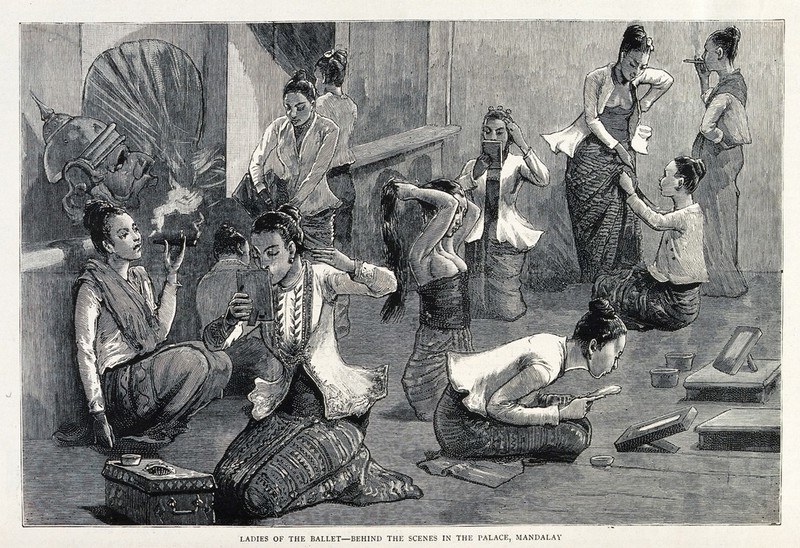
Ballet dancers preparing to perform. Wood engraving.
Unknown artist
- Dance:
- Ballet
- Source:
- Wellcome Collection
- Rights:
- Rights vary by item — check the source record before reusing this image. Source record ↗
- Recorded as:
- Check
For historians and dancers, this engraving is valuable documentary evidence of how 19th-century ballet companies actually functioned: the roles of dressers and attendants, the fit and construction of costumes in performance, and the backstage spaces where dancers prepared. It also reveals the period's understanding of ballet as a profession staffed by working women, not just a romantic spectacle.
What you are looking at
A wood engraving depicting the backstage preparations of a ballet company in what appears to be a palace dressing room. The scene is crowded with female dancers at various stages of dress and readiness: some sit on the floor adjusting costumes or footwear, others stand being fitted or having their hair and headdresses arranged by attendants. The setting is sparse and utilitarian—wooden floorboards, plain walls, basic furnishings—yet the title insists this is a palace. The composition is dense and layered, with figures overlapping across the depth of the room, creating a sense of focused activity and organized chaos. The lighting is even and cool, typical of wood engraving's tonal range, and the artist has rendered the textures of fabric, skin, and architectural detail with fine parallel lines. The mood is one of professional preparation rather than theatrical glamour.
The dancing
The dancers display the characteristic posture and musculature of trained ballet performers. Several are seated, adjusting pointe shoes or stockings with the concentration and precision such work demands. Standing figures hold themselves with the upright carriage and turned-out legs of ballet training. One dancer in the center foreground stretches or bends in a position suggesting active warm-up. The attendants—dressers and hair-makers—move among them with purposeful efficiency. Arm positions are varied and naturalistic rather than posed; the artist captures the unglamorous reality of bodies in motion and in rest, not the perfected lines of performance.
The dance depicted
This is a backstage scene of professional ballet, most likely from the mid-to-late 19th century based on the costume elements visible—the fitted bodices, the length and cut of the tutus being prepared, and the style of headdresses. The title's reference to "the Palace, Mandalay" suggests this may document a specific touring production or mythologize a European company's backstage preparations. The image shows ballet as labor: the physical preparation, the support systems of dressers and hairdressers, and the instrumental relationship between dancer and costume. This is not the romanticized vision of ballet but its working reality.
How it was made
This is a wood engraving, a relief printing technique in which an image is carved into the end grain of a hardwood block. Wood engraving allowed for fine detail and tonal gradation through careful line work, and it was the standard medium for book and periodical illustration in the 19th century. The technique suggests this work was made for reproduction in a newspaper, magazine, or illustrated book—a medium of relatively wide circulation rather than a unique artwork. The precision of the line work and the subtle modeling of form through parallel hatching are characteristic of skilled engravers of the period.
About this work
This wood engraving documents the hidden labor behind professional ballet performance: the dressing room, the fittings, the attendants, the unglamorous preparation that precedes the illusion of effortless grace onstage. It belongs in a dance gallery because it shows ballet not as an aesthetic ideal but as an organized physical practice involving multiple bodies and intensive preparation. The work is significant as both a social document—revealing the infrastructure of professional dance—and as a record of 19th-century ballet's visual and material culture. It challenges the popular image of ballet as pure and ethereal by insisting on the materiality of costume, the body's practical needs, and the coordinated effort required to mount a performance.
How to look at it
Look first at the density of activity: the artist has packed the composition to show the scale of preparation required. Note the individual poses—how many dancers are seated, how many standing, and how the attendants move among them with specific tasks. Observe the costume pieces: the long tutus, the fitted bodices, the elaborate headdresses, all in states of adjustment and repair. The wood engraving technique itself—the fine parallel lines that model form and fabric—asks you to read texture and three-dimensionality from pure line, a skill that was second nature to 19th-century viewers of illustrated papers but may require patience now.
The period
The wood engraving belongs to the era of Romantic Ballet (roughly 1830s–1870s), when ballet had become a major form of theatrical entertainment across Europe and was increasingly documented in the popular press. Illustrated newspapers and magazines of this period regularly published backstage scenes, dressing-room dramas, and glimpses of performers' lives, both to satisfy public curiosity about the theater world and to demystify the glamour of performance. This engraving likely appeared in such a publication, contributing to a growing visual archive of ballet as a profession and a business, not merely an art form.
Where it lives
This work comes from the Wellcome Collection, a major archive of art and artifacts related to medicine, science, and human experience. Its presence in a medical collection suggests it may have been acquired as documentary material about the human body, physiology, or the conditions of professional performers rather than as a fine art work. The fact that it survives in the Wellcome Collection indicates it was valued as a record of human activity and social practice.
Dance in this work
Questions about this work
Where is the actual ballet performance happening?
This engraving shows only the backstage dressing room. The performance itself is happening elsewhere in the palace, out of view. The artist chose to depict preparation rather than performance, which is why the scene is crowded with practical labor rather than theatrical poses.
Why are so many attendants present if this is ballet?
Professional 19th-century ballet required extensive support staff. The elaborate costumes, headdresses, and makeup of the period demanded skilled dressers and hair-makers. Each dancer would typically have an attendant to help with fittings, repairs, and last-minute adjustments.
Is this a real event or an imagined scene?
The title "Ladies of the Ballet—Behind the Scenes in the Palace, Mandalay" suggests a specific reference, but without more information about the source publication, it is unclear whether this depicts an actual touring company or whether it is a generic backstage scene given a specific title for dramatic effect.
What can I learn about costume from this image?
The engraving shows ballet tutus mid-19th-century length (relatively long compared to later eras), fitted bodices, stockings, and headdresses that range from simple to elaborate. You can see how costumes were adjusted and fitted on the body, and how they sat when a dancer was not actively performing.
More Ballet artwork