49 works in this view — arrow keys or swipe to move between them.
Dance in Art
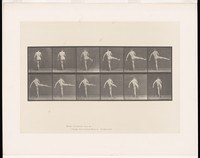
A man performing ballet. Collotype after Eadweard Muybridge, 1887.
Unknown artist
- Dance:
- Ballet
- Source:
- Wellcome Collection
- Rights:
- Rights vary by item — check the source record before reusing this image. Source record ↗
- Recorded as:
- Check
Muybridge's sequential photographs were revolutionary for dancers and choreographers, making invisible mechanics visible and challenging the idea that classical ballet positions existed as fixed poses rather than as moments within continuous kinetic flow. This image is a foundational document in the history of both ballet pedagogy and movement science: it shows how the discipline made itself teachable across time and distance through visual reproduction.
What you are looking at
This is a grid of twelve consecutive posed positions arranged in two rows of six, each occupying a separate vignette framed by ruled lines. The figure is a male dancer in mid-nineteenth-century dress—dark jacket, light breeches, and soft shoes—shown against a plain background. The sequence reads left to right, top to bottom and documents the mechanics of classical ballet movement: standing positions with varied arm placements, rises onto demi-pointe, a développé or unfolding leg extension, and positions of equilibrium. The lighting is even and shadowless, typical of scientific studio documentation. The poses proceed logically through fundamental positions and transitions rather than capturing a continuous narrative or emotional moment.
The dancing
The dancer is consistently shown in profile or three-quarter view, allowing clear sight lines to the legs and torso. His frame is upright and formal throughout, with the turned-out leg position characteristic of classical ballet vocabulary visible in most frames. The arms move through various positions—lowered, raised to shoulder height, extended in arabesques—with deliberate precision rather than fluid flow. His weight shifts between full foot contact and relevé (rise), and the depth of plié in the deeper positions is subtly indicated by flexion in the legs. The single figure repeats across the frames in progressively different positions, creating a visual dictionary of posture and carriage.
The dance depicted
This is a study of classical ballet technique, almost certainly in the Cecchetti tradition which dominated elite European training in the 1880s. The sequence isolates and documents fundamental positions—likely incorporating first through fifth positions—and the transitions between them, with particular attention to épaulement (shoulder articulation) and port de bras (arm carriage). This is pedagogical material: not a performance but a teaching tool designed to make the abstract vocabulary of ballet language visible and repeatable. The methodical arrangement and clinical presentation suggest its purpose was to standardize instruction, making it useful for dancers, teachers, and those studying kinesiology.
How it was made
This is a collotype after photographs by Eadweard Muybridge, the pioneering movement photographer known for his sequential images of human and animal locomotion. Muybridge's original photographs were taken using multiple synchronized cameras to capture rapid motion frame by frame; here they have been translated into a collotype, a photo-mechanical printing process that allowed photographic tonal gradations to be reproduced in ink on paper with high fidelity. The collotype process was expensive and produced prints in limited quantities, making this work circulate among specialists—anatomists, dancers, choreographers, physicians—rather than as popular illustration. The technical precision of the source material and the printing process gave the image authority as a document of actual human movement rather than an artist's interpretation.
About this work
This work sits at the intersection of dance documentation and scientific inquiry in the late nineteenth century. Muybridge's sequential photographs transformed how movement could be studied and taught, breaking down fluid action into discrete, analyzable frames. For ballet, this meant that the codified positions and transitions of classical technique could be isolated, preserved, and disseminated with unprecedented accuracy. The work belongs in a dance gallery both as evidence of how ballet was understood and taught at this historical moment, and as a landmark in the technology of movement capture itself—a predecessor to film and digital motion analysis.
How to look at it
Look at the progression from left to right across each row: the dancer is not frozen in arbitrary poses but in a logical sequence that builds understanding of how one position transitions to another. Notice how the arms change relationship to the torso and head, and how the legs maintain turned-out placement even in positions where balance or reach might tempt relaxation—this is what the classical vocabulary demands. The even, shadowless lighting means every contour of the body is legible; Muybridge was not concerned with aesthetics or drama but with clarity of anatomical information. Each frame is equally important: this is pedagogy rendered as image.
The artist
Eadweard Muybridge (1830–1904) was an English photographer who pioneered high-speed sequential photography. Working in California from the 1870s, he developed systems using multiple synchronized cameras to document human and animal movement frame by frame. His systematic studies—published as *Animal Locomotion* (1887), a multi-volume compendium of thousands of photographs—became foundational references for anatomists, artists, dancers, and early animators. For dance, his work offered the first precise technical documentation of how bodies actually moved, independent of artistic convention or memory.
The period
The 1880s saw ballet in the midst of a broader professionalization and standardization of classical training. The Cecchetti method, which codified positions and movements into a unified system, was being taught across Europe and reaching dancers through notation and written description. At the same time, photography and photomechanical printing were opening new possibilities for visual documentation and circulation of knowledge. Muybridge's work arrived at a moment when ballet technique was becoming increasingly rigorous and when the technological means existed to capture and reproduce its mechanics with scientific precision. The intersection of these developments made his images invaluable to dancers and teachers seeking to perfect and standardize their craft.
Where it lives
The work is held in the Wellcome Collection, a repository of materials documenting the history of medicine, science, and human experience. Its presence in a medical collection reflects how Muybridge's movement studies were received: as scientific documents relevant to anatomy, physiology, and the understanding of human function, as well as to art and athletics.
Dance in this work
Questions about this work
Is this a photograph or a drawing?
It is a collotype, a photomechanical printing process that translates a photograph into ink on paper. The source images were made by Eadweard Muybridge using multiple synchronized cameras. The collotype process allowed these photographs to be reproduced and circulated while preserving the photographic tonal range and detail, making it more like a printed photograph than a drawing, though it is technically a printed image.
What is this sequence showing?
The twelve frames document classical ballet positions and arm carriage, proceeding through fundamental placements and transitions of the Cecchetti method. The dancer moves through variations of position, épaulement, and port de bras, showing the precision and geometric alignment required of trained ballet dancers.
Who was the dancer?
The catalogue record does not identify the dancer. Muybridge's *Animal Locomotion* studies employed many models, often professional dancers and athletes from the San Francisco Bay Area where he worked.
Why was this useful?
Before film, sequential photography was the only way to break down rapid or complex human movement into visible, repeatable frames. For ballet teachers and dancers, these images provided a precise visual reference for correct technique—a standard that could be consulted, studied, and shared across studios and countries.
More Ballet artwork