49 works in this view — arrow keys or swipe to move between them.
Dance in Art
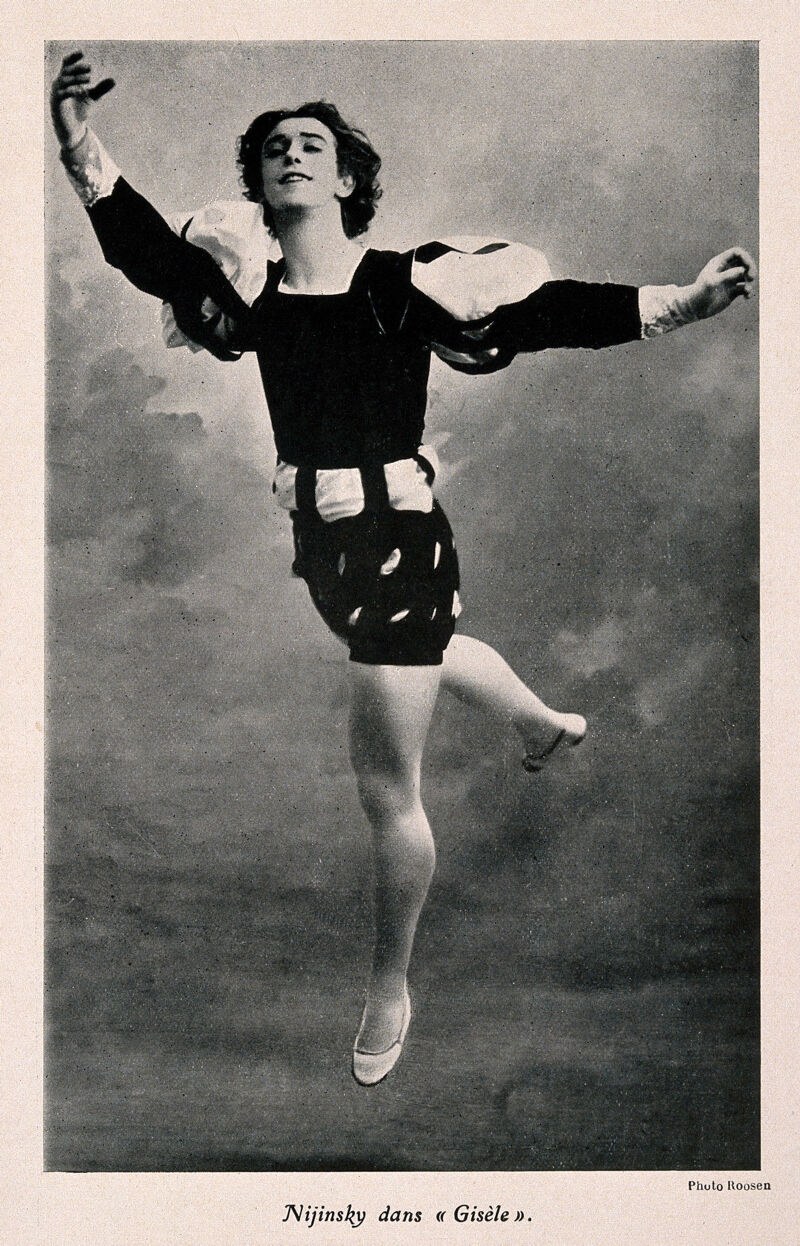
Vaslav Nijinsky, a ballet dancer, in a scene from Gìsèle'. Reproduction of a photograph by Roosen, 1934.
Unknown artist
- Dance:
- Ballet
- Source:
- Wellcome Collection
- Rights:
- Rights vary by item — check the source record before reusing this image. Source record ↗
- Recorded as:
- Check
This image exemplifies the Romantic ballet aesthetic at its peak—the attempt to create the illusion of weightlessness and supernatural grace that defined the movement's artistic vision. For ballet historians and dancers, it provides concrete evidence of how a major classical role was performed and how a professional male dancer of the era deployed his body: the height of the jump, the line of the extension, the carriage of the head and arms. The photograph is also significant as a record of early 20th-century theatrical photography and the documentation practices used to preserve performances before film.
What you are looking at
A male dancer in mid-leap against a neutral gray studio backdrop, captured in a moment of weightless elevation. He wears a dark tunic or jacket with voluminous sleeves in a pale fabric, cinched at the waist with a decorative belt, and dark tights. His right leg extends upward in a high développé or attitude position, while his left leg is bent beneath him; his arms are spread wide in an open fifth position, one raised higher than the other, the palms expressive. His head is tilted back and his gaze directed upward, creating a sense of ethereal aspiration. The lighting is even and frontal, with subtle modeling that emphasizes the line of his body and the extension of his limbs. The photograph captures the instant of maximum suspension, the dancer appearing almost to float rather than jump.
The dancing
A single male dancer in a classical vertical leap, demonstrating exceptional height and line. His weight appears suspended at the apex of a jump, with the supporting leg bent sharply beneath him and the working leg extended in a high, turnout position. His arms frame the body symmetrically in a wide open position with clear palms and extended fingers. The carriage is noble and elongated; his torso remains upright and centered over his hips despite the dramatic leg extension, and his head is held back in a line of romantic aspiration rather than technical concentration.
The dance depicted
This is a dancer performing in the Romantic ballet idiom, almost certainly from a classical or neo-classical production. The costume—dark tunic with puffed sleeves, cinched waist, and tights—and the romantic carriage and epaulement suggest classical European ballet rather than character or national dance. The exceptional airiness of the jump and the nobility of the gesture suggest this may be a principal role; the pose and elevation are consistent with the male vocabulary of mid-to-late 19th century and early 20th century classical ballet as danced across Europe. The photograph's notation of 'Gisèle' in the caption identifies this as from Act II of the Romantic ballet Gisèle, likely the Wili prince or a similar aerial male role.
How it was made
This is a black-and-white photographic print, credited to 'Photo Roosen' in the margin. The clean studio lighting, even exposure, and sharp focus on the dancer's silhouette suggest professional theatrical photography from the early 20th century using glass plate or similar large-format technology. The photograph is mounted on a slightly larger cream-toned backing sheet. The studio setting and technical control indicate this was a formal documentation of the dancer's performance, likely created for publicity or archival purposes—a standard practice for photographing principal dancers in major roles during this era.
About this work
This photograph documents a male dancer performing in Gisèle, captured at the moment of maximum suspension in a classical leap. The Romantic ballet Gisèle, first choreographed by Jules Perrot and Jean Coralli in 1841, became one of the cornerstone works of the classical ballet repertoire, and the second act—where the Wilis, spirits of dead brides, dance in an ethereal corps—showcases some of the most demanding male jumping vocabulary in ballet. This image records the embodiment of that Romantic aesthetic: weightlessness, noble carriage, and a kind of transported ecstasy conveyed through the uplifted head and open arms. The photograph is part of the Wellcome Collection, which holds it as a document of human movement and physical achievement.
How to look at it
Pay attention to the exceptional height and suspension of the jump—the dancer is caught at the apex, where his weight appears to have no downward force. Notice how his supporting leg is bent deeply beneath him while his working leg extends fully in turnout; this is the classical male vocabulary. Observe the alignment of his torso, which remains upright and noble even as his legs create maximum extension and drama. His arms and head are positioned in the open, uplifted Romantic pose—not the geometric precision of later 20th-century styles, but the emotional and spiritual aspiration that defined 19th-century ballet. The studio setting and frontal lighting are typical of theatrical photography of the period, designed to show the dancer's line and technique with maximum clarity.
The artist
The photographer is credited as 'Roosen,' likely a professional theatrical or studio photographer working in the early 20th century. The technical quality and the formal documentation of a principal dancer suggest someone established within the theatrical photography world, but without additional records no more can be said of their practice or reputation.
The period
This photograph dates to a moment when Gisèle, written in 1841, was a canonical work of the Romantic ballet repertoire performed across Europe. By the early 20th century, the role had been danced by generations of artists, and the codification of the classical vocabulary was well established through the teaching of figures like Enrico Cecchetti and the Imperial Russian school under Marius Petipa. The photograph captures the dancer in the legacy of the Romantic male ideal—noble, aerial, and devoted to the ethereal female spirits. This was also the era of early ballet photography, when theatrical dance was being systematically documented through still images, both as publicity and as a record for dancers and choreographers.
Where it lives
The photograph is held by the Wellcome Collection in London and was acquired as a document of human movement and physical achievement. It was originally a professional theatrical photograph, one of many such images made of principal dancers in major roles during the early 20th century.
Dance in this work
Questions about this work
Is this really from Gisèle?
Yes; the caption reads 'Nijinsky dans « Gisèle »'—'Nijinsky in Gisèle.' The catalogue description references this notation. However, this identification should be treated with caution, as it comes from the source (Wellcome), and secondary verification would be needed to confirm which Gisèle production and which season this photograph documents.
What is the costume?
The dancer wears a dark, close-fitting tunic or jacket with full, pale-colored sleeves gathered at the cuff, a decorative belt at the waist, and dark tights. This is consistent with a male principal role in classical ballet of the 19th and early 20th centuries, likely a Romantic or courtly character—a prince, a spirit, or a nobleman. The costume emphasizes the line of the body and allows for maximum visibility of the dancer's technique.
How was this photograph made?
This is a black-and-white photographic print made by photographer Roosen. The technical quality—sharp focus, even studio lighting, and clear tonal range—indicates professional equipment and expertise. The photograph was likely made in a theatre studio or photographic studio using glass plates or similar large-format photography technology, standard practice for documenting principal dancers in the early 20th century.
What makes this jump so impressive?
The dancer is caught at the apex of a vertical leap with exceptional height and suspension. His supporting leg is bent sharply beneath him while his working leg extends fully in turnout overhead—a demanding technical combination that requires both power and control. The apparent ease and weightlessness of the jump, conveyed through the open arms and uplifted head, represents the Romantic ideal of male ballet technique.
More Ballet artwork