49 works in this view — arrow keys or swipe to move between them.
Dance in Art
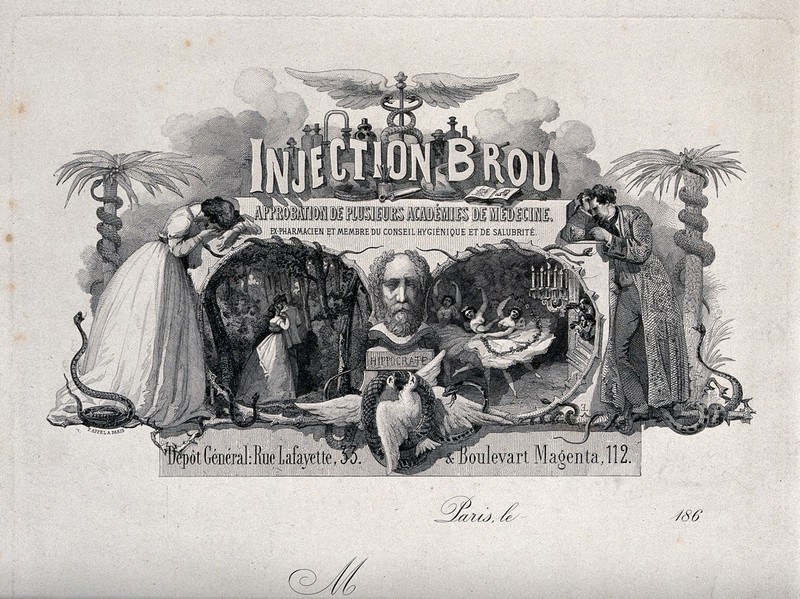
Pharmaceutical bill-head of Injection Brou: the head of Hippocrates, a couple in a forest and ballet dancers. Etching, 186-.
Unknown artist
- Dance:
- Ballet
- Source:
- Wellcome Collection
- Rights:
- Rights vary by item — check the source record before reusing this image. Source record ↗
- Recorded as:
- Check
This print documents the cultural work that dance performed in 19th-century commerce and medicine: the dancing body was not merely beautiful, but was enlisted as proof of efficacy and health. The image reveals how deeply dance was embedded in the visual rhetoric of modern medicine, and how the body in movement became a sign of cure and vitality. For dance historians, it shows how completely the Romantic ballroom couple had become the visual shorthand for healthy, harmonious embodiment.
What you are looking at
This is a richly allegorical pharmaceutical trade bill-head for 'Injection Brou,' an approved injection treatment. The design is divided into distinct registers. At the top, the caduceus (winged staff of Hermes) presides over the title, flanked by palm fronds—symbols of medicine and victory. Below, the composition splits into two narrative scenes. On the left, a bearded man in classical dress (possibly Hippocrates, the father of medicine) sits in contemplation or consultation, while a draped female figure—possibly representing a patient or the spirit of healing—stands nearby with her back to the viewer. On the right, a pair of dancers in elegant dress perform together in a forest setting, their bodies caught in an intimate, graceful movement. The right-hand couple wears contemporary 19th-century clothing and moves with the refinement of ballroom or theatrical dance. Below both scenes runs an ornamental base with classical masks and scrollwork. The entire composition is rendered as an etching in black ink on cream paper, with careful attention to light and shadow to create depth and drama across the crowded allegorical field.
The dancing
The dancing couple on the right are positioned in a close, partnered hold typical of 19th-century social or theatrical dance. The woman's body leans slightly into her partner; her skirt billows with movement, suggesting a turn or forward momentum. The man's frame appears upright and controlled, his arm guiding her through the step. Their posture conveys elegance and mutual support rather than athletic exertion. The couple occupy the lower foreground of the right half, positioned as if to balance the seated and standing figures of the medical allegory on the left. The composition suggests a moment of flowing, continuous movement rather than a held pose—a waltz turn or similar romantic figure.
The dance depicted
The dancers appear to be performing a waltz or similar romantic ballroom dance, the dominant social dance of the mid-to-late 19th century. The coupled hold, the woman's billowing skirt, and the forest setting all point toward Romantic-era theatrical or ballroom dance as practiced in elite European society. The inclusion of dancers on a pharmaceutical bill-head is unexpected and suggests that dance itself was being invoked here as a symbol—possibly of health, vitality, pleasure, or the restoration of bodily vigor that the injection promised. The composition reads as an allegory in which classical medicine (Hippocrates, the caduceus) and modern therapeutics are paired with the aesthetic ideal of dancing grace and physical harmony.
How it was made
This is an etching, a intaglio printmaking technique in which an image is incised into a metal plate and ink is drawn from the grooves. Etching allowed for fine detail and tonal variation through cross-hatching and line density, as seen here in the careful modeling of drapery, facial features, and the texture of foliage. The technique was well suited to commercial and medical ephemera in the 19th century, producing multiple impressions for distribution. The quality of line and the decorative ambition of the composition—the allegorical framing, the ornamental base, the symmetry of the design—suggest this was a professionally executed work intended to lend prestige and authority to a commercial pharmaceutical product. The bill-head format itself (letterhead for professional correspondence) was standard for Parisian merchants and practitioners in this era.
About this work
This pharmaceutical bill-head for Injection Brou is an allegorical engraving that places ballroom or theatrical dance at the heart of a medical claim. The work divides its visual field between classical medical authority (Hippocrates, the healing serpent) and the promise of vital, graceful embodiment—embodied in the figure of an elegantly dancing couple. Made as a commercial ephemeroid in 19th-century Paris, the print testifies to the cultural power of dance as a marker of health, beauty, and social status. It belongs in a dance history precisely because it shows how dance imagery was conscripted into medical and commercial rhetoric: the dancing body was not merely beautiful, but a guarantee of the cure.
The work invites us to ask why a pharmaceutical company would choose to advertise its product through the image of dancers. In the 19th century, bodily vigor and graceful movement were inseparable from ideas of health and cure. By pairing dance with medicine, the engraver made a visual argument that Injection Brou would restore the body to a state of aesthetic and vital wholeness—that it would allow the patient to dance again.
How to look at it
Observe how the composition divides into two allegorical registers: on the left, the authority of past medicine (Hippocrates, the classical physician); on the right, the promise of present vitality (the dancing couple in a lush landscape). The dancers are frozen at a moment of flowing, continuous movement—the turn or swirl of a waltz—which suggests not the effort of dance but its effortless grace. Note how the woman's body leans and flows into her partner's frame, and how her skirt billows with the momentum of the step. This visual language of ease and grace is the silent argument of the bill-head: that Injection Brou would restore the body to this state of harmonious, beautiful movement. The ornamental base—with its masks and classical scrollwork—anchors the whole fantasy in the authority of tradition.
The artist
The artist is not recorded. The work is a commercial engraving executed for a Parisian pharmacy or pharmaceutical distributor (the address given is 'Boulevard Magenta, 112'). The maker would have been a professional reproductive engraver, skilled in allegorical composition and capable of synthesizing medical, classical, and commercial iconography. The style and execution suggest training in mid-19th-century French engraving practice.
The period
This work dates to the mid-or-late 19th century, a period of rapid modernization in European medicine and the rise of pharmaceutical marketing as a visual and commercial enterprise. The Romantic waltz had become the dominant social and theatrical dance form across Europe by this time, representing elegance, courtship, and refined pleasure. In parallel, the rise of clinical medicine and therapeutics—including the development of injection as a mode of drug delivery—created demand for authoritative, persuasive marketing. The allegorical mode (invoking Hippocrates, classical medical symbols) was a standard way to lend historical weight and respectability to modern commercial products. The pairing of classical allegory with Romantic-era dance is characteristic of mid-Victorian design, in which historical styles were layered to create an effect of timelessness and authority.
Where it lives
This work is held in the Wellcome Collection, a major repository of medical history, art, and material culture. As a pharmaceutical bill-head, it is classified as ephemera—commercial printing designed for immediate use and circulation. Its preservation in an archive reflects the modern understanding that such objects are valuable documents of medical history, commercial design, and the visual culture of health and illness.
Dance in this work
Questions about this work
Why is there dancing on a medical bill-head?
Dance was a visual shorthand for health, vitality, and bodily harmony in the 19th century. By showing an elegant, graceful couple in motion, the pharmaceutical company made a visual argument that their injection would restore the body to this state of effortless beauty and vigor. The dancing body served as proof of the cure.
What kind of dance is shown here?
The coupled hold, the woman's billowing skirt, and the Romantic-era dress suggest a waltz or similar ballroom dance of the mid-19th century. The couple are frozen in a moment of turning or swirling motion, which was the defining figure of the waltz.
Is this a famous work or artist?
The artist is not recorded. This is a commercial engraving made for a Parisian pharmaceutical distributor at 112 Boulevard Magenta. Its value lies not in individual artistic genius, but in what it tells us about medical marketing, dance culture, and 19th-century visual rhetoric.
What does the classical imagery mean?
The caduceus (winged staff of Hermes), Hippocrates, and the classical drapery invoke the authority and prestige of ancient medicine. By framing the modern injection within this classical allegorical language, the bill-head claims that the new therapeutic is heir to the oldest and most respected medical tradition.
More Ballet artwork