28 works in this view — arrow keys or swipe to move between them.
Dance in Art
The Dance Class
Edgar Degas
- Era:
- Late 1800s (Victorian Ballroom)
- Source:
- Internet Archive
- Rights:
- Rights vary by item — check the source record before reusing this image. Source record ↗
- Recorded as:
- Check
Degas is the only major artist of his era to document ballet training and rehearsal as seriously as performance, and to do so with genuine understanding of technique. This work is foundational to any discussion of how dance is represented in visual art, and it remains the most truthful large-scale image of a 19th-century ballet class.
What you are looking at
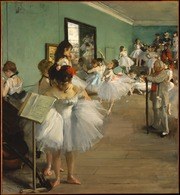
A ballet studio in what appears to be mid-to-late 19th century Paris, lit by soft natural light from tall windows on the left. The floorboards run the length of the room, with a barre visible along the wall. Multiple female dancers in practice tutus occupy the space: some stand at the barre, one executes a développé or similar extension at center, others sit or recline on the floor in various states of rest or preparation. A male figure—likely the ballet master—stands at right, observing and presumably instructing. The color palette is dominated by pale greens and warm wood tones, with the dancers' white and pale pink tutus creating focal points throughout the composition. The scene captures a working rehearsal rather than a performance, with dancers scattered informally across the space in a moment of disciplined yet intimate instruction.
The dancing
The central dancer displays an extended leg position characteristic of classical ballet technique, with the supporting leg straight and the free leg raised high in what appears to be a développé or battement. Her upper body remains upright and composed, typical of academic ballet training. The seated and reclining dancers around her adopt various poses suggesting rest between exercises or stretching. The ballet master's posture—standing upright, watching intently—conveys authority and active instruction. Overall, the bodies demonstrate the controlled, vertical alignment and precise positions that define classical ballet training, with particular emphasis on the careful placement of the legs and maintenance of turnout.
The dance depicted
This is classical ballet training, specifically a rehearsal or class in a professional ballet academy. The dress, setting, technique, and hierarchy of instruction all confirm this is 19th-century romantic or classical ballet as practiced in major European companies. The artist has captured ballet at the moment of its highest institutional refinement in Paris—not performance but the disciplined, repetitive work of the studio where technique was built. The emphasis on the ballet master's presence and the dancers' focus on his direction shows the pedagogical relationship central to ballet transmission at this period. This is not social dancing or theatrical performance, but the serious labor underlying both.
How it was made
This is an oil painting on canvas. The soft, atmospheric handling of light and the intimate scale of the composition suggest Degas's characteristic interest in the private world of the ballet studio rather than the public spectacle of the stage. The muted palette and loose brushwork in the background allow the figures and their gestures to emerge without theatrical emphasis. The medium permitted Degas to capture fleeting poses and unstaged moments—a key innovation in his work—where photography, despite its precision, could not easily manage the movement and soft fabric of a working studio.
About this work
This is Edgar Degas's *The Dance Class*, one of the artist's defining works in his long engagement with ballet in 19th-century Paris. Degas painted the ballet studio repeatedly across his career, drawn to the discipline, bodily control, and hierarchical instruction he found there. Unlike most ballet imagery of his era—which focused on the glamor of performance and the allure of the female dancer—Degas insists on the studio as a site of work: unglamorous, concentrated, governed by the ballet master's eye. The painting records classical ballet technique at a moment of mature institutional development, when the Paris Opéra was the world capital of the form. For dancers and historians, this work remains invaluable evidence of how ballet was actually practiced and taught in the 1870s.
How to look at it
The viewer should first locate the central figure—the dancer executing the extended leg position—and observe how Degas has placed her not as the obvious focal point but as one element in a larger composition of scattered, resting, or preparing dancers. Notice the way the light rakes across the floor, catching the fabric of the tutus and the wooden boards. Observe the ballet master's position and the direction of his gaze, which pulls the viewer's eye toward the central dancer and confirms the hierarchy of attention in the studio. The composition is deliberately asymmetrical and off-balance, as if the viewer has stepped into an ongoing rehearsal rather than viewing a posed scene. This casualness is deceptive: it required careful study of movement and light to achieve.
The artist
Edgar Degas (1834–1917) was a French painter and printmaker who became obsessed with ballet in the 1860s and returned to it as subject matter throughout his life. He attended rehearsals at the Paris Opéra, sketched dancers in motion, and had access to the ballet studio that few artists of his era enjoyed. Unlike his Impressionist colleagues, Degas combined his direct observation with careful compositional study, often drawing from multiple viewpoints and moments to construct scenes that felt alive but were carefully constructed. His dance works—both paintings and pastels—moved the subject from the sentimental and erotic registers into which it had been cast, and instead honored the dancers' labor and the formal discipline of classical technique.
The period
The 1870s were a transitional moment in ballet. The Romantic era had peaked and passed; the great Romantic ballerinas and the era's signature works (Giselle, La Sylphide) were still performed but no longer the cutting edge. Classical technique was being refined and systematized, particularly through the Russian Imperial Ballet's adoption and development of the French technique. Paris remained the prestige center, but the heyday of the Paris Opéra as the world's dominant ballet company was beginning to fade as St. Petersburg and Moscow became serious rivals. In art, Impressionism was newly established; Degas's work sits at the intersection of Impressionist interests (contemporary life, modern subjects, effects of light) and his own commitment to form and structure. The studio setting also reflects mid-century French culture's interest in the professions and the dignity of work, even (or especially) women's work.
Where it lives
The painting is held in a major public collection. This image comes from the Internet Archive digital collection, which aggregates high-resolution images of artworks in museums worldwide.
Dance in this work
Questions about this work
Who is the ballet master in this painting?
The painting does not identify him by name. Degas attended rehearsals at the Paris Opéra and drew many ballet masters, but this figure represents the type and role rather than a specific individual. The ballet master's identity was less important to Degas than his function in the composition—as the source of authority and the focus of the dancers' attention.
What is the significance of the seated and resting dancers?
Rather than arrange all the dancers in a display of technique, Degas shows them as working people—some active, some resting, some stretching. This reflects the real rhythm of a ballet class or rehearsal, where concentrated work alternates with recovery. It also humanizes the dancers and resists the tendency of earlier ballet imagery to treat them as purely decorative.
Is this a rehearsal for a specific ballet?
The painting depicts a training class or rehearsal rather than preparation for a particular performance. The exercises shown are the fundamental vocabulary of classical ballet, not choreography for a named work. This allows the image to speak to ballet training in general rather than to a single production.
Why is the color so subdued compared to other ballet paintings of the era?
Degas rejected the theatrical brightness and artifice of stage lighting in favor of the cool, natural light of a working studio. The pale greens and muted tones reflect actual daylight and reinforce the separation between the studio (a space of serious work) and the stage (a space of spectacle). The restraint also draws attention to the bodies and their positions rather than to costume or decor.
More dance artwork