29 works in this view — arrow keys or swipe to move between them.
Dance in Art
Avalon Ballroom Poster (1966) - Wes Wilson
Wes Wilson
- Dance:
- Ballroom
- Era:
- 1950-1980 (Rock & Roll / Disco)
- Source:
- Internet Archive
- Rights:
- Rights vary by item — check the source record before reusing this image. Source record ↗
- Recorded as:
- Check
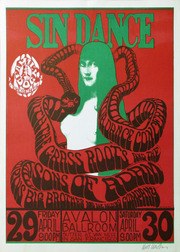
This poster is a primary document of how dance actually happened in 1960s counterculture—not as learned technique or social convention, but as individual, ecstatic, body-centered exploration. It shows the moment when ballroom venues were repurposed and traditional notions of dance were rejected in favor of a more primal, expressive mode. For dancers and historians, it demonstrates that dance history cannot be limited to named styles and trained bodies; the writhing figure on this poster represents a real and influential form of movement practice.
What you are looking at
A psychedelic concert poster in hot orange-red and acid green, dominated by a sinuous female figure rendered in flowing, organic Art Nouveau curves. The woman's body wraps around itself in an impossible S-bend, her white face and long green hair creating a stark focal point against the background. Her body seems to morph into and merge with serpentine forms—snakes or ribbons—that coil around the composition in sweeping arabesques. The text "AVALON BALLROOM" curves along the top in blocky letters; "28" appears at bottom, likely indicating a date. The style is pure psychedelic poster art: heavily contoured, swirling, with flat color fields and no naturalistic shading. The figure's posture is impossible for an actual human body—this is an abstraction of movement rather than a depiction of it.
The dancing
A single female figure dominates, her body twisted into a reversed C-curve with her back arched and her frame inverted relative to any ballroom dance position. Her arms and legs are suggested rather than clearly articulated, absorbed into the overall flowing line of her form. There is no closed hold, no frame, no recognizable ballroom posture. The body appears weightless and boneless, floating rather than standing; the serpentine quality suggests writhing or undulating motion rather than the structured steps of social dance.
The dance depicted
The poster advertises an Avalon Ballroom event—a San Francisco psychedelic rock venue—but the figure depicted is not dancing ballroom in any conventional sense. The writhing, contorted posture suggests the ecstatic, uninhibited movement of dancers in psychedelic rock venues: freeform, individual, body-centered movement that was the opposite of the structured partnering of ballroom dance. The impossibility of the pose is deliberate; it evokes the altered states and boundary-dissolving consciousness associated with the counterculture and psychedelic experience. This is what ballroom-goers of 1966 might actually be doing on the dance floor—not formal steps, but immersive, expressive, non-codified movement.
How it was made
This is a lithographic poster, a medium that allowed for bold, flat areas of color and strong graphic impact suited to concert promotion and street posting. The technique enabled the artist to create the seamless, flowing curves and the precise color separation (orange-red ground, acid green accents, white figure) characteristic of 1960s psychedelic design. Lithography's accessibility meant these posters could be produced in quantities suitable for community distribution, and the bold graphic language ensured visibility and immediate visual impact—essential for promoting live events to a young, mobile audience.
About this work
This is a concert poster for the Avalon Ballroom, a legendary psychedelic rock venue in San Francisco's Haight-Ashbury district. Designed by Wes Wilson, a master of the psychedelic poster idiom, it advertises not ballroom dancing in the traditional sense but the freeform, body-centered movement of dancers in a countercultural rock venue. The poster conflates two meanings of "ballroom"—the formal social dance tradition and the contemporary venue—and uses an impossible, undulating female figure to suggest the ecstatic, unstructured movement of the 1960s counterculture. It belongs in a gallery of dance imagery because it documents a genuine and widespread form of dance practice: the communal, improvised movement that defined a generation's nightlife and consciousness.
How to look at it
Look at the impossible contortion of the body—no actual dancer could achieve this pose. That impossibility is the point. The artist has rejected naturalism in favor of an image that communicates the sensation of dancing rather than the mechanics of it. The writhing, serpentine quality and the figure's apparent weightlessness suggest altered consciousness and the dissolution of bodily boundaries. The flat, screaming colors and the way the figure seems to melt into the background reflect the synesthetic experience—the crossing of sensory boundaries—that psychedelic drugs and rock music were said to produce. This is a poster designed to be read at a distance, in motion, in the context of a crowded street or a concert venue; its impact comes from its visual intensity and its embodiment of a felt experience rather than from representational clarity.
The artist
Wes Wilson (1937–2006) was the preeminent graphic designer of psychedelic rock posters in San Francisco, working for the Avalon Ballroom, the Fillmore, and other legendary venues from 1965 onward. He pioneered the visual language of psychedelia: illegible lettering, impossible anatomy, flowing organic forms, and Day-Glo colors that seemed to vibrate off the page. His training in graphic design and his immersion in the Bay Area music and drug scene gave him the technical skill and cultural fluency to create images that didn't just advertise events but visually embodied the altered states and boundary-dissolution those events promised. His work shaped how an entire generation imagined music, dance, and liberation.
The period
In 1966, ballroom dancing as a social institution was already in decline among young Americans, displaced by rock music and the emerging youth counterculture. The psychedelic rock scene was exploding in San Francisco, with venues like the Avalon Ballroom repurposing old dance halls as concert spaces. The movement that filled these venues was radically different from ballroom: it was solo, non-partnered, improvisational, and often associated with altered consciousness from drugs and the immersive sensory experience of live rock. This poster captures the moment of transition—the old ballroom space and the new dance form it contained, rendered in the visual language of psychedelia, which valued the irrational, the impossible, and the ecstatic.
Where it lives
The work comes from the Internet Archive digital collection, a source of digitized cultural materials. As a concert poster, it was originally a mass-produced promotional item intended for distribution and public posting, not a limited-edition artwork; many examples would have been printed and distributed throughout San Francisco in 1966.
Dance in this work
Questions about this work
Is this actually showing ballroom dance?
No, not in the traditional sense. The Avalon Ballroom was a historic dance hall repurposed as a rock concert venue. In 1966, the dancers filling it were moving to psychedelic rock music in freeform, improvised ways—not in the structured partnered steps of ballroom dancing. The poster captures this collision: a ballroom space now inhabited by a new, countercultural form of movement. The impossible, writhing posture on the poster embodies that new movement far better than any naturalistic ballroom pose could.
Who was Wes Wilson?
Wes Wilson (1937–2006) was the master of San Francisco psychedelic poster design. He created iconic concert posters for the Avalon Ballroom, the Fillmore, and other venues, inventing much of the visual language we associate with 1960s psychedelia: impossible lettering, distorted anatomy, flowing organic forms, and vibrant Day-Glo colors. His work was influential beyond concert advertising; it shaped how an entire generation visualized altered consciousness and countercultural values.
What does the snake or serpent mean?
The serpentine forms wrapping around the figure suggest both the undulating motion of dance and the idea of transformation or boundary-dissolution. Snakes appear throughout psychedelic art and symbolism as signs of transcendence, shedding of old forms, and return to primal states. The fusion of the human figure and the serpent reinforces the poster's theme: the body dissolving into pure movement and sensation.
Why is the figure contorted into that impossible pose?
The impossible pose rejects naturalism in favor of communicating the sensation of dancing—weightlessness, ecstasy, the dissolution of bodily boundaries. For audiences experiencing psychedelic drugs and immersive rock concerts, the body was no longer a fixed, mechanical object but something fluid, permeable, and transformative. The poster's anatomy is impossible because it's capturing a felt experience, not a physical fact.
More Ballroom artwork