49 works in this view — arrow keys or swipe to move between them.
Dance in Art
Ballet 101 Photos Seymour D. D. Teoli Jr. A. C. ( 1.1)
D.D. Teoli Jr. A.C.
- Dance:
- Ballet
- Source:
- Internet Archive
- Rights:
- Reusable with conditions: credit the creator; non-commercial use only. Source record ↗
- Recorded as:
- http://creativecommons.org/licenses/by-nc-nd/3.0/
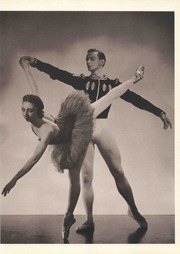
For dancers and choreographers, this image is a technical reference: it shows the exact geometry and energy distribution of a classical pas de deux adagio, frozen in a way that reveals what the technique achieves. For historians, it documents how ballet was presented in the early twentieth century and how the male role was visualized—not as a mere support, but as an equal partner with his own powerful physical presence and line.
What you are looking at
A male and female dancer are captured mid-performance against a neutral background in this black-and-white photograph. The male dancer, dressed in a fitted dark tunic or shirt, stands in a wide stance with one leg extended and both arms spread wide open to the sides at shoulder height, creating an expansive, dynamic frame. The female dancer, in a classical ballet tutu, is positioned in front of him in a supported arabesque or similar extended leg position, leaning back into his frame. The lighting is even and theatrical, suggesting studio or stage photography. The composition emphasizes the relationship between the two bodies and the geometrical lines created by their limbs and torsos.
The dancing
The male dancer provides the base and frame, supporting the female dancer's weight through an intimate partnering hold. His posture is strongly grounded and open—legs in a wide demi-plié or lunge position, both arms extended laterally in a gesture of presentation or support. The female dancer's body is elongated and curved, her free leg extended and her torso tilted backward in a classical ballet line. Their spatial relationship suggests he is both supporting and showing her off. The contrast between his powerful stance and her floating, ethereal line follows classical ballet partnering convention.
The dance depicted
This is theatrical ballet, most likely from the early-to-mid twentieth century based on the photographic style and the aesthetic of the tutu and male costume. The pose suggests a moment from a classical or neoclassical ballet adagio—a sustained passage in which a male dancer supports a female soloist through a series of extended positions. The photograph captures the illusion of effortlessness central to ballet technique: the male dancer's visible strength anchors the female dancer's apparent weightlessness. Without identifying the ballet specifically, the image documents the core grammar of classical ballet partnering.
How it was made
This is a black-and-white photograph, likely gelatin silver print or similar photographic process common in the early twentieth century. The even studio lighting, the theatrical framing, and the sharp focus on the dancers' bodies suggest professional stage or rehearsal photography rather than candid documentation. The medium allowed the preservation of a single frozen moment of movement—a significant advantage over painting or drawing for capturing the precise geometry of dance and the instantaneous relationship between partners. The photograph's circulation via the Internet Archive suggests it was once part of a institutional or archival collection.
About this work
This photograph documents a moment in classical ballet partnering: a male dancer in a powerful grounded stance supporting a female dancer in an extended, curved line. The image is a study in the aesthetics and technique of early twentieth-century theatrical ballet, capturing the essential relationship between support and weightlessness, strength and grace. It belongs in a gallery about dance as evidence of how the ballet partnership was understood, performed, and visually recorded during a formative period in the dance's modern history.
How to look at it
Observe the photograph as a study in balance and counterweight: the male dancer's grounded, wide stance is the answer to the female dancer's aerial, curved line. Notice how his extended arms frame her body and direct the viewer's eye. The photograph captures the moment of suspension—the instant at which the female dancer appears weightless and the male dancer's effort is completely concealed. This was the goal of classical ballet technique, and the photograph proves its success.
The artist
D.D. Teoli Jr. A.C. is credited as the photographer in the catalogue record, but no further biographical information is available. The photographic archive or collection from which this work derives may have contained many such studies of dancers and theatrical subjects, suggesting Teoli may have worked as a theatre or dance photographer, though this cannot be confirmed from the record.
The period
Early twentieth-century ballet was undergoing rapid modernization in Europe and America. While classical technique remained the foundation, choreographers and dancers were experimenting with new dramatic content and more athletic male roles. Studio and stage photography became an important tool for documenting and promoting ballet, allowing images of dancers to circulate in magazines, programs, and archival collections. This photograph sits within that documentary tradition, capturing the aesthetic ideals of the era: the female dancer as the primary visual focus, ethereal and extended; the male dancer as a powerful, dignified support whose strength is displayed through his frame and posture.
Where it lives
The work is held in the Internet Archive digital collection. It is catalogued as part of a series titled 'Ballet 101 Photos' attributed to D.D. Teoli Jr. A.C., suggesting it was one of many documentary or instructional photographs of ballet subjects, though the original institutional source and date of creation remain unrecorded.
Dance in this work
Questions about this work
What ballet is this from?
The catalogue record does not identify a specific ballet, and the photograph alone does not provide enough context to determine which work is depicted. The pose is typical of an adagio section in classical or neoclassical ballet, but it could derive from any number of ballets created in the early twentieth century or later.
When was this photograph taken?
The date is not recorded in the catalogue. The photographic technique, studio lighting, and aesthetic of the dancers' costumes suggest early-to-mid twentieth century, but this is an estimate based on visual evidence, not archival information.
Who are the dancers?
The catalogue record does not identify the dancers. The photograph was part of a series titled 'Ballet 101 Photos,' which suggests it may have been created for instructional or documentary purposes rather than to record a specific performance or famous dancers.
What is the male dancer's role called?
In classical ballet, the male dancer here is performing the role of the danseur or cavalier in a pas de deux. His primary function is to support the female dancer (prima ballerina or ballerina) while displaying his own strength, elevation, and line. Early twentieth-century ballet still emphasized the female dancer as the primary visual focus, though the male role was increasingly valued for its athleticism and artistry.
More Ballet artwork