49 works in this view — arrow keys or swipe to move between them.
Dance in Art
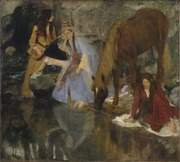
Portrait of Mlle Fiocre in the Ballet "La Source" (Portrait de Mlle...E[ugénie] F[iocre]: à propos du ballet "La Source")
Edgar Degas
- Dance:
- Ballet
- Era:
- Late 1800s (Victorian Ballroom)
- Source:
- Internet Archive
- Rights:
- Rights vary by item — check the source record before reusing this image. Source record ↗
- Recorded as:
- Check
Degas fundamentally changed how dance appears in art by turning away from the performance spectacle toward the unglamorous reality of training and preparation. This painting documents the actual conditions of a professional dancer's life in the nineteenth century—the crowding, the physical manipulation, the constant adjustment—and asserts that this labor, not the finished performance alone, is worthy of serious artistic attention. For historians of dance, the work provides rare visual evidence of how Romantic ballet was actually practiced, costumed, and taught.
What you are looking at
A richly colored oil painting depicting a moment of theatrical preparation or rehearsal rather than performance. The composition centers on a ballerina in a white tutu, pointe shoes, and pale pink bodice, captured in profile or three-quarter view as she adjusts her costume or takes instruction. She is surrounded by figures in darker clothing—likely her teacher, dresser, or fellow dancers—who attend to her from multiple angles. The setting is shadowy and intimate, rendered in deep browns, ochres, and greens, with dramatic lighting that isolates the dancer's pale form. A male figure in dark clothing stands prominently to the right. The painting's loose, gestural brushwork and the tonal palette create an atmosphere of concentration and the unglamorous labor behind theatrical spectacle. The work captures not the finished performance but the moment just before or the private ritual of preparation.
The dancing
The central dancer stands with her weight forward, her body oriented to display the classical ballet silhouette—elongated neck, raised shoulders, and the characteristic turnout suggested by her positioning. Her arms are not in a formal arabesque or attitude but rather in the practical gesture of someone being dressed or adjusted, hands raised near her torso. The surrounding figures lean in attentively; their postures suggest they are assisting, teaching, or observing. There is no partnering or social embrace; the spatial relationship is hierarchical and professional rather than romantic. The dancer's isolation within the composition—her brightness against the darker attendants—emphasizes her as the subject of scrutiny.
The dance depicted
This depicts the world of Romantic ballet as practiced in the mid-nineteenth century, specifically the preparation of a dancer, possibly for the role of Fiocre in the ballet *La Source* (1866), a work by Léon Minkus and Arthur Saint-Léon. The painting documents the labor and discipline of professional ballet rather than its illusion. Degas was fascinated by this behind-the-scenes realm—the studios, rehearsals, and preparation spaces where dancers lived most of their working lives. The image shows ballet as a technical practice requiring instruction, costume adjustment, and physical readiness rather than as pure artistic flight.
How it was made
This is an oil painting, identifiable by the layered, blended application of pigment and the rich depth of color and shadow characteristic of the medium. Degas worked in oil, pastel, and mixed media throughout his career; his distinctive technique here employs a relatively dark, warm ground over which lighter passages are built, creating a sense of intimate interior light. The loose brushwork, particularly in the background figures and drapery, suggests rapid notation of observed detail—a technique Degas developed from his practice of drawing from life in the theater. The painting would have been intended for exhibition and private collection, reaching viewers who valued contemporary social observation and technical virtuosity.
About this work
This painting represents Edgar Degas's sustained engagement with the ballet as a subject of modern life and artistic investigation. Rather than celebrating the dancer as an idealized figure, Degas presents her as a working professional—a young woman whose body is the instrument of her labor, subject to adjustment, instruction, and the demands of physical training. *La Source*, first performed in 1866, was one of the major ballet productions of the era, and Fiocre was a celebrated dancer of the Romantic period. Degas's decision to paint not the performance but the preparation reveals his interest in the gap between theatrical illusion and material reality. The work belongs to a substantial body of ballet imagery he produced throughout the 1860s and beyond, making the theater studio as much a site of aesthetic investigation as the stage itself.
How to look at it
Attend to the lighting: Degas has lit the dancer as if she were a studio model or a figure under examination, not a performer in a spotlight. Notice the absence of any theatrical apparatus—no stage, no audience, no music. The painting captures a pause in action, a moment of waiting and adjustment rather than movement. Look at the contrast between the dancer's precise classical posture and the informal, working gestures of the figures around her. The brushwork in the background is deliberately rough and unfinished compared to the dancer's form, suggesting Degas's prioritization of the human figure and his disinterest in atmospheric detail. The overall composition is crowded and intimate, as if you are standing in the studio yourself, which is exactly the experience Degas sought to create.
The artist
Edgar Degas (1834–1917) was a founding member of the Impressionist group who devoted an extraordinary proportion of his work to dance. Unlike the Impressionists' focus on light and landscape, Degas pursued the human figure with the intensity of a Renaissance draftsman, but he chose modern subjects: the ballet studio, the racetrack, the café. He drew constantly from life, visiting the Opéra in Paris to sketch dancers during rehearsals and performances. His ballet works span from the 1860s through the early twentieth century, making dance one of the central preoccupations of his entire career. He approached dancers as athletes and professionals, not romantic ideals, and he employed a radical compositional vocabulary—cropping, asymmetry, unusual viewpoints—learned partly from Japanese prints and photography.
The period
The 1860s were a transitional moment in ballet. Romantic ballet, with its emphasis on the ethereal and the supernatural, had dominated the preceding decades, but its conventions were becoming codified and commercial. *La Source*, produced at the Opéra in 1866, was a contemporary success but represents ballet in a period of formal conservatism. Simultaneously, artists and critics were becoming fascinated by the modern world and its hidden labors—the backstage, the studio, the private moment. Degas's interest in dancers coincided with broader shifts in art toward social observation and the aestheticization of contemporary life. Photography was emerging as a medium during this period, and Degas's cropped compositions and unusual angles reflect photography's influence on how artists now composed scenes.
Where it lives
The work is catalogued as held in an unspecified collection and sourced from the Internet Archive digital collection. The catalogue record provides minimal provenance information, and the current location and institutional holding are not documented in the available record.
Dance in this work
Questions about this work
Who was Eugénie Fiocre?
Eugénie Fiocre (1845–1908) was a celebrated French ballet dancer of the mid-nineteenth century, a principal dancer at the Opéra during the Romantic and early modern periods. She created roles in major ballets of the 1860s, including Frantz in *Coppélia*. Degas's interest in her as a subject reflects her prominence in Parisian theatrical life and the dancer's celebrity during that era.
What is 'La Source' and why did Degas paint this portrait in connection with it?
*La Source* (1866) was a ballet with choreography by Saint-Léon and music by Léon Minkus, premiered at the Opéra with Fiocre in a leading role. Degas was in the habit of attending and sketching at the Opéra, and he often produced portraits of celebrated dancers associated with significant productions. This painting documents Fiocre's professional identity through her costume and preparation rather than through performance on stage.
Why did Degas paint backstage and rehearsal scenes instead of performances?
Degas was interested in the reality of labor and the modern worker's body. He saw the studio and the dressing room as more truthful subjects than the theatrical illusion of the stage. By depicting preparation, adjustment, and training, he asserted that the dancer's professional identity and skill were more worthy of artistic attention than the romantic fantasy the stage presents to the audience.
Is this painting a portrait of Fiocre or a scene of ballet life?
It is both. The title identifies it as a portrait *à propos du ballet*, meaning a portrait occasioned by or connected to the ballet. Degas presents Fiocre as an individual but situates her within her professional context—being dressed, adjusted, and prepared by others. The work is neither a formal seated portrait nor a pure genre scene, but a hybrid that treats the dancer as both subject and working professional.
More Ballet artwork