49 works in this view — arrow keys or swipe to move between them.
Dance in Art
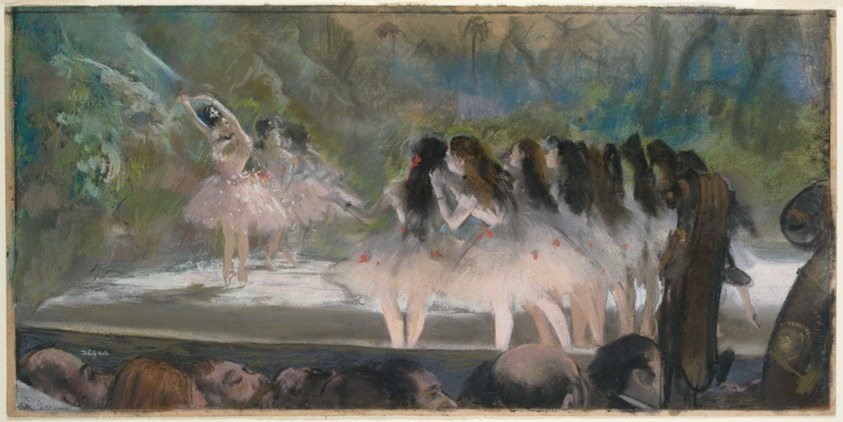
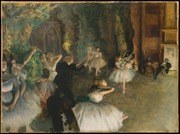
The Rehearsal of the Ballet Onstage
Edgar Degas
- Dance:
- Ballet
- Era:
- Late 1800s (Victorian Ballroom)
- Source:
- Internet Archive
- Rights:
- Rights vary by item — check the source record before reusing this image. Source record ↗
- Recorded as:
- Check
This painting revolutionized how ballet was represented in art. Before Degas, dancers appeared on canvas as ethereal stage creatures, frozen in moments of perfect grace. Degas showed them as working professionals: tired, corrected, concentrated, real. For dancers, it is a rare historical document of how classical technique was actually taught and practiced in a major ballet institution of the 1870s. For art historians, it exemplifies Degas's commitment to capturing modern life in all its unglamorous particularity—art about work, not about beauty.
What you are looking at
A ballet rehearsal in progress, captured in soft, diffused light that suggests a studio or practice space rather than a performance stage. Multiple dancers in pale practice dresses are arranged across the composition, some actively moving while others pause or adjust their positions. The setting is intimate and informal—a working space rather than a formal theatre. Degas uses warm earth tones and muted greens to establish the interior, with strong diagonal lines created by the dancers' bodies and the architectural elements of the room. The light pools unevenly across the figures, creating pools of brightness and shadow that give the scene immediacy and a sense of captured motion. The foreground is occupied by dancers in various attitudes: some bent forward, arms extended, others standing at rest. The background dissolves into softer focus, suggesting more figures and the depth of the studio space.
The dancing
The dancers display the characteristic postures of rehearsal and instruction: some are in active extension with arms raised or swept, displaying the turned-out positions of classical ballet; others stand or rest, their bodies reflecting fatigue or waiting. The nearest figures show the slight forward bend and engaged core typical of dancers between combinations. Their limbs are elongated and graceful but without the rigid perfection of performance—these are working bodies in a working space. The composition includes approximately seven to ten figures, distributed across the canvas in loose, overlapping groups rather than in formal stage alignment. Their dresses, plain and practical, hang and move naturally rather than with the formal stiffness of stage costume.
The dance depicted
This is a classical ballet rehearsal, most likely of the French or Italian tradition practiced in Paris in the 1870s. The informal arrangement, the simple practice dress, and the evident instruction or correction happening between dancers all point to a working session rather than a performance or formal class. The dancers' poses suggest exercises in extension, balance, and épaulement—the rounded arm positions and turned-out legs that are foundational to classical technique. Degas has chosen to depict the unglamorous reality of ballet training, the repetitive work and physical exhaustion that precedes the spectacle of the stage. The title's reference to 'rehearsal' is precise: this is the labour behind performance.
How it was made
The work appears to be pastel or oil on canvas, executed with Degas's characteristic technique of building form through layered colour and confident linear drawing. The soft edges and luminous quality suggest pastel, a medium Degas favored for capturing the fleeting effects of light and movement in studio spaces. The technique allowed him to work rapidly and revise as he observed, essential for capturing the informal, constantly shifting poses of dancers at work. The handling of light—how it falls across fabric and skin—depends on the transparency and blending possible in pastel, giving the scene its intimate, almost documentary quality. The medium itself signals this as a study from life rather than a formal commissioned work.
About this work
This is one of Degas's finest paintings of the ballet studio, the world behind the curtain where dancers trained in the techniques that made performance possible. Rather than depicting the spectacle of performance or the formal poses of a staged class, Degas has chosen the working rehearsal: the moment of instruction, correction, and repetition. The painting belongs to a substantial body of his work from the 1870s exploring the Paris Opera Ballet, its dancers, teachers, and the spaces where their labour happened. It is a work about the invisible infrastructure of theatrical art, about the hours of unglamorous work that made the moments of stage spectacle possible.
How to look at it
Pay attention to where Degas has placed light and where he has not. The uneven illumination is not arbitrary—it follows the actual light of a studio window, and makes some dancers vivid while others fade into shadow. This is how rehearsals look. Notice the variety of attitudes: no two dancers are in the same pose or at the same moment in their movement. This is not a choreographed group tableau but a captured instant of many individual labours. Look at the dancers' faces and bodies for signs of attention, fatigue, or correction. The woman bending forward in the foreground is not performing elegance—she is working. The apparent casualness of composition is the result of precise observation and careful arrangement.
The artist
Edgar Degas (1834–1917) was obsessed with the Paris Opera Ballet from the 1860s until his death, producing hundreds of paintings, pastels, prints, and drawings of dancers in performance, rehearsal, and daily life. Unlike his Impressionist colleagues, Degas was trained in rigorous academic drawing and modelled his practice on Renaissance masters; his interest in dancers combined this classical training with a modern commitment to capturing fleeting, asymmetrical moments of contemporary life. He had privileged access to the Opera, including backstage and rehearsal spaces, allowing him to observe dancers in candid moments. His ballet works were not sentimental: they were studies in movement, light, and the human body under strain.
The period
In the 1870s, when this was painted, classical ballet in Paris was undergoing transformation. The Romantic era's obsession with ethereal, otherworldly female dancers was giving way to a more virtuosic, technically demanding aesthetic. The Paris Opera Ballet, the world's leading ballet institution, was training dancers in increasingly complex technique. At the same time, modern art was turning toward the capture of contemporary life and transient moments—Impressionism was emerging. Degas's ballet paintings occupy the intersection of these currents: they are modern art about modern labour, using avant-garde techniques to capture the reality of a traditional art form. The rehearsal was becoming a subject of serious artistic interest, reflecting broader curiosity about creative labour and process.
Where it lives
The work is documented in the Internet Archive digital collection. The medium is not recorded in the catalogue entry, but from examination of the image appears to be pastel or oil.
Dance in this work
Questions about this work
Is this a real rehearsal or an imagined scene?
Degas had direct access to rehearsal studios at the Paris Opera and painted from life observation, but like all artists he composed and arranged his scenes for maximum effect. This is a truthful representation of what rehearsals looked like—the poses, the light, the informal dress—but choreographed as a painting rather than a documentary record.
Why is the painting so dark and unfocused compared to other ballet paintings?
The soft light and diffused background are deliberate choices reflecting the actual conditions of a studio lit by windows, and Degas's technique of capturing transient, off-guard moments. He is not interested in the theatricality of performance lighting, which would be bright and even. The darkness and shadow are part of the painting's honesty.
What can we learn about ballet technique from this painting?
The turned-out positions, the arm carriage, the engagement of the core, and the focus on balance and extension all reflect classical technique of the period. The informal poses show how dancers actually positioned their bodies between exercises, and how they recovered from physical exertion. It is a historical document of 1870s classical training.
Why did Degas paint so many ballet scenes?
The ballet studio offered Degas everything he cared about as an artist: contemporary modern life, the problem of capturing fleeting movement, the interplay of light and shadow, formal composition, and the human body as the primary subject. It was also the world of beauty, labour, and some exploitation, allowing him to explore contradictions in modern life.
More Ballet artwork