49 works in this view — arrow keys or swipe to move between them.
Dance in Art
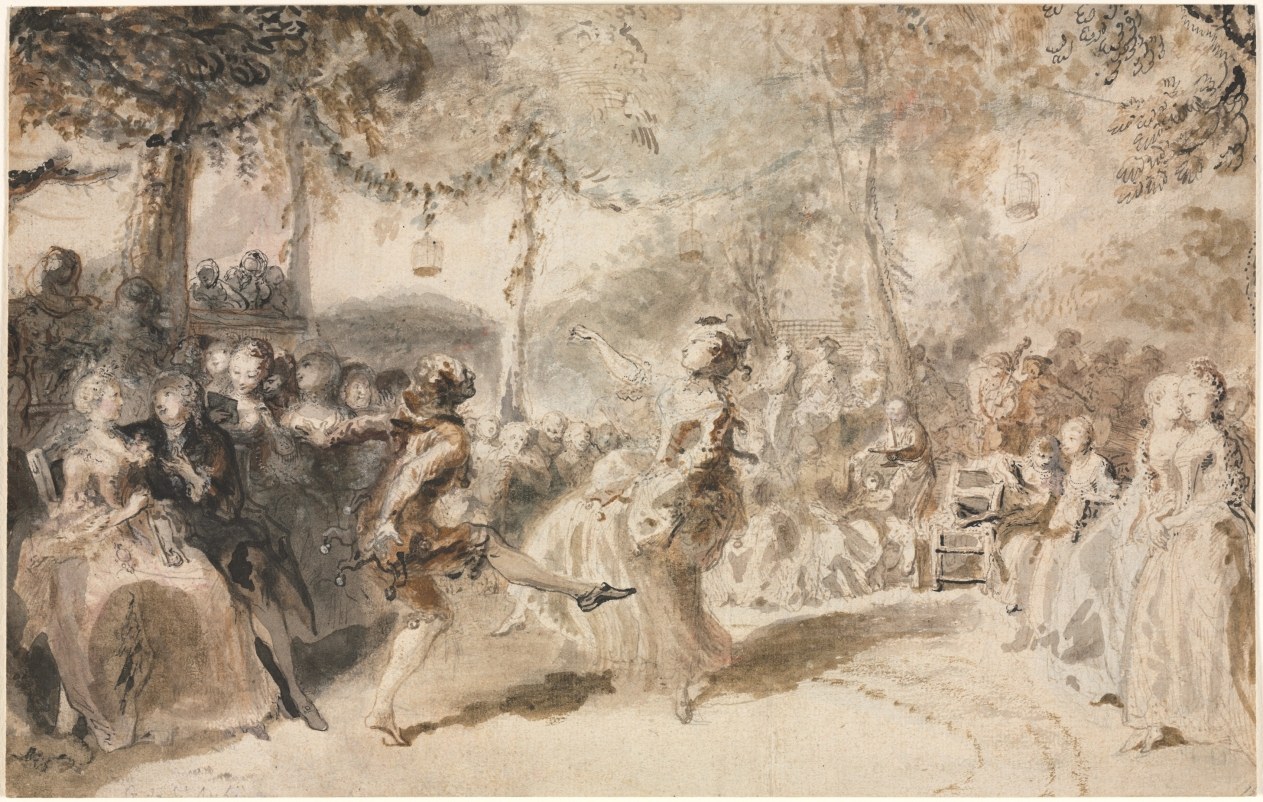
Costumed Dancers Performing in a Garden Tavern
Gabriel de Saint-Aubin (French, 1724–1780)
- Source:
- Cleveland Museum of Art
- Rights:
- Public domain — free to use, share and adapt.
- Recorded as:
- CC0 (Public Domain)
This work documents a form of aristocratic dance-theater that left no other record—a garden masquerade in which pantomime, ballet, and social performance were not yet fully separated. It shows us what 18th-century spectators actually saw, and the artist's choice to emphasize gesture and costume over precise footwork tells us that expression and theater mattered more than technique to this audience.
What you are looking at
A garden party unfolds beneath tall trees strung with garlands and lanterns, where costumed figures enact a theatrical dance. The composition divides into two crowds: on the left, spectators in dark dress watch from a raised platform or terrace; on the right and center, figures in pale, flowing costumes perform or process through the garden space. The foreground shows a figure in light drapery with arm raised, as if mid-gesture or invocation. The entire scene is rendered in sepia tones with delicate wash work, the foliage and architectural elements suggested rather than detailed, emphasizing the theatrical artifice of the moment. The costume suggests 18th-century dress—the women wear high-waisted, loose robes or chemises, some with flowers in their hair; the men wear contemporary coats and breeches. The setting evokes a private theatrical entertainment, an open-air masquerade or garden fête.
The dancing
The central dancer stands with one arm extended upward in a gesture of appeal or invocation, the body in three-quarter profile with weight shifted; the posture is expressive and rhetorical rather than strictly balletic. Surrounding figures are distributed across the garden space in informal groups—some standing, some seated on benches or chairs, none in the paired holds of formal ballroom dance. The costumes are unified in their lightness and classicism, suggesting a coordinated ensemble or masque rather than street dress. The pose of the principal figure suggests pantomime or dramatic gesture as much as dance proper.
The dance depicted
This appears to document a theatrical garden entertainment or masquerade of the mid-18th century, likely featuring pantomime, allegorical performance, or the kind of stylized pastoralism fashionable in aristocratic circles. The raised arm and expressive stance suggest influence from commedia dell'arte or classical dramatic convention rather than ballroom technique. The costuming and setting place it within the tradition of garden fêtes galantes or open-air spectacles common in European aristocratic life. Without more specific iconographic detail, the precise dance form—if 'dance' is even the primary mode—cannot be confidently identified; the scene is as much theater as dance.
How it was made
This is a pen and wash drawing, likely heightened with watercolor, executed with considerable delicacy. The artist has used soft brushwork and tonal washes to create atmospheric depth—the foliage and sky fade into pale, almost illegible marks at the edges. Fine pen lines define the figures and the architecture, while broad strokes of wash establish mass and shadow. The technique suggests the work was made for circulation as a finished drawing or as a study for engraving; it has the refined, controlled execution of a design for a cultivated audience rather than a quick sketch. The delicate rendering would have allowed reproduction as an engraving, which likely extended its reach.
About this work
This is a record of a theatrical garden entertainment—a masquerade or fête—staged in the mid-18th century, rendered with the grace and informality appropriate to the subject. The work captures a moment when dance, pantomime, and spectacle merged in aristocratic social performance. The image shows us not just the movement but the setting and social structure of the event: the hierarchy between performers and audience, the role of costume and artifice, the idealization of the garden as a space for entertainment. For historians of dance and theater, it is evidence of a now-vanished performance mode: the open-air, mixed-media spectacle that preceded modern theater.
How to look at it
Look first at the composition: the artist has placed the principal figure at the center with arm raised, drawing the eye upward and emphasizing the theatrical moment. The crowd of spectators on the left provides context—these are witnesses to a performance, not participants. The setting, with its trees and lanterns, creates an enchanted space distinct from ordinary garden life. Notice the contrast between the detailed definition of the foreground figures and the fading, indistinct treatment of the background—a technique that emphasizes the theatrical 'stage' and separates performers from setting. The pale, flowing costumes unify the performers and distinguish them from the darker-dressed spectators.
The period
The image dates to approximately 1740–1780, a period when garden fêtes and open-air spectacles were fashionable entertainment among European aristocracy. This was the age of Rococo aesthetics, when art celebrated lightness, playfulness, and the pleasures of social life. In dance, this was the era when ballet was becoming professionalized and technically demanding, yet aristocratic amateurs still participated in court spectacles and garden entertainments. Painters and printmakers documented these events both as records and as celebrations of elite leisure. The delicate, picturesque mode of the drawing reflects the aesthetics of the period—a taste for naturalism tempered by artifice, and for the pleasures of theater and costume.
Where it lives
This work is held by the Cleveland Museum of Art and catalogued as part of their collection of dance-related art. It arrived without attribution or detailed provenance, as is common for drawings of this era and market value.
Dance in this work
Questions about this work
Is this ballet?
Not in the strict sense. The figure's gesture and the theatrical setting suggest a pantomime or allegorical entertainment. The raised arm and expressive pose are characteristic of 18th-century dramatic gesture, and the lack of pointe work or the formal line of balletic training suggests this is social theater rather than professional ballet. However, the event likely included dancing as part of a mixed entertainment.
What is the figure doing with their arm raised?
The gesture appears to be one of invocation, appeal, or dramatic exclamation—a pose from pantomime or classical theater. It may indicate a moment in a narrative or allegorical scene, such as calling the spirits of the garden, or making an emotional appeal to other performers or the audience. Without the text or music that accompanied the performance, we cannot be certain of the meaning.
Why are people watching from a platform on the left?
This reflects the social structure of aristocratic entertainment: the garden fête was a spectacle staged for an invited audience. The raised platform suggests a designated viewing area, separating spectators from performers and emphasizing the theatrical nature of the event. Such entertainments were as much about displaying taste, wealth, and social position as about the performance itself.
What era is this from?
The style of dress, the aesthetic of the drawing, and the fashion for garden fêtes all point to the mid-18th century, roughly 1740–1780. This was the height of Rococo culture and a period when such open-air, mixed-media spectacles were fashionable among the European aristocracy.
More dance artwork