49 works in this view — arrow keys or swipe to move between them.
Dance in Art
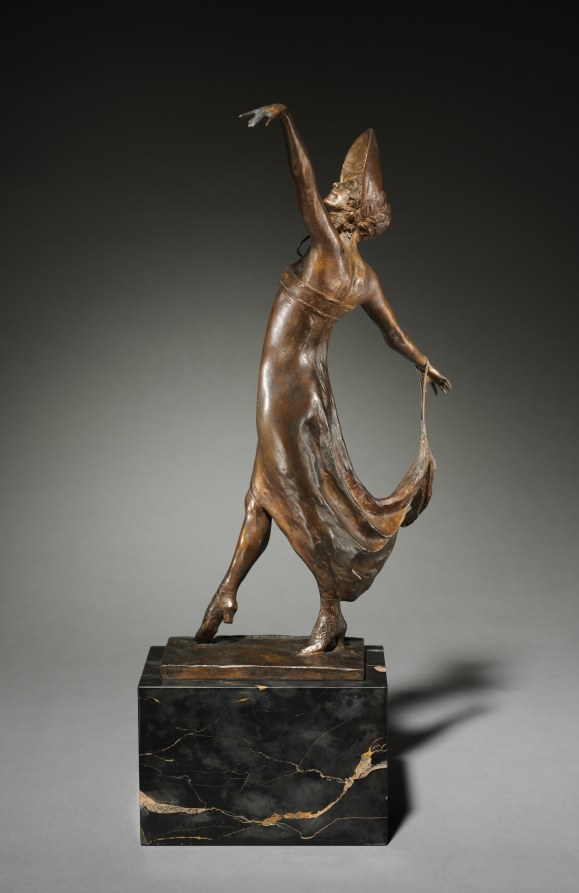
Pavlova Dancing the Gavotte
Malvina Hoffman (American, 1887–1966)
- Source:
- Cleveland Museum of Art
- Rights:
- Public domain — free to use, share and adapt.
- Recorded as:
- CC0 (Public Domain)
Pavlova was arguably the most influential dancer of the 20th century, and her image—including through sculpture—shaped how ballet was understood across Europe and America. Works of this kind are primary evidence for how the dance profession valued itself and how it wished to be represented in culture. The gavotte, resurrected and reinterpreted by ballet as a refined, ethereal solo, shows how historical dance forms were repurposed by modernity.
What you are looking at
A bronze sculpture of a single female figure cast in a dynamic, elongated pose stands on a black marble base. The dancer rises from a narrow stance on one leg, her torso twisted in an exaggerated S-curve that lifts her chest and extends her free arm upward in a graceful arc. Her head tips back slightly, crowned with an elaborate feathered or plumed headdress that adds considerable height to the composition. Her other arm extends downward, and fabric—likely representing a skirt or drapery—billows behind and below her in a sweeping curve that suggests rapid movement or a moment of suspension. The entire figure leans into the vertical axis with a balletic elegance, the musculature and articulation of the limbs carefully modeled to convey both strength and refinement. The warm patina of the bronze contrasts sharply with the cool black of the marble, and the sculpture is positioned to be read from multiple angles.
The dancing
The dancer stands in an asymmetrical, highly arched position with weight clearly on one pointed foot—suggesting balletic training. The raised arm reaches upward with an extended line from shoulder to fingertip, while the opposite arm trails downward. The torso is dramatically hyperextended backward, the head tilted to follow the line of the spine. The costume includes a substantial headdress and flowing skirt material, both integral to the sculpture's silhouette. This is a single figure captured mid-motion, not a partnered or group composition.
The dance depicted
The title indicates this depicts Anna Pavlova dancing the Gavotte, the Baroque court dance performed in characteristic early 20th-century theatrical style. Pavlova (1881–1931) was the most famous ballet dancer of her era, renowned for her lightness and expressive solo work. The gavotte, originally a moderate-paced French court dance, had been adapted into the ballet vocabulary by the Romantic and late 19th-century periods. This sculpture captures a moment of balletic interpretation rather than historically authentic gavotte steps—the extreme arch, the lifted port de bras, and the pointe work are all markers of classical ballet technique, not Baroque court practice. The garment and headdress suggest theatrical costume rather than historical dress.
How it was made
This is a bronze sculpture, cast from a three-dimensional model. The bronzed surface has developed a warm, mottled patina over time. The artist has achieved fine detail in the modeling of musculature, drapery, and facial features, suggesting professional foundry casting. The figure's elongated proportions and dynamic torsion indicate this was not cast from life but conceived as an idealized artistic interpretation. The marble base, a conventional choice for formal sculpture of this era, emphasizes the work's status as a studio or museum piece rather than an applied or decorative object. The technique allows for a fully volumetric work that reveals new aspects of the pose from different viewpoints.
About this work
This bronze sculpture preserves a moment of Pavlova's famous gavotte performance in three-dimensional form, capturing the balletic aesthetic of the early 20th-century stage. Pavlova was the dominant figure in dance culture during the first three decades of the century, and her influence extended beyond the theater into visual art—sculptors, painters, and photographers all sought to commemorate her distinctive style. The work belongs to the tradition of commemorative dance sculpture that flourished in the late 19th and early 20th centuries, when the rise of celebrity dance culture and the technical achievements of Romantic and classical ballet made dancers themselves worthy subjects for fine art. This piece documents not a historical dance form but the moment when ballet had become the defining expression of what 'dance' meant in European elite culture.
How to look at it
Notice the extreme backward arch of the torso and the way the headdress carries the vertical line even further upward, creating an almost impossible elongation of the spine. The weight of the figure rests on a single pointed foot, a balletic convention that became a shorthand for grace and ethereality. The drapery is carved to flow away from the body as if caught in the momentum of the movement, giving the static bronze a sense of suspended motion. The sculpture is designed to be read frontally—the dramatic profile of the arch and extended limbs—but also invites movement around its base to appreciate how the figure occupies three-dimensional space.
The period
Pavlova's career spanned the high point of Imperial Russian ballet in the early 1900s through her death in 1931. Her solo performances, particularly in short ballets like *The Dying Swan* (1905), created a template for the modern ballet soloist. The gavotte was one of several Baroque and early 18th-century dances that late 19th-century choreographers incorporated into the ballet repertory, often as vehicles for a lead dancer to display lyrical technique and ethereal presence. The early 20th century saw intense artistic interest in commemorating great performers, and sculpture—a traditionally male and monumental form—was increasingly used to honor women dancers. This work dates to a moment when dance was secure enough in its artistic status to warrant permanent public and museum representation.
Where it lives
This work is held in the Cleveland Museum of Art and was recorded in its dance-related collection. It is a formal museum object, likely acquired as a cultural artifact documenting the dance history of the early 20th century rather than as a contemporary commission.
Dance in this work
Questions about this work
Who was Anna Pavlova?
Pavlova (1881–1931) was a Russian prima ballerina of the Imperial Theatre in Saint Petersburg and the most celebrated dancer of the early 20th century. She was renowned for her technical perfection and emotional expressiveness, and became an international celebrity through tours of Europe and the Americas. She is most famous for the role of the Dying Swan in a short ballet choreographed for her by Michel Fokine in 1905.
What is the gavotte, and why would Pavlova dance it?
The gavotte was a moderate-paced French court dance of the 17th–18th centuries, typically danced by couples. By Pavlova's era, it had been absorbed into the ballet repertory as a character or 'national' dance, often performed as a short solo or duet. Choreographers valued it for its elegance and as a link to dance history, and Pavlova, being an outstanding classical technician, would have performed it as a vehicle to display her command of both historical style and modern balletic virtuosity.
Is this sculpture based on a photograph or a performance?
The sculpture is likely inspired by photographs and performances Pavlova gave, but it is an artistic interpretation rather than a direct record. The extreme arch and the idealized musculature suggest the sculptor aimed to capture the essence of Pavlova's style and the spirit of the dance, rather than to document a specific moment or pose.
More dance artwork