49 works in this view — arrow keys or swipe to move between them.
Dance in Art
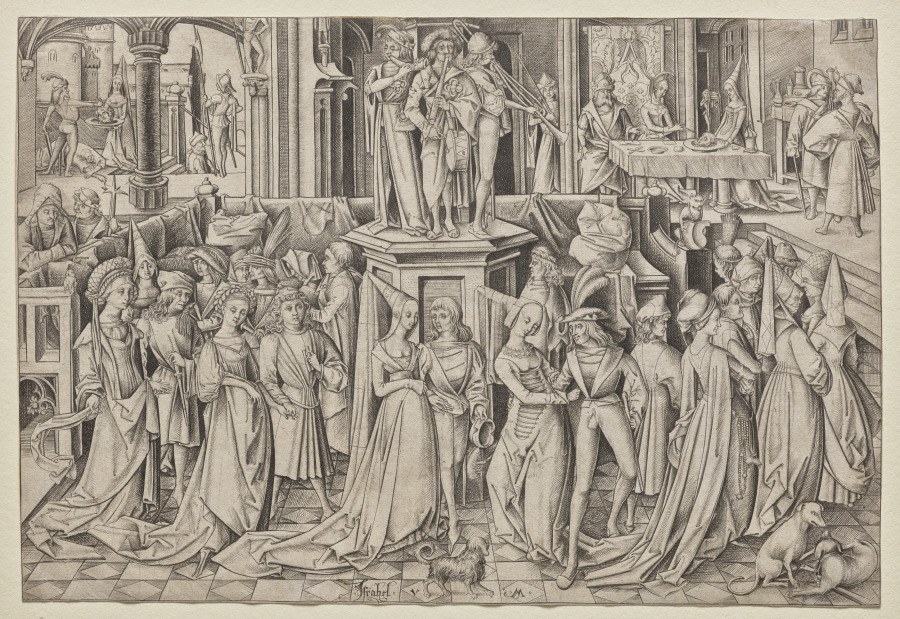
The Dance at the Court of Herod
Israhel van Meckenem (German, c. 1440–1503)
- Source:
- Cleveland Museum of Art
- Rights:
- Public domain — free to use, share and adapt.
- Recorded as:
- CC0 (Public Domain)
The work is valuable not as documentation of actual dance but as evidence of how Renaissance culture imagined dance within court ritual: as formal, processional, hierarchical, and inseparable from costume and spatial decorum. It shows that even a scene nominally about dance (Salome's performance for Herod) was rendered by the artist as a static pageant rather than captured movement—reflecting Renaissance values that privileged stillness, line, and aristocratic composure over kinetic energy or virtuosity.
What you are looking at
A densely populated court scene centered on a figure standing atop a classical pedestal, likely representing King Herod. The composition fills the entire picture plane with aristocratic figures in elaborate flowing robes and headdresses arranged in multiple spatial registers. In the foreground, a group of courtiers and attendants in rich fabrics clusters around the base of the pedestal; in the middle ground, the figures grow denser, creating a sense of theatrical depth. The background shows architectural arcades and interior spaces where additional scenes unfold—feasting, conversation, and formal business. The engraving employs the dense, intricate line work characteristic of Northern Renaissance printmaking, with figures overlapping and interweaving to create visual richness. The moment captured appears to be one of courtly pageantry: formal, hierarchical, and saturated with the rituals of aristocratic display.
The dancing
The standing figure on the pedestal commands the composition through verticality and elevation, a formal pose suited to judicial or ceremonial authority. Around this central figure, courtiers adopt varied postures: some stand in profile with arms gesturing in conversation, others face the viewer or turn inward toward the central figure. The bodies are elongated in the Renaissance manner, and several figures display the crossed-leg stance favored in courtly pose-work of the period—a marker of leisured sophistication. The women's voluminous skirts and the men's flowing robes create silhouettes that dominate the visual field; arms are frequently raised or extended, creating rhythmic lines that guide the eye through the composition. No closed partner holds are visible; instead, bodies orient toward social encounter and spectatorial arrangement.
The dance depicted
Despite the title's reference to Herod's dance, the image depicts a broader court pageantry rather than an active dance performance. The figure on the pedestal may represent Salome or her attendants in the moment before or after dance rather than in the act itself. The composition suggests the formal, processional movement of Renaissance court life—the slow, hierarchical circulation of courtiers in spaces of power. If dance is present, it would be the courtly, decorous movement style of Renaissance aristocratic ritual: measured, frontal, emphasizing line and decoration over dynamic action. The engraving preserves the visual record of how Renaissance Northern Europe imagined the legendary court of Herod—a projection of contemporary court culture backward onto a biblical narrative.
How it was made
This is an engraving, recognizable from the fine parallel hatching lines that build tone and shadow throughout the composition. The technique allowed extraordinary detail and intricate linear patterning, which the artist has exploited fully: every fold of fabric, every architectural element, every figure is rendered with equal specificity, creating a unified visual field of dense information. Engravings of this scale and complexity were expensive to produce and circulated to educated elites—collectors, scholars, courtiers—as prestige objects. The technique's black-and-white linearity works against the representation of movement; stillness and pattern dominate over action.
About this work
This engraving depicts a legendary biblical scene—the court of King Herod—reimagined as a Renaissance court pageant. The work is a dense composition of aristocratic figures in formal dress arranged around a central pedestal figure, rendered with the linear precision of Northern Renaissance printmaking. Rather than capturing active dance, it preserves an imagined moment of courtly ritual and hierarchical display, using the story of Herod as a frame for documenting Renaissance ideals of aristocratic bearing and spatial organization. The work belongs to a long tradition of biblical narrative engravings that doubled as records of contemporary court culture and costume—a mirror held up to the elite viewers who purchased them.
How to look at it
The viewer should attend to the layering and density: this is not a moment of action frozen mid-movement but a formal assembly arranged for viewing. Notice how the artist has organized the composition vertically, with the pedestal figure as apex and figures arranged in ranks and clusters below—a visual logic of hierarchy rather than narrative flow. The elaborate costume and architectural detail are not secondary decoration but primary content; they constitute the meaning of the scene. The absence of clear dynamic movement or dance action is itself significant: it reveals that for Renaissance printmakers and their audiences, court pageantry was legible as dance-like even when static.
The period
The work dates from the Northern Renaissance period (likely 16th century, based on style), when engraving had become the primary medium for distributing complex narrative scenes across Europe. Biblical stories were staple subjects for printmakers, particularly narratives involving spectacle and court drama. During this period, Renaissance court culture was codifying aristocratic movement into formal systems—the roots of what would become ballet. Herod's court as a subject allowed artists to blend biblical narrative with contemporary court imagery, creating a doubled temporal space where ancient legend and present aristocracy collapsed into each other.
Where it lives
The work is in the Cleveland Museum of Art and is catalogued as part of the museum's dance-related art collection. The museum source (cma) indicates it is likely accessible to researchers through the museum's collection database or physical archives.
Dance in this work
Questions about this work
Is this actually depicting Salome's dance for Herod?
The title references that narrative, but the engraving does not show active dance movement. Instead, it renders the court scene surrounding Herod as a formal pageant. The artist may have interpreted the biblical 'dance' as the aristocratic ritual and procession visible in the composition—a Renaissance understanding that collapsed courtly movement into the category of dance.
Why is there so much detail of costume and architecture?
For Renaissance collectors and courtiers, these details were the point. Engravings of this kind functioned as visual manuals of aristocratic fashion, bearing, and spatial decorum. They were aspirational objects that documented how the elite should dress, move, and arrange themselves in hierarchical space.
Who is the artist?
The artist is unknown according to the catalogue record. The style and technique suggest Northern Renaissance printmaking tradition, likely 16th century, but a specific attribution cannot be established from the image alone.
More dance artwork