49 works in this view — arrow keys or swipe to move between them.
Dance in Art
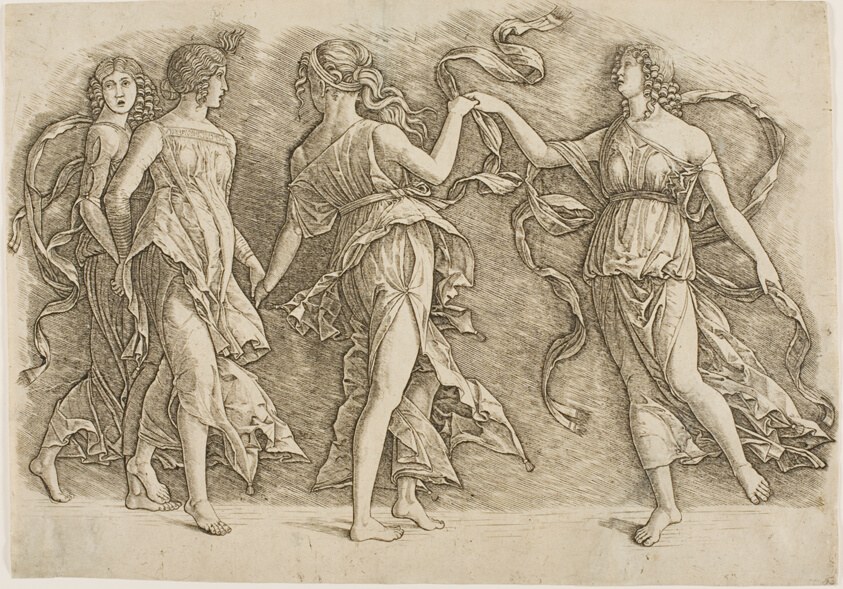
Four Women Dancing
Andrea Mantegna
- Source:
- Art Institute of Chicago
- Rights:
- Public domain — free to use, share and adapt.
- Recorded as:
- CC0 (Public Domain)
This work is a rare early modern document of Renaissance or early Baroque court dance at a moment when dance was being systematized, taught, and represented in art and print. For historians, it offers visual evidence of posture, spacing, and costume in courtly movement. For dancers, it demonstrates how Renaissance artists understood the body in motion—the emphasis on the upper torso, the open arm positions, and the elongated proportions that would define courtly movement for generations.
What you are looking at
Five figures in classical drapery are arranged across the composition in a frieze-like procession. The work is a pen-and-ink engraving rendered in fine parallel hatching, a technique that creates tonal depth and sculptural weight. Three figures occupy the left and center—two women in flowing garments facing left, one of them winged (likely Cupid or a putto), and a standing figure in the center with arms raised. Two more women, similarly draped, occupy the right side of the composition. The figures move with graceful, elongated limbs and balletic posture. The setting is minimal; the ground line is barely indicated, and there is no architectural or landscape detail. Light is suggested through the engraver's careful control of line density, creating highlights on the bodies and shadows in the folds of fabric. The composition suggests a moment of social interaction—perhaps a gathering of nymphs or allegorical figures—rather than a narrative climax.
The dancing
The bodies are arranged in a gentle S-curve across the page. The central standing figure has both arms raised in an open, welcoming gesture, weight appearing equally distributed. The figure second from left raises one hand toward her face in a gesture of attention or surprise. The leftmost winged figure leans forward with one leg extended, suggesting movement toward the group. The rightmost figure turns her body away while looking back over her shoulder, her drapery caught in an elegant spiral. All five figures maintain the elongated proportions and refined posture characteristic of Renaissance and early baroque aesthetic. The spacing between them suggests formal spacing rather than intimate grouping—they are arranged as if for a dance or procession, each occupying distinct space.
The dance depicted
This appears to depict a Renaissance or early Baroque social dance or allegorical dance scene, most likely an interpretation of court dance. The composition and costume suggest the tradition of ballet de cour or masque dancing, in which aristocratic figures performed choreographed movement in formal procession or geometric formation. The graceful, upright carriage and the emphasis on arm gestures align with the aesthetic of Renaissance dance, where upper-body dignity and hand positions carried meaning. However, without inscription, the specific dance cannot be named with certainty. The winged figure and allegorical drapery suggest this may depict a mythological or court entertainment rather than a peasant or folk tradition.
How it was made
This is a fine engraving executed in pen and ink, recognizable by the parallel hatching lines that build tone and volume across the figures and drapery. The technique required skilled hand work and careful planning, as corrections are impossible once the plate is incised. The delicate line work and the refinement of the composition suggest this was intended for a cultivated audience—likely a print for collectors, scholars, or courtly patrons. Engravings of this type circulated widely in the sixteenth and seventeenth centuries, serving both as independent artworks and as illustrations in printed books on courtly conduct, dance instruction, or classical mythology.
About this work
This engraving depicts five classically draped figures in an elegant, formalized grouping that reads as either a court dance, an allegorical procession, or a scene from a Renaissance entertainment. The composition, technique, and costume all point to the sixteenth or early seventeenth century—an era when dance was central to courtly life and frequently represented in prints and manuscripts. The work belongs in a gallery of dance in art because it documents how dance was conceptualized and staged at the early modern court: as a formal, geometric, allegorical practice in which the body's carriage and the grace of movement expressed social status and refinement.
The engraving demonstrates the Renaissance understanding of dance as a visual art form worthy of artistic representation. The careful attention to drapery, posture, and spatial arrangement shows that the artist understood dance as a discipline requiring training and grace. Such prints circulated among aristocratic and educated audiences, serving as both records of actual performances and as aspirational models for how the body should move in courtly space.
How to look at it
Attend to the positioning of the hands and arms, which carry the weight of expression in Renaissance dance. Notice how the central figure's raised arms frame the composition, and how each figure's gesture—from the leftmost figure's forward lean to the rightmost figure's backward glance—creates a sense of sequential movement rather than static pose. The engraver has frozen the moment at a point of gentle transition, where the group appears about to shift into new formation. The careful use of drapery, with fabric caught mid-movement, conveys the dynamism that line work alone cannot achieve.
The period
This work dates to the sixteenth or early seventeenth century, an era when dance was central to European courtly culture. The Renaissance and early Baroque courts sponsored elaborate entertainments in which dance played a key role—most notably the ballet de cour in France and the masque in England. At the same time, dance was being systematized through written instruction: texts like Thoinot Arbeau's *Orchésographie* (1588) and later sources documented dance steps and etiquette. Artists of this period frequently depicted dance, both in manuscript illuminations and in prints, often presenting it as an allegorical or mythological scene rather than as a literal record. The composition of this work—with its frieze-like arrangement and classical drapery—reflects this convention of elevating dance to the status of a classical or allegorical subject.
Where it lives
The work is held by the Art Institute of Chicago. It is catalogued as a work of unknown date and artist, and is classified as a print from the collection.
Dance in this work
Questions about this work
What dance is being shown here?
The specific dance cannot be identified with certainty from the image alone. However, the composition, costume, and posture all suggest Renaissance or early Baroque court dance—likely a moment from a ballet de cour, masque, or formal courtly procession. The allegorical drapery and winged figure suggest this depicts an entertainment or mythological scene rather than a practical dance manual.
Who made this engraving?
The artist is not recorded in the catalogue. The style and technique suggest a skilled hand trained in Renaissance printmaking, but without a signature or other identifying mark visible in the image, attribution would require further research into archives or scholarly literature.
How do I know this is an engraving and not a drawing?
The parallel hatching lines, the even pressure of the line, and the high degree of finish all indicate this is an engraving—a print made from an incised metal plate—rather than a drawing in pen or chalk. Engravings can be reproduced and distributed in multiple copies, which made them important vehicles for spreading knowledge of courtly practices across Europe.
What period does this depict?
The work itself likely dates to the sixteenth or early seventeenth century, based on style and technique. It may depict dances and costumes from that same era, or it may look backward to classical or Renaissance sources. The flowing drapery and classical posture reference ancient Greek and Roman art, a convention common in courtly art of this period.
More dance artwork