40 works in this view — arrow keys or swipe to move between them.
Dance in Art
American Ballet Theatre Ballet Evening
Unknown artist
- Dance:
- Ballet
- Rights:
- Not recorded. Do not assume this image is free to reuse — check the source record.
This photograph documents the American Ballet Theatre at a moment when it was consolidating its artistic identity and international reputation. It shows how classical ballet was staged, framed, and marketed to audiences in the mid-twentieth century—the emphasis on the prima ballerina, the formal ensemble support, and the dramatic lighting all reflect the values and aesthetic priorities of the period. For historians of dance and photography, it offers evidence of how professional dance companies created visual records of their work.
What you are looking at
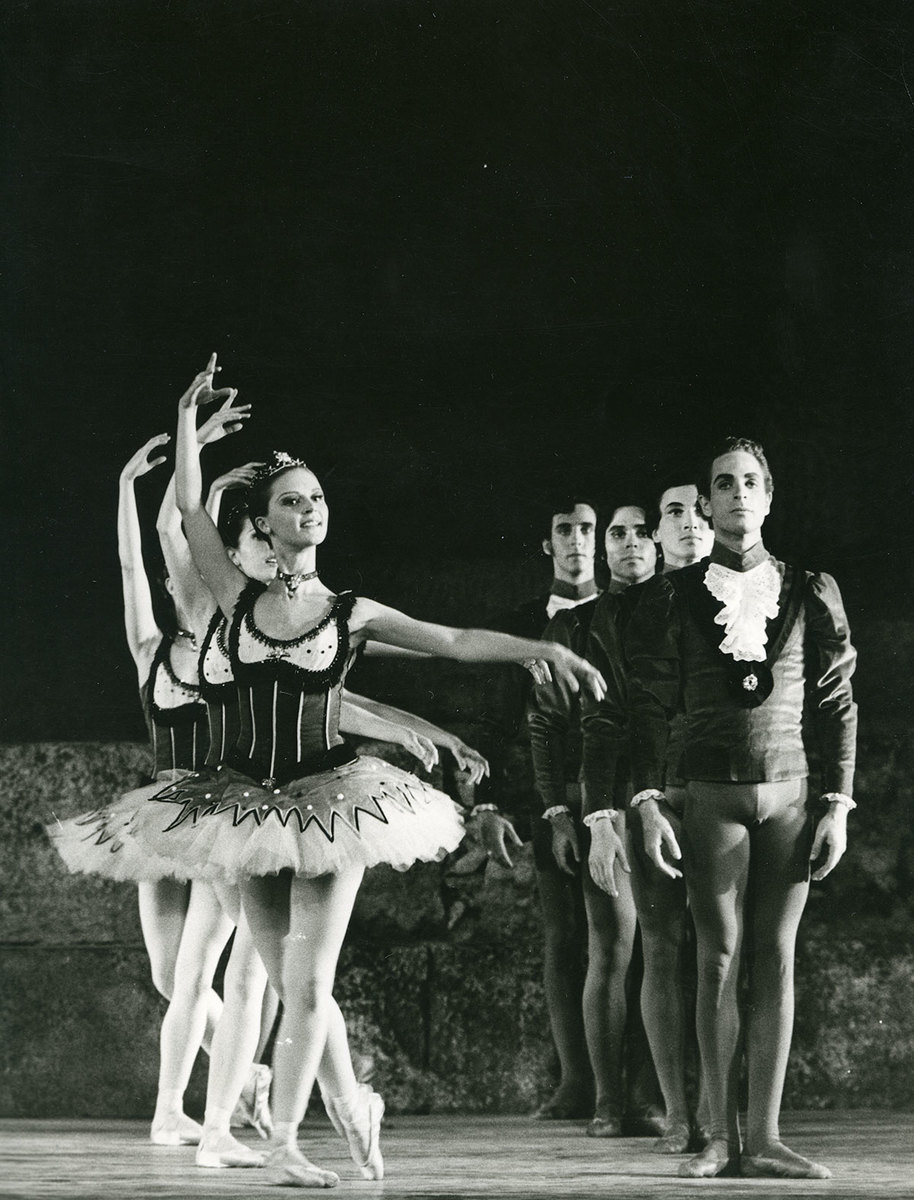
A black-and-white photograph captures a formal ballet performance on stage. In the foreground, a female dancer in a classical tutu and pointe shoes executes a pose with one leg raised and both arms lifted in an expressive arc. She wears a dark bodice with decorative details and a white tulle skirt with a spiky or saw-tooth decorative trim at the hem. Behind her stands a line of five male dancers in dark jackets with white shirt fronts, arranged in a formal tableau. The stage is lit dramatically against a dark background, creating strong contrasts that emphasize the dancers' positions. The composition suggests a crucial narrative moment in a classical ballet—the central female figure commands attention while the corps of men frame and support the scene.
The dancing
The prima ballerina occupies the visual center, poised on one supporting leg in a position suggesting sustained elegance—likely an arabesque or attitude. Her upper body displays the characteristic lifted port de bras of classical ballet, with forearms raised and fingers extended in a refined, expressive gesture. The male dancers stand in a disciplined line, their posture upright and formal, creating a stark visual contrast with the female dancer's fluid, curved frame. The spatial relationship—the woman as focal point with men in supporting formation—follows the classical ballet convention where the ballerina is the primary artistic object.
The dance depicted
This is clearly classical ballet, likely from the mid-twentieth century. The photograph documents what appears to be American Ballet Theatre, as titled. The tutu style, the decorative trim treatment, and the formal corps arrangement suggest a Romantic or early twentieth-century revival ballet—possibly a work like *Swan Lake*, *Giselle*, or *Les Sylphides*, where a soloist female dancer is sustained by male ensemble support. The dramatic lighting and posed moment indicate a climactic or thematically significant instant from a narrative ballet, frozen for documentation or publicity.
How it was made
This is a professional black-and-white photograph, likely taken for archival or publicity purposes during a live performance or photocall. The dramatic studio lighting and sharp focus suggest it was taken in controlled conditions rather than during an actual performance, possibly a studio documentation session or dress rehearsal photography. The photograph's formal composition and publication quality indicate it was distributed as promotional material or archive documentation, typical of American Ballet Theatre's mid-twentieth-century practice of generating performance photographs for critics, archives, and the public record.
About this work
This photograph documents American Ballet Theatre during its mid-twentieth-century artistic period. The image captures the classical ballet aesthetic of the era: the idealized female form on pointe, the supporting male ensemble, and the formal dramatic staging conventions inherited from nineteenth-century Romantic ballet. The photograph is not merely a record but a composed image—the lighting, framing, and moment chosen all serve the propaganda of ballet itself, presenting the form as refined, organized, and visually hierarchical.
The work belongs in a dance gallery because it shows not just what classical ballet looked like at a particular moment but how ballet was presented to the public: as an art form centered on the sublime female dancer, supported by an ordered and disciplined corps. It is also significant as a photographic artifact of American Ballet Theatre's formative decades, when the company was establishing itself as a custodian of classical repertory and a vehicle for major ballerinas.
How to look at it
Observe the composition: the photograph is arranged as a visual hierarchy, with the female dancer's lifted, expansive pose dominating the frame while the men form a static, supporting structure behind her. Notice the specific moment chosen—not a turn or a jump, but a held, expressive position that emphasizes line and form. The lighting isolates the ballerina from the background and emphasizes the contours of her body and the geometry of her pose. The saw-tooth trim on the tutu catches the light and adds visual interest. Pay attention to the formal, almost heraldic quality of the composition: this is not a candid moment of performance, but a composed image designed to present ballet as an art of refined visual order.
The artist
The photographer is unrecorded in the catalogue. The photograph bears the style and technical quality of mid-twentieth-century theatrical dance photography, suggesting it was taken by a professional house photographer or hired dance photographer during an ABT production or documentation session. Such photographs were typically created under studio conditions or during rehearsal rather than mid-performance, allowing for the controlled composition and lighting visible here.
The period
This photograph dates from American Ballet Theatre's period of artistic consolidation, likely the 1940s–1950s. At this time, ABT was establishing itself as a major American company through its revival of nineteenth-century classical ballets and commissioning of new works from major choreographers. The photograph reflects the mid-century aesthetic of ballet promotion: the emphasis on physical perfection, technical display, and the visual spectacle of the tutu and pointe work. Postwar American culture was investing heavily in ballet as a marker of cultural refinement, and photographs like this served both as archival records and as promotional images in a wider cultural campaign to establish ballet as a legitimate American art form.
Where it lives
The photograph is held in the Europeana digital collection. It is documented as an artwork from American Ballet Theatre, though specific production, date, and original photographer remain unrecorded in the catalogue. The photograph's professional quality and formal composition suggest it was generated as institutional documentation or publicity material.
Dance in this work
Questions about this work
What ballet is this from?
The catalogue record does not identify the specific ballet. The costume style, ensemble arrangement, and the title 'American Ballet Theatre Ballet Evening' suggest it could be from a classical Romantic ballet such as *Swan Lake* or *Giselle*, or from a twentieth-century revival work in that idiom. Without additional information, the specific production cannot be determined from the image alone.
Who is the ballerina?
The catalogue record does not identify the dancer. The photograph was created as a documentation or publicity image of American Ballet Theatre, but the specific performer is not recorded.
When was this taken?
The catalogue record lists the date as unknown. The style of the photograph, the tutu design, the male costume, and the formal composition suggest a date in the mid-twentieth century, likely 1940s–1950s, during American Ballet Theatre's formative decades.
Why does the tutu have a spiky trim?
The decorative saw-tooth or spiky trim at the hem of the tutu is a visual and tactile embellishment common in classical ballet costumes. It adds visual interest during movement, catches stage lighting, and gives the tutu a distinctive silhouette. The trim may also indicate a specific production or choreographer's aesthetic preference.
More Ballet artwork