36 works in this view — arrow keys or swipe to move between them.
Dance in Art
Bolshoi Ballet Ballet Evening
Unknown artist
- Dance:
- Ballet
- Rights:
- Not recorded. Do not assume this image is free to reuse — check the source record.
The photograph documents Bolshoi Ballet theatrical practice at a moment when the company was still developing its distinctive approach to dramatic ballet, blending classical technique with expansive narrative storytelling. It preserves evidence of male dancer performance that goes beyond pure classical virtuosity, showing the kind of character work and dramatic physicality that shaped 20th-century ballet. The image is also historically important as a primary record of a specific production that is likely not otherwise well-documented.
What you are looking at
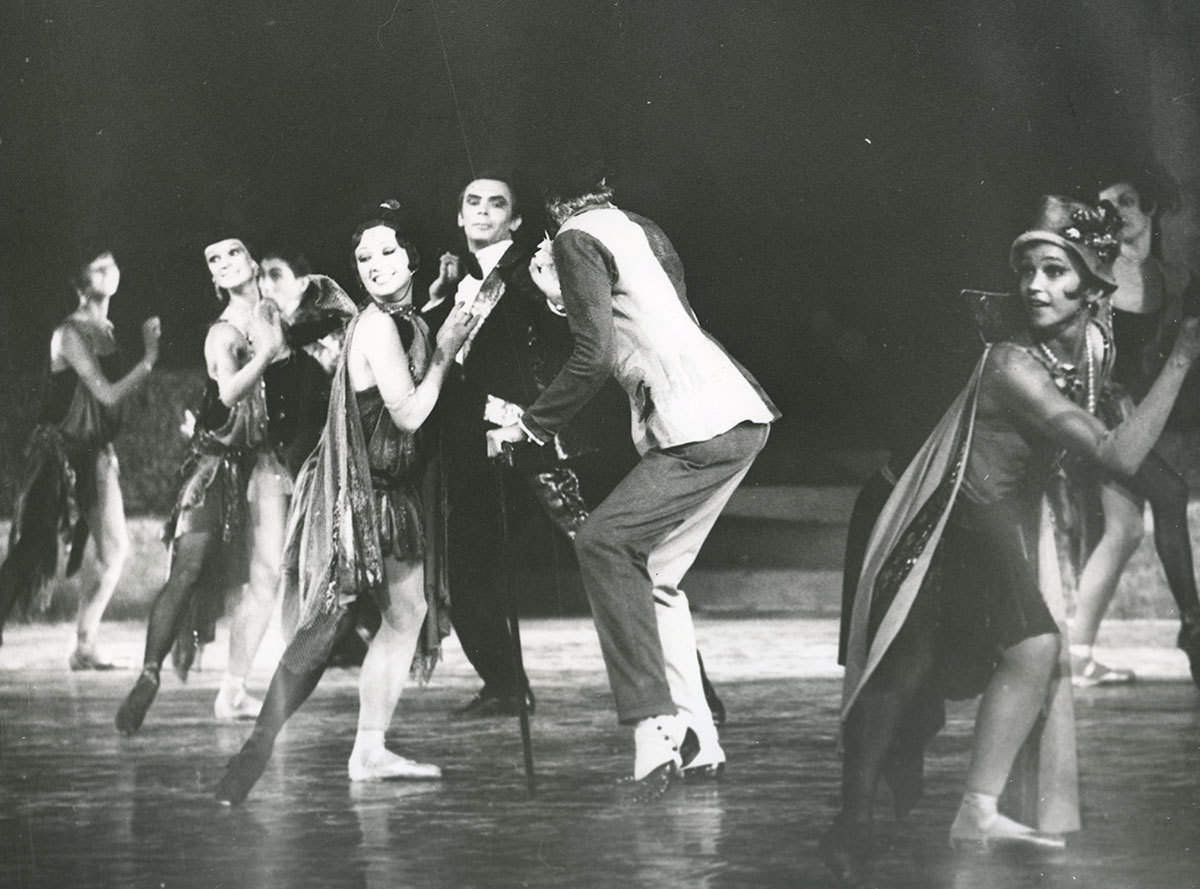
A theatrical stage scene dominated by a single male dancer in the center, bent forward in a dramatic pose with his torso nearly horizontal, one leg extended behind him, arms raised. He wears formal evening dress—dark jacket and trousers with a white shirt and what appears to be a headpiece or crown. He is surrounded by a ensemble of female dancers in various states of motion, arranged loosely across the stage in a semi-theatrical composition. The women wear a mixture of costumes suggesting exoticism or fantasy: draped fabrics, some bare-limbed, with ornamental headdresses and jewelry. Several are caught mid-movement with raised arms or twisted torsos. The stage is lit from above against a dark background, creating strong contrast. The photograph is black and white and appears to have been taken during performance or dress rehearsal, capturing the theatrical energy and spatial relationships of the dancers rather than a single frozen moment.
The dancing
The male dancer dominates spatially through his extreme forward fold and horizontal extension, creating a striking silhouette. His posture suggests either a character moment—perhaps collapse, supplication, or dramatic transformation—rather than academic ballet technique. The surrounding female dancers occupy the stage in varied positions: some with arms aloft, some in profile, creating a sense of surrounding action or ensemble response. The women's positioning and varied arm gestures do not suggest a formal corps de ballet in uniform alignment, but rather a looser, more theatrical grouping. No visible pointe work or closed ballroom holds; the framing is broadly theatrical rather than technically precise.
The dance depicted
The extreme physical vocabulary and theatrical composition suggest this is from a theatrical ballet production, likely a dramatic or character-driven piece rather than pure classical technique. The male dancer's deep forward fold and the ensemble's expressive, varied positioning recall Romantic ballet conventions, where male dancers often adopted dramatic, sometimes grotesque or exaggerated poses. The exotic costuming and loose ensemble arrangement suggest a narrative ballet set in a fantastical realm—possibly a harem scene, supernatural encounter, or other theatrical scenario. The Bolshoi Ballet in the 20th century was known for dramatic productions that blended classical technique with theatrical storytelling.
How it was made
This is a black-and-white photograph, almost certainly taken during a stage performance or dress rehearsal under theatrical lighting. The image quality and aesthetic suggest early-to-mid 20th century photography. The photographer has captured movement and theatrical composition rather than posed stillness, evident in the varied positions and slightly soft focus of some figures. The theatrical lighting creates sharp contrasts between figures and background, emphasizing the compositional arrangement across the stage plane rather than depth.
About this work
This photograph documents a moment from a Bolshoi Ballet theatrical production, capturing a dramatic ensemble scene with a male dancer in a striking forward-folded position surrounded by costumed female dancers. The image records a now-lost or poorly documented performance, preserving evidence of the Bolshoi's approach to narrative ballet and theatrical spectacle in the 20th century. The composition and costuming suggest a fantastical or exotic setting, the kind of ambitious theatrical production for which the Bolshoi became known internationally. The photograph is valuable precisely because it shows dancers in the act of performing, on stage, under real conditions—not posed or reconstructed.
How to look at it
Observe the male dancer's extreme physical commitment to the pose—the forward fold is not a controlled classical line but a dramatic gesture of intensity or abandon, suggesting character and narrative rather than pure technique. Note how the female dancers' positions and arm gestures vary rather than align, a choice that creates visual excitement and ensemble energy rather than formal precision. The theatrical lighting from above creates a stage picture meant to be read from the audience's viewpoint, emphasizing composition and dramatic grouping. The photographer has chosen a moment of high energy and visual complexity, capturing the theatrical impact of the scene rather than a moment of stillness.
The period
This photograph likely dates to the 1920s–1940s, a period of significant innovation at the Bolshoi Ballet. The Soviet era brought new emphasis on narrative, realism, and dramatic character work, moving away from some Romantic-era conventions while retaining classical vocabulary. The exotic or fantastical costuming visible here reflects the continued influence of Diaghilev's Ballets Russes, whose productions had captivated Moscow and inspired ambitious theatrical ambition. Male dancers in this era were expected to master both pure classical technique and dramatic character work, a shift from 19th-century practice.
Where it lives
The photograph is held in the Europeana digital collection, which aggregates cultural heritage materials from European institutions. No catalogue record details the original holding institution, photographer, or archival accession number. The bare title 'Bolshoi Ballet Ballet Evening' suggests the original documentation was minimal.
Dance in this work
Questions about this work
When was this photograph taken?
The catalogue record does not provide a date. The photographic style, costume design, and lighting suggest early-to-mid 20th century, likely 1920s–1940s based on the Bolshoi's aesthetic during that period. Without institutional documentation it cannot be dated more precisely.
What production is this from?
The catalogue record provides only the generic title 'Bolshoi Ballet Ballet Evening.' The exotic costumes and dramatic male role suggest a narrative ballet with a fantastical setting, but the specific production cannot be identified without additional archival information.
Why is the male dancer in such an extreme pose?
The deep forward fold with extended leg suggests a moment of dramatic character work rather than classical technique—possibly a moment of transformation, emotional climax, or character expression within the narrative. Soviet-era Bolshoi productions often demanded that male dancers move beyond pure technique into expressive, sometimes grotesque dramatic physicality.
Are these dancers in a closed hold or ballroom hold?
No. The dancers are spatially separated across the stage, not partnered in a closed hold. This is theatrical ballet composition, not ballroom dance.
More Ballet artwork