34 works in this view — arrow keys or swipe to move between them.
Dance in Art
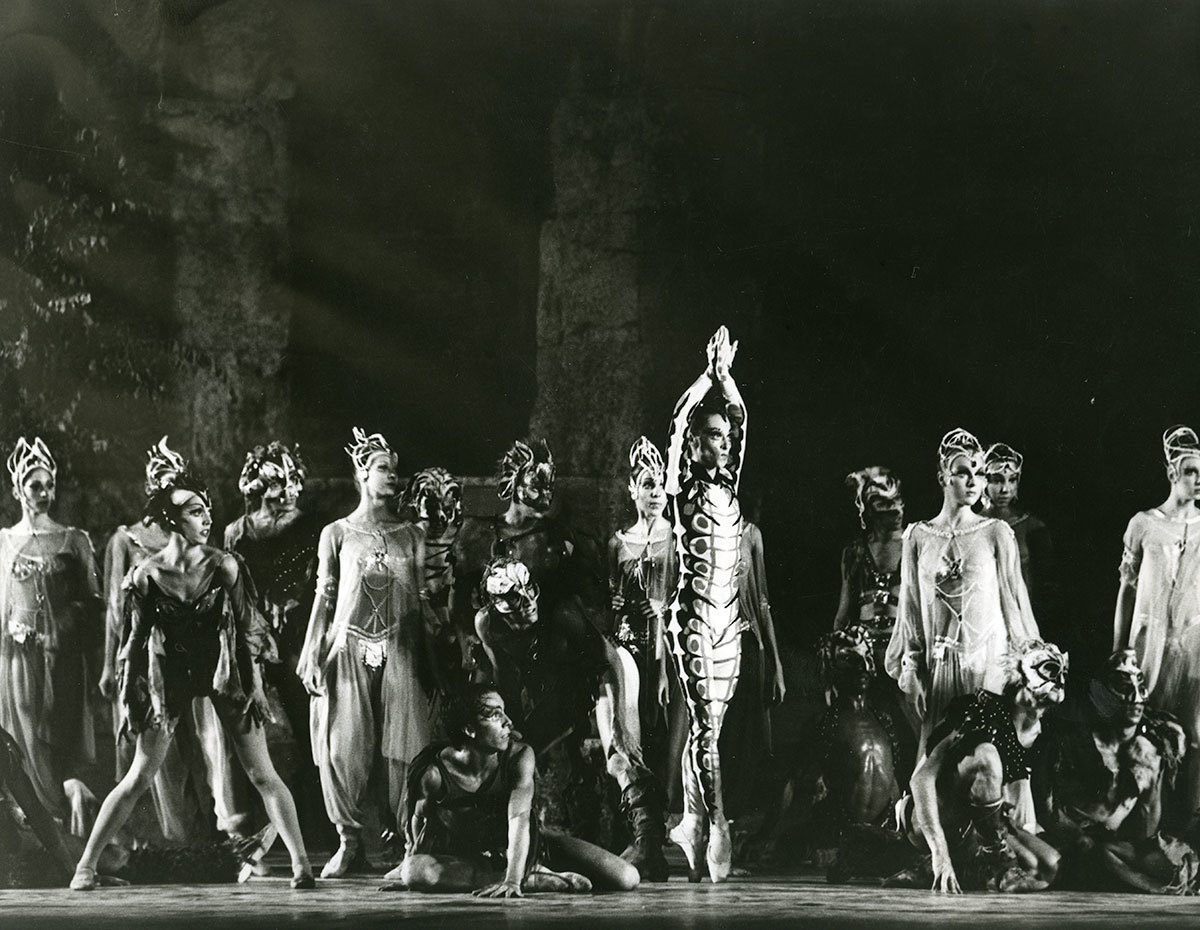
Harkness Ballet Ballet Evening
Unknown artist
- Dance:
- Ballet
- Rights:
- Not recorded. Do not assume this image is free to reuse — check the source record.
This image exemplifies the grammar of classical ballet spectacle in the twentieth century—how the form organized dancers in space to communicate hierarchy, narrative, and aesthetic value. For dancers and choreographers, it documents a moment in the evolution of neoclassical ballet staging practices, showing how Balanchine-influenced choreography adapted the formal imperial tradition for modern audiences and modern theatres.
What you are looking at
A formal ballet ensemble fills the stage in a carefully composed tableau. A central figure in ornate armor and an elaborate plumed headdress stands with arms raised in triumph, commanding the attention of two symmetrical groups arranged to either side. The stage is lit dramatically against a dark background, creating sharp contrasts that emphasize the architectural scale of the set—tall columns or pylons rise behind the dancers, suggesting an ancient or exotic location. The supporting dancers wear flowing light-colored gowns with decorative details and tall crowns or tiaras; several crouching or kneeling figures in darker costumes occupy the foreground. The composition is strictly hierarchical: the central hero dominates, the chorus is arranged in stable, parallel lines, and the lighting isolates the key figures from the background.
The dancing
The central male dancer stands in a commanding pose with both arms raised overhead in a V-shape, suggesting a moment of victory or apotheosis. His upper body is erect and his posture displays the formal, turned-out carriage of classical ballet. The corps de ballet around him maintains strict alignment and formal stance; the female dancers stand with upright posture, their bodies composed in the fifth position or in formal, quiet contrapposto. The kneeling or crouching figures in the foreground frame the composition and may represent subjects or supplicants, creating visual depth and narrative context. The entire ensemble demonstrates the formal vocabulary of early-to-mid twentieth-century neoclassical ballet staging.
The dance depicted
This is a scene from a classical or neoclassical ballet, most likely staged in the mid-twentieth century. The hierarchical staging, the martial or mythological costume of the central figure, the columned architectural setting, and the formal ensemble arrangement suggest a work in the tradition of Sergei Diaghilev's Ballets Russes or the neoclassical ballets of George Balanchine. The Harkness Ballet (founded 1964) was known for performing both classical and contemporary works, and this image may document a production from that company's repertoire, though the specific ballet cannot be identified with certainty from the photograph alone. The staging prioritizes visual spectacle and symmetrical group choreography over intimate narrative, consistent with neoclassical or imperial ballet aesthetics.
How it was made
This is a black-and-white photograph, likely taken during a live performance or dress rehearsal. The photographic medium captures the moment as it occurred on stage, preserving the lighting design, spatial relationships, and composition as the audience would have witnessed them. The photograph shows the technical skill of theatrical photography in isolating the stage picture against darkness and maintaining sharp focus across multiple planes of figures. The absence of color and the grainy quality suggest this is a professional documentation photograph from the 1960s or early 1970s, the era of the Harkness Ballet's most active period.
About this work
This photograph documents a moment from a classical ballet production, capturing the formal visual language of mid-twentieth-century neoclassical ballet staging. The work privileges spectacle, geometric composition, and hierarchical arrangement of the ensemble—visual strategies inherited from imperial Russian ballet and refined by the modernist choreographers of the Ballets Russes. The image shows how ballet in this period constructed meaning through costume, lighting, and the precise placement of bodies in space, with the narrative or emotional content conveyed through the formal relationships of the dancers rather than through intimate mimesis. The photograph is a record of how ballet audiences encountered these works: as carefully composed tableaux unfolding under theatrical light.
How to look at it
Attend to the frozen moment in the central figure's pose: the raised arms and upright torso capture a moment of stillness or apotheosis rather than dynamic motion. Notice how the photographer has composed the frame to emphasize the symmetry and hierarchy of the stage picture—the dark background isolates the dancers, and the framing lines (the columns, the orderly rows of the ensemble) all draw the eye toward the center. The costume and makeup are theatrical and heavily stylized; this is not an attempt at realism but rather a formal visual language where the body becomes part of a composed design. The kneeling figures in the foreground complicate this formal arrangement and introduce narrative or dramatic meaning—they suggest a story of triumph, supplication, or mythological encounter beneath the abstract geometry.
The period
The Harkness Ballet (1964–1997) was founded by the patron Rebekah Harkness as a vehicle for contemporary and classical dance. In the 1960s and early 1970s, the company performed a repertoire that included works by established choreographers (Jerome Robbins, George Balanchine) and commissions from younger artists. This photograph likely dates to that era. At the time, classical ballet was undergoing revision: while traditional Russian and European companies maintained the imperial repertoire, American companies like Harkness and New York City Ballet were introducing faster tempos, more geometric compositions, and a cooler aesthetic. This image sits within that transformation—formal and ceremonial, but with the clean geometry of modernism rather than the ornamental density of earlier twentieth-century spectacle.
Where it lives
The image is held in the Europeana digital collection, a federated European repository of cultural heritage. The catalogue record lists it as from the Harkness Ballet, indicating it was part of that company's documentation, though the specific performance, choreographer, and production details are not recorded in the available metadata.
Dance in this work
Questions about this work
What ballet is this from?
The catalogue record does not identify the specific ballet. The costume, setting, and staging suggest a neoclassical work, possibly from the Balanchine tradition, but without additional documentation or notation, the work cannot be named with certainty.
Who are the dancers?
The photograph does not identify individual dancers. It was taken during a Harkness Ballet production, likely in the 1960s or early 1970s, but the archive does not record the cast.
Why is the stage so dark?
The dark background is a deliberate choice in theatrical lighting design. It isolates the dancers and the set from the auditorium, focusing the audience's attention on the lit stage picture. This creates visual drama and allows the choreography and costume to read clearly from a distance.
What is the armor for?
The ornate costume suggests the central figure is a warrior, hero, or deity—a character requiring visual authority and formal dignity. The armor and plumed headdress are theatrical conventions for representing power, and the formal ballet vocabulary (upright posture, turned-out legs, precise position) formalizes and abstracts that power into an aesthetic statement.
More Ballet artwork