33 works in this view — arrow keys or swipe to move between them.
Dance in Art
Kremlin Ballet and Bolshoi Ballet Academy Ballet Evening 1
Unknown artist
- Dance:
- Ballet
- Rights:
- Not recorded. Do not assume this image is free to reuse — check the source record.
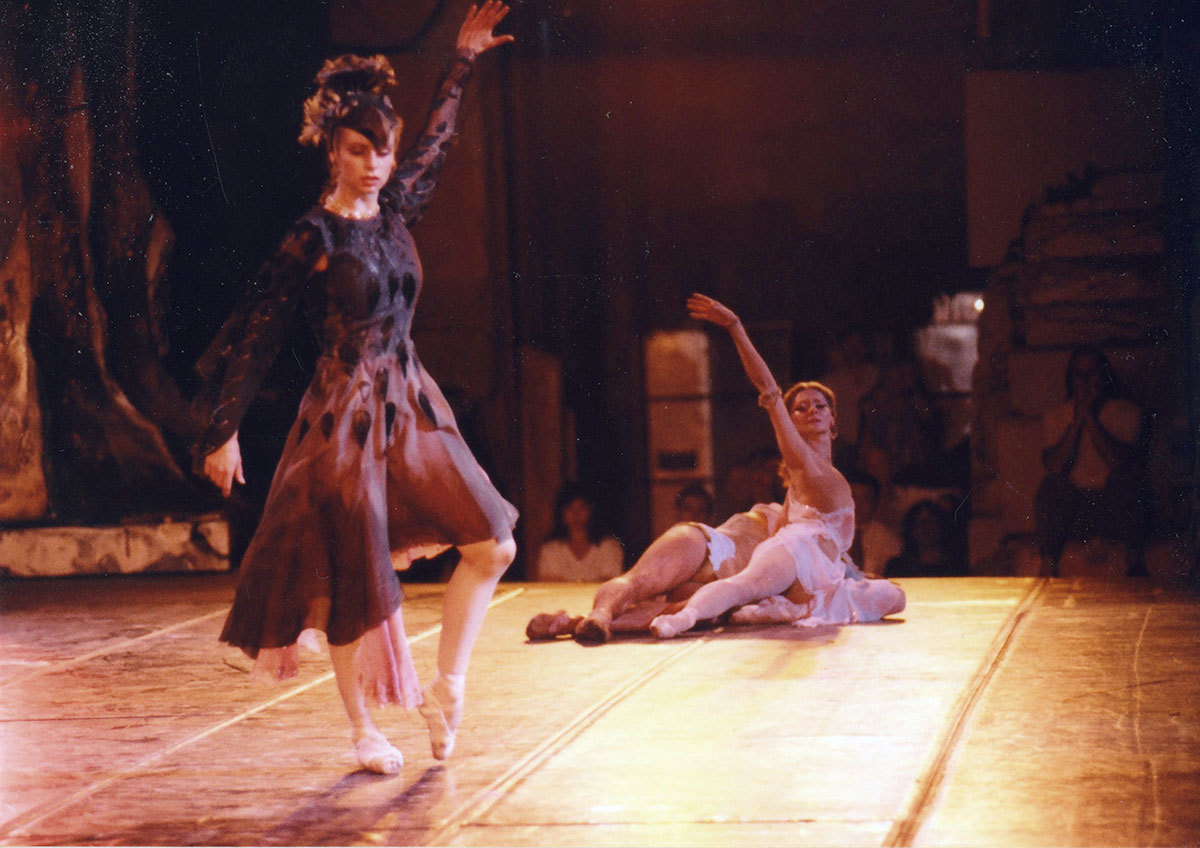
This photograph documents the Bolshoi and Kremlin Ballet Academy at a moment when Soviet ballet was a global artistic force, and it shows the integration of performance with pedagogy—the presence of students alongside a trained soloist in a single staged work. For historians and dancers, it is evidence of how classical ballet was transmitted and performed within the Soviet institutional system, and it captures the aesthetic and physical values of that tradition in motion.
What you are looking at
A theatrical ballet scene lit in warm amber and purple tones, photographed from the audience perspective. In the foreground, a soloist in a dark costume with long sleeves stands on pointe en attitude, one arm raised in classical port de bras, commanding the stage. She wears her hair up in a period style. Behind her, two younger dancers in pale pink practice clothes lie or recline on the wooden stage floor, their bodies in extended positions suggesting they are executing floor work or a choreographed fall sequence. The stage is a polished wooden floor marked by geometric divisions. Audience members are visible in soft focus in the background, watching from the wings or house. The lighting is theatrical and warm, with strong shadows defining the depth of the stage space.
The dancing
The lead dancer demonstrates a controlled classical position—standing en pointe with engaged turnout, her body framed in the upright carriage of academic ballet. Her raised arm shows the rounded port de bras typical of classical training. The two younger dancers display balletic extension and control even in horizontal positions on the floor, their legs stretched and bodies composed rather than collapsed. The spatial relationship suggests a hierarchy common in ballet: a soloist center stage with supporting dancers positioned lower or behind.
The dance depicted
This is a classical ballet scene, likely from a rehearsal or performance of a Bolshoi or Kremlin Ballet Academy production, as the catalogue suggests. The imagery captures a moment that blends instruction and performance—the younger dancers may be students, given the academy reference in the title, while the lead dancer executes a solo variation. The warm, golden stage lighting and formal arrangement suggest a finished piece rather than a working rehearsal. The inclusion of floor work and the classical vocabulary place this within the Vaganova or similar Soviet ballet training system.
How it was made
This is a color transparency or color film photograph, likely a 35mm slide or similar theatrical documentation format from the mid-to-late 20th century. The warm color cast, slight grain, and photographic quality suggest it was shot under theatrical stage lighting, which is characteristic of how Soviet and Eastern European ballet companies documented their performances and training in the 1960s–1980s. The photograph captures the live moment in real time, preserving details of staging, costume, and lighting that would have been lost in other media.
About this work
A documentary photograph of a classical ballet scene from a Kremlin Ballet or Bolshoi Academy production, capturing a moment in which a soloist performs a classical variation while younger dancers execute floor work behind her. The image is a rare record of Soviet ballet pedagogy and performance at an institutional level, showing both the technical refinement of the lead dancer and the training of younger dancers within a single choreographed moment. It belongs in a gallery of dance imagery because it preserves both the kinetic and theatrical reality of ballet training and performance in a specific cultural and historical context.
How to look at it
Attend to the contrast between the stillness and control of the lead dancer and the extended vulnerability of the younger dancers on the floor—this spatial and physical arrangement tells a story about hierarchy and instruction within ballet. Notice the precise geometry of the stage floor and how the bodies are positioned within it; Soviet ballet pedagogy was meticulous about spatial placement and alignment. The warm stage lighting is not incidental—it creates a psychological intimacy despite the formality of the poses, suggesting that even a technical display carries emotional content.
The artist
The photographer is not recorded. The work appears to be institutional documentation, likely created by a staff photographer or theater photographer employed by the Kremlin Ballet or Bolshoi Ballet Academy. Such photographs were typically made for archival, promotional, or pedagogical purposes and were not always credited or widely circulated.
The period
This photograph dates from an era when color photography of theater was becoming more feasible but was still costly and relatively rare. Soviet ballet was at its international zenith in the mid-20th century, and institutional documentation of rehearsals and performances was part of the systematic training and archival practices of the Bolshoi and state academies. The staging, costumes, and lighting reflect the neoclassical and romantic ballet aesthetics that dominated Soviet repertoire in this period.
Where it lives
The image is held in the Europeana digital collection, which aggregates cultural heritage materials from European institutions. It is catalogued as part of documentation of the Kremlin Ballet and Bolshoi Ballet Academy, but the specific holding institution, accession number, and original date are not recorded in the available metadata.
Dance in this work
Questions about this work
Is this a rehearsal or a performance?
The theatrical lighting, the presence of an audience visible in the background, and the formal staging suggest this is a performance or a formal rehearsal filmed as a performance. The inclusion of younger dancers executing floor work as part of the choreography indicates this is a designed moment in a finished piece, not a working session.
Why are the younger dancers on the floor?
In Soviet ballet pedagogy, floor work and ensemble work were integrated into formal training and performance. The younger dancers may be students of the academy performing as part of an ensemble or a pedagogical piece designed to show multiple levels of training within a single work.
What ballet technique is being shown?
This is classical ballet in the Vaganova tradition, which was the standard method of the Bolshoi and Kremlin Ballet Academy. The lead dancer's carriage, turnout, and port de bras are characteristic of this system, and the floor work follows similar principles of extension and control.
More Ballet artwork