31 works in this view — arrow keys or swipe to move between them.
Dance in Art
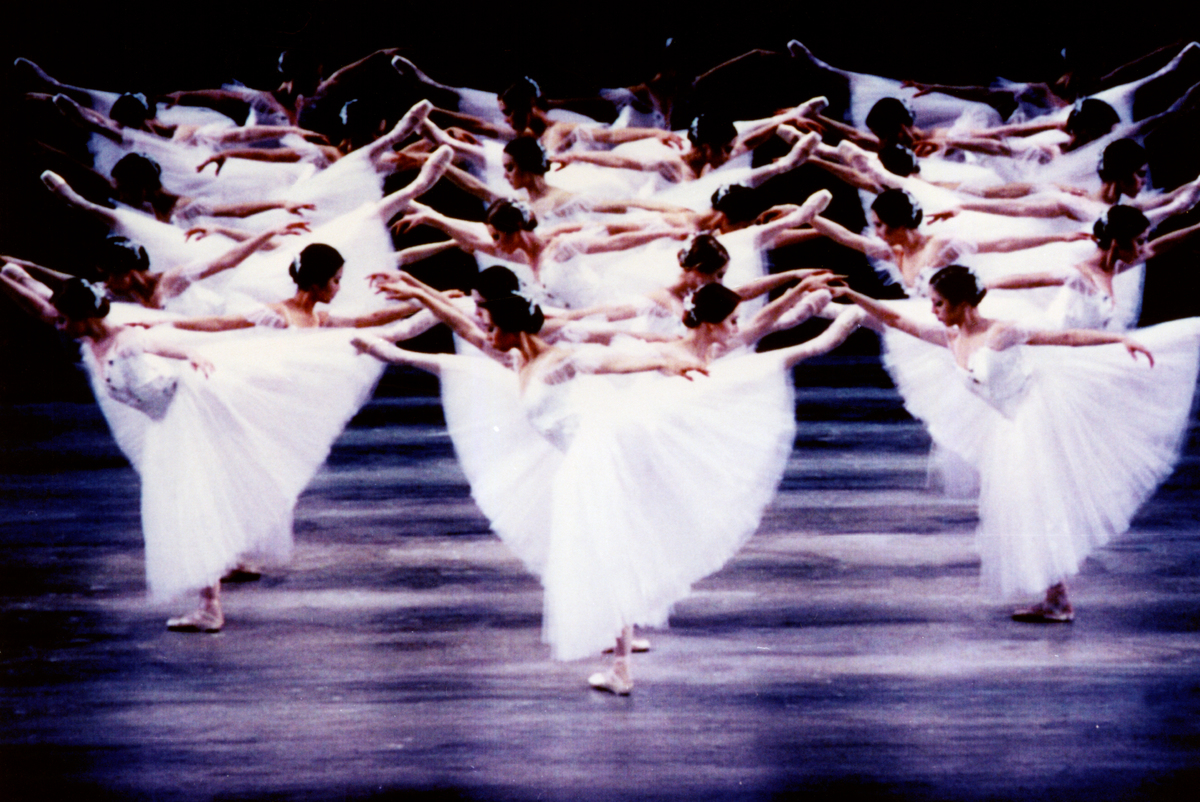
San Fransisco Ballet Ballet Evening
Unknown artist
- Dance:
- Ballet
- Rights:
- Not recorded. Do not assume this image is free to reuse — check the source record.
This photograph documents the visual and kinetic vocabulary of mid-twentieth-century professional ballet—the corps de ballet formation as a tool for creating abstract, geometric beauty. For dancers, it exemplifies the demanding unison work that defines classical ballet ensemble training. For historians, it captures a moment in the evolution of ballet as a visual and theatrical art form, when large corps work and synchronized patterning were central to major company aesthetics.
What you are looking at
A large ensemble of ballet dancers in white tutus and pointe shoes performs in synchronized formation across a darkened stage, lit by strong overhead and sidelighting that casts their bodies in sharp relief against the black background. The dancers are arranged in multiple rows receding into depth, creating a visual rhythm of repeated silhouettes. Each dancer holds an identical pose with one arm extended to the side and the other bent, their bodies angled in a coordinated arabesque or attitude line. The lighting is theatrical, with a cool blue-purple wash suggesting stage gels typical of mid-twentieth-century ballet production. The composition emphasizes geometric precision and the corps de ballet's disciplined unity—a hallmark of Neoclassical ballet spectacle. The dancers' pale skin and white costumes glow luminously against the void, creating an ethereal, almost abstract quality despite the literal representation of bodies in motion.
The dancing
All visible dancers hold nearly identical arm and leg positions, suggesting a corps de ballet phrase rather than solo work. The primary visible position shows one arm extended laterally at shoulder height with a bent or curved carriage, while the supporting leg is straight and the working leg appears to be raised behind or to the side in an extended line. The dancers stand en pointe, their silhouettes clean and elongated. The repetition across many dancers indicates this is a moment of unison work, demonstrating the classical ballet principle of matched positions and synchronized spacing. The scale of the ensemble—at least 20-30 dancers visible—and the uniformity of costume and pose are consistent with a major ballet company's production.
The dance depicted
This is almost certainly a scene from a twentieth-century Neoclassical or Classical ballet, most likely a corps de ballet passage or ensemble number. The synchronized formation, white tutus, and emphasis on geometric patterning are hallmarks of mid-century ballet spectacle, particularly the type popularized by George Balanchine and the New York City Ballet, though similar formations appear in other major company repertories. The specific pose—extended arm and raised leg in unison—appears to be a moment from a signature ensemble sequence, possibly a passage from a classic like *Swan Lake*, *The Nutcracker*, or another full-length ballet. The lighting and photographic style suggest a documentation of a live performance rather than a staged photograph, likely from a 1960s or 1970s professional production.
How it was made
This is a color photograph, likely a transparency or slide, of a live stage performance. The photographic capture of stage lighting and the slight graininess suggest professional theatrical documentation photography, possibly shot with high-speed film to capture movement under stage lights. The color palette—vivid whites and blues with deep blacks—shows the color fidelity of mid-century color photography. This type of performance documentation was made by professional photographers hired by dance companies for archival, promotional, and publication purposes. The fact that it was preserved in a digital collection (Europeana) suggests it was originally held by a major institution or performing arts archive.
About this work
This is a documentation photograph of a corps de ballet ensemble at full scale, capturing a moment of synchronized classical ballet movement from a professional twentieth-century production. The work is a record of live performance practice, showing how a major ballet company deployed its ensemble dancers in unison formations—a central technique of Neoclassical choreography. The image documents both the aesthetic (the visual harmony of repeated bodies in identical poses) and the technical demand (the precision required to achieve such unity across many dancers). For dance historians and practitioners, it is primary evidence of mid-century ballet production values, ensemble training, and the repertory practices of professional ballet companies during the era of Balanchine's dominance and the international spread of American ballet technique.
How to look at it
Attend to the geometric precision of the formation: notice how the dancers' bodies create a visual grid receding into the depth of the stage, and how every line from shoulder to extended arm to raised leg mirrors the others. Look at the quality of light—how the cool stage gels make the white tutus luminous while erasing surface detail, rendering the dancers' bodies as pure line and form. Observe the moment captured: this is likely a held position or a moment of stillness within a phrase, not peak movement, which allows the photographer to register the pose with clarity. This compositional choice—freezing unison work in a moment of perfect alignment—was itself a convention of mid-century ballet documentation and marketing.
The artist
The photographer is unrecorded in the catalogue. The image comes from Europeana, a digital aggregation of European cultural collections. Professional theatrical photography of this era was typically commissioned by dance companies and carried out by staff photographers or hired specialists; individual attribution is often lost in archive transfers.
The period
This photograph dates to the era of Neoclassical ballet's international dominance, roughly 1960s–1970s, when the vocabulary and values of George Balanchine and the New York City Ballet were reshaping ballet worldwide. Large, unified corps passages were a signature feature of this choreographic language, valued for their visual abstraction and their emphasis on technique over narrative. The photograph's color fidelity and the style of stage lighting reflect mid-century theatrical technology and aesthetic priorities. San Francisco Ballet, mentioned in the title, was one of the major American ballet companies engaged with this modern classical vocabulary during this period.
Where it lives
The image is held in Europeana, a digital aggregation of European cultural collections, and is identified as part of a San Francisco Ballet performance. The original source institution is not specified in the available record. It is a professional performance documentation photograph, likely archived by the ballet company or by a performing arts institution.
Dance in this work
Questions about this work
What ballet is this from?
The catalogue record does not specify a work title, only identifying it as a 'San Francisco Ballet Ballet Evening.' The photograph may document a passage from a full-length classical ballet (such as *Swan Lake* or *The Nutcracker*) or from a Neoclassical ensemble work. Without additional documentation, the specific ballet cannot be determined from the image alone.
When was this taken?
The record lists the date as unknown. The photographic style, color technology, stage lighting, and costume aesthetic are consistent with the 1960s–1970s, but the image could be from as early as the 1950s or as late as the 1980s. A more precise date would require archival research in San Francisco Ballet's records.
Why do all the dancers look the same?
This is a corps de ballet, the ensemble of a ballet company trained to move in unison. The identical costumes, poses, and spacing are intentional: they create a visual pattern or abstract design on stage. The dancers' individual identities are submerged into the collective body, which is a defining feature of classical and Neoclassical ballet aesthetics.
What is the lighting technique here?
The dancers are lit with a strong overhead and sidelighting (likely ellipsoidal instruments with blue or cool-toned gels), which casts them in sharp relief against a black stage void. This creates maximum visibility of line and form while emphasizing the abstract, almost sculptural quality of the ensemble. The technique is typical of mid-century ballet lighting design.
More Ballet artwork