29 works in this view — arrow keys or swipe to move between them.
Dance in Art
Royal Opera Ballet, Stockholm Ballet
Unknown artist
- Dance:
- Ballet
- Rights:
- Not recorded. Do not assume this image is free to reuse — check the source record.
For ballet historians and dancers, this image documents both the technical vocabulary of classical ballet and the partnership conventions that defined the form. The photograph captures not just a step but a relationship—the way male and female bodies were trained to work together in the classical tradition, and the specific aesthetic standard of the mid-century European ballet world. For those studying the Royal Swedish Ballet specifically, it provides direct evidence of the company's repertory and training methods during this period.
What you are looking at
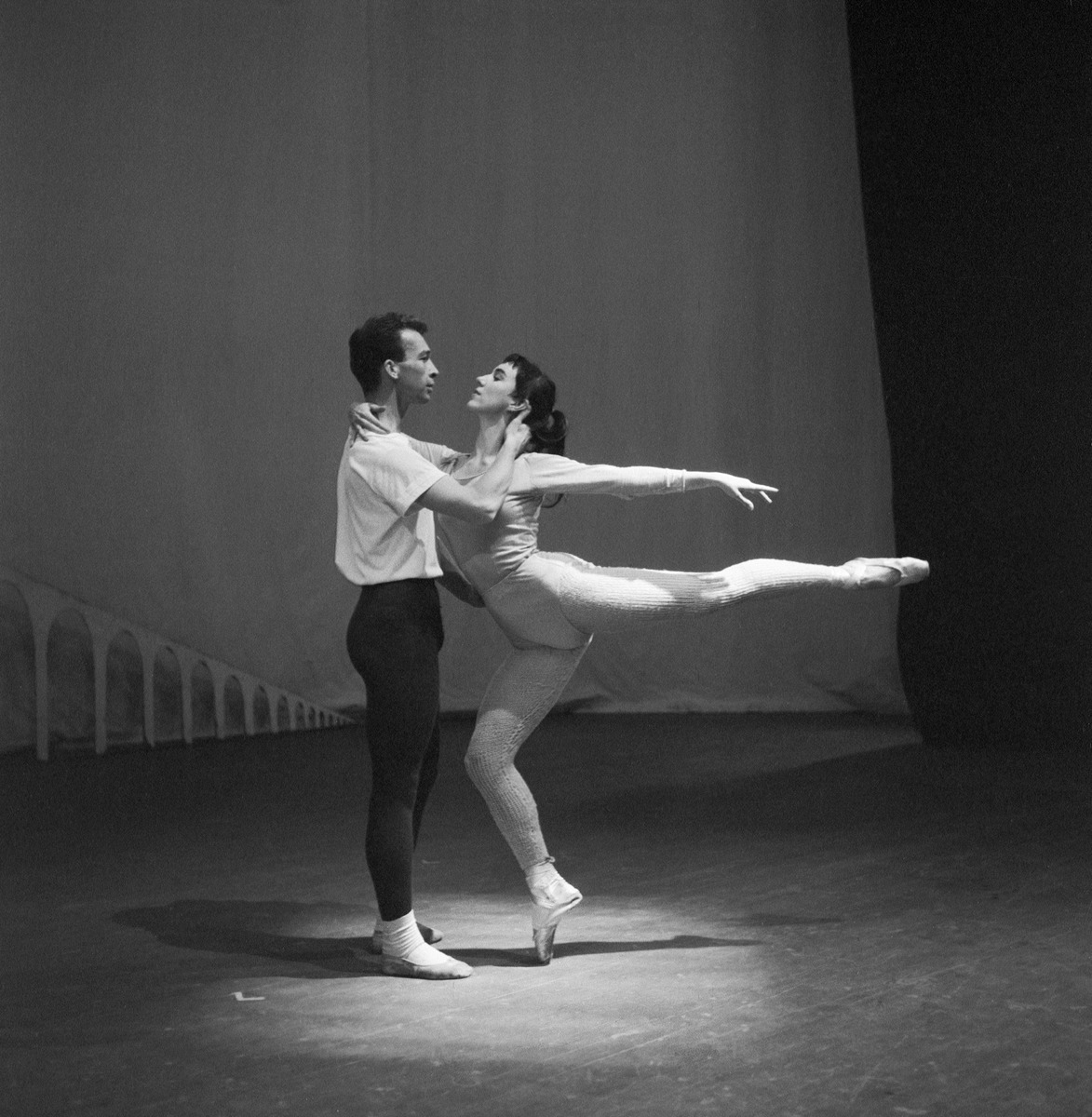
A male and female dancer perform together on a stage lit by warm spotlight against a dark background. The male dancer, dressed in a white shirt and dark trousers, supports the female dancer who is in an extended arabesque position on pointe. She wears a fitted light-colored leotard with long legs extended in a high, controlled line. The composition is minimal and austere—bare stage, no sets or props—which emphasizes the dancers' bodies and the technical precision of the movement. The female dancer's gaze is lifted, her posture aristocratic and controlled. The male dancer's arms frame her body with practiced confidence, his weight grounded and stable. The image is black and white photography, high-contrast and sharply focused, with strong theatrical lighting that creates defined shadows and isolates the pair against the void of the stage.
The dancing
The male dancer stands in a stable supporting position, his left arm extended to support the female dancer's back while his right arm reaches forward, creating an open frame. The female dancer balances on her right pointe foot in a full arabesque, her left leg extended high behind her body in a straight, elongated line; her arms are positioned in classical ballet carriage—one arm extended forward in line with her body, the other held in second position. The line from her extended leg through her upper body is continuous and unbroken, demonstrating classical training. The physical relationship between them is one of partnership and trust, with the male dancer providing stable support while the female dancer executes a technically demanding balance.
The dance depicted
This is almost certainly a scene from classical ballet, most likely from a Romantic or Neoclassical work in the repertory of the Royal Swedish Ballet or another major European company of the mid-20th century. The arabesque is one of the fundamental positions in classical ballet vocabulary, and the adagio partnership shown here—a supported balance in an extended position—is characteristic of the slow movement sections in classical pas de deux. The technical standard visible here (the height of the arabesque, the control, the classical carriage) and the theatrical presentation suggest this is from a major work in the classical repertory, possibly *Swan Lake*, *The Nutcracker*, or another 19th-century classic. The Stockholm Ballet notation in the catalogue record indicates this is a company record, likely from a production or study documentation.
How it was made
This is a black and white photograph, likely taken during a live performance or dress rehearsal. The high contrast and sharp focus suggest professional theatrical photography, possibly using flash or studio lighting to freeze the movement sharply against the dark stage background. The composition—framed tightly on the dancers with minimal stage visible—is typical of mid-20th-century dance photography designed for documentation or publication. The technical quality and deliberate framing suggest this was taken by a professional photographer with access to the company, which was common practice for European state ballet companies in the 1950s–1960s.
About this work
This photograph documents a moment of classical ballet partnership at the Royal Swedish Ballet, capturing the essential grammar of the classical pas de deux—a male dancer supporting a female dancer in an extended, controlled balance. The arabesque arabesque, one of ballet's core positions, is executed here with the technical precision and aesthetic refinement that defined mid-20th-century European classical training. The photograph's stark theatrical setting and professional execution make it a valuable record of how this fundamental ballet vocabulary was performed and presented during the modern classical period.
How to look at it
Attend to the line created by the female dancer's body—from her supporting foot through her extended leg and into her upper back and head. This unbroken line is the central aesthetic goal of classical ballet and is what gives the arabesque its characteristic elegance. Notice how the male dancer's support allows this line to exist; his stability is invisible but essential. The moment chosen is one of suspension—not a movement in transition but a held balance—which is typical of photography's relationship to dance: the camera freezes what would otherwise be a moment in a flowing sequence. The theatrical lighting, which isolates the dancers from the darkness beyond, is characteristic of mid-century ballet staging and makes the bodies the sole focus of attention.
The artist
The photographer is not recorded in the available catalogue information. However, the professional quality and theatrical documentation style suggest this was taken by a staff or freelance photographer working with the Royal Swedish Ballet, a major European company with strong documentation practices. The image is part of a larger photographic record of the company's productions and personnel.
The period
This photograph dates from the era when classical ballet was the dominant form of theatrical dance in Europe, and when the national ballet companies of major capitals—including Stockholm—maintained extensive archives of their productions through professional photography. The mid-20th century saw intense interest in standardizing and documenting classical technique, partly through photographs and film. The Royal Swedish Ballet, with roots in the 18th-century court and continuous operation through the 20th century, maintained strong classical traditions influenced by both the Italian Cecchetti method and Russian Imperial school methods. The theatrical lighting and stage presentation visible here reflect post-war European ballet standards.
Where it lives
This photograph is held in the Europeana digital collection and is attributed to the Royal Swedish Ballet (also known as the Stockholm Ballet). It is catalogued as a theatrical archive photograph documenting the company's repertory and personnel, though the specific production, date, and photographer are not recorded in the available metadata.
Dance in this work
Questions about this work
What is an arabesque?
An arabesque is a classical ballet position in which the dancer stands on one leg (usually en pointe for women) and extends the other leg behind the body in a straight line, typically at or above hip height. The arm carriage varies depending on the classical school and the specific choreography, but the extended line of the body is the defining feature. It is one of the fundamental positions in ballet vocabulary and appears in almost every work in the classical repertory.
What is the role of the male dancer in a classical pas de deux?
In classical ballet partnership, the male dancer provides physical support, stability, and frame for the female dancer, allowing her to execute extended movements and balances that would be difficult or impossible alone. He also performs his own choreography and demonstrates his own technical skill. The relationship is choreographed and requires years of training to execute safely and convincingly. The male dancer is not merely a support but an equal partner in the dance, though the aesthetic focus traditionally rests on the female dancer's line and extension.
What was the Royal Swedish Ballet?
The Royal Swedish Ballet (Kungliga Svenska Baletten) is one of Europe's oldest continuously operating ballet companies, with roots in the 18th-century Swedish court. It maintained the classical ballet tradition through the 20th century and remains active today. The company has historically focused on the classical repertory, particularly works of the 19th-century romantic and classical periods, though it has also commissioned new work. It is an important institution in Scandinavian dance history.
More Ballet artwork