28 works in this view — arrow keys or swipe to move between them.
Dance in Art
Royal Opera Ballet, Stockholm Ballet (2)
Unknown artist
- Dance:
- Ballet
- Rights:
- Not recorded. Do not assume this image is free to reuse — check the source record.
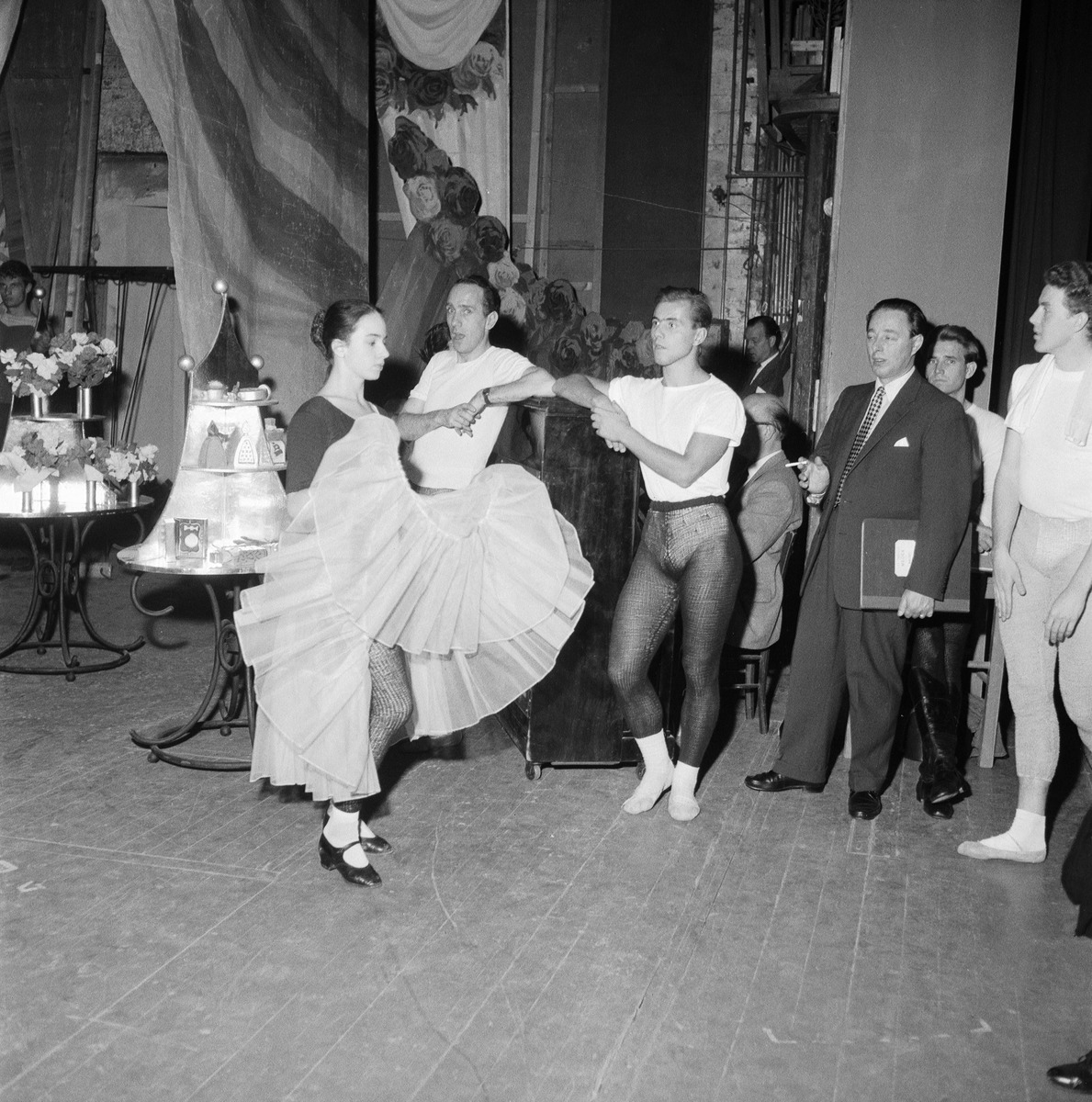
This photograph shows ballet not as finished performance but as a moment of work, observation, and instruction—the rehearsal as a site where choreography, technique, and human relationship are negotiated. For historians, it documents the practice and infrastructure of mid-twentieth-century European ballet; for dancers, it preserves a moment of the arabesque and the corps in service to the soloist.
What you are looking at
A black-and-white photograph captures a ballet rehearsal or performance in progress. At the center, a female dancer in a pale tutu and dark leotard performs an arabesque or similar extension, one leg raised high behind her, her body angled forward in classical line. Around her stand several male dancers in white t-shirts and tights, and a group of suited observers—directors, choreographers, or company officials—positioned at the edges of the studio floor. The setting appears to be a theatrical stage or large rehearsal space with draped fabric visible in the upper background and what appears to be scenic elements or décor. Flowers in a vase sit on a small table to the left. The composition is theatrical and formal, capturing a moment of intense focus on the soloist while the supporting male dancers attend to or frame her movement.
The dancing
The principal dancer demonstrates a high, controlled arabesque with excellent turnout and extension, her supporting arm in classical port de bras position. Her spine is aligned and extended, her working leg straight and lifted. The male dancers surrounding her are shirtless or in minimal dress, suggesting they are either in rehearsal costume or performing in a modernist idiom. Their posture is attentive rather than dancing; they appear to be spotting or supporting the principal's phrase. The gathered men in suits maintain formal distance, suggesting this is a professional observation or coaching moment rather than an unstructured rehearsal.
The dance depicted
This is classical ballet, most likely rehearsal photography from a professional ballet company. The title suggests this is the Royal Opera Ballet or Stockholm Ballet (or both companies in collaboration), placing it in mid-twentieth-century European classical dance. The arabesque and the framing of the principal female dancer suggest Romantic or Neoclassical repertoire. The presence of male dancers in such proximity and the semi-formal dress suggest this may be from a work with a modern or experimental aesthetic sensibility, or a rehearsal moment for a classical work in which the staging or costume has been simplified. The photograph documents both the physical vocabulary of the dance and the social hierarchy of a professional ballet rehearsal—principal, corps, and direction.
How it was made
This is a black-and-white gelatin silver print, a documentary photograph likely taken during a rehearsal or performance. The sharpness and composition suggest a professional photographer working in a theatrical setting. The quality of the print and the care taken in framing indicate this was a formal record, possibly for a company archive or press. The medium allowed documentary capture of movement and rehearsal process in ways painting or drawing could not, and implies circulation within professional theatre networks and possibly in dance publications of the period.
About this work
This photograph documents a moment from a mid-twentieth-century European ballet company's rehearsal or performance, capturing the classical vocabulary and professional structure of mid-century ballet. The image preserves both the aesthetic of the dance—the precision of the arabesque, the classical line—and the social reality of that dance world: the hierarchy between principal, corps, and direction, the gendered division of labour, the formality of observation. It is a record of what ballet looked like and how it was made in this period and place.
How to look at it
Attend to the quality of the arabesque: the height of the leg, the alignment of the spine, the control of the supporting arm. Note the moment captured—not a travelling step or a turn, but a sustained extension, suggesting the photographer or director valued the classical line above the illusion of movement. Observe the male dancers' stillness and attention: they are not dancing but witnessing or supporting, a rehearsal protocol that tells you about the hierarchy of the piece. The formal observers at the margin indicate this is a professional and documented moment, not a casual rehearsal.
The period
This photograph was taken during the mid-twentieth century, when classical ballet was being revived and reformulated across Europe after the disruptions of world war. The Stockholm Ballet and the Royal Opera Ballet (likely the Royal Swedish Opera) were major institutions in Nordic dance at this time. The aesthetic visible here—the emphasis on classical line, the presence of a formal direction watching rehearsal—reflects the institutional professionalism and classical conservatism that dominated European ballet in the 1950s and early 1960s. The inclusion of male dancers in close proximity to the principal, and their semi-formal dress, may suggest the influence of modernist choreography beginning to inflect classical companies.
Where it lives
The photograph is held in the Europeana digital collection, a European aggregator of digitised cultural heritage. This suggests it originates from a museum, archive, or cultural institution in Europe, but the specific holding institution is not recorded in the catalogue.
Dance in this work
Questions about this work
Is this a performance or a rehearsal?
The composition and the presence of formal observers—men in suits positioned at a distance—strongly suggest this is a rehearsal moment being documented, possibly one of significant artistic importance. The simplified male costume and the focused attention on the principal's body rather than on spectacle support a reading as a professional rehearsal photographed for the record.
What ballet is this from?
The catalogue record does not identify a specific work. The title indicates the Royal Opera Ballet or Stockholm Ballet, but does not name the choreography or music. The classical arabesque and the formal rehearsal setting suggest a work in the classical or Neoclassical repertoire, but without further documentation, the specific ballet cannot be determined.
When was this photograph taken?
The catalogue record gives the date as unknown. The style of the photograph, the dress of the observers, and the aesthetic of the dance suggest the 1950s or early 1960s, but this cannot be confirmed from the image alone.
More Ballet artwork