25 works in this view — arrow keys or swipe to move between them.
Dance in Art
Royal Opera Ballet, Stockholm Ballet (5)
Unknown artist
- Dance:
- Ballet
- Rights:
- Not recorded. Do not assume this image is free to reuse — check the source record.
This photograph provides rare documentary evidence of how classical ballet was actually practiced and staged in mid-twentieth-century Scandinavia, showing the training standards, ensemble work, and costume choices of an institutional company. It captures the corps de ballet—often invisible in performance documentation—in a moment that reveals the coordination and discipline required of group work in classical ballet. For dance historians and practitioners, it offers a window into the Scandinavian ballet tradition during a period of significant artistic development.
What you are looking at
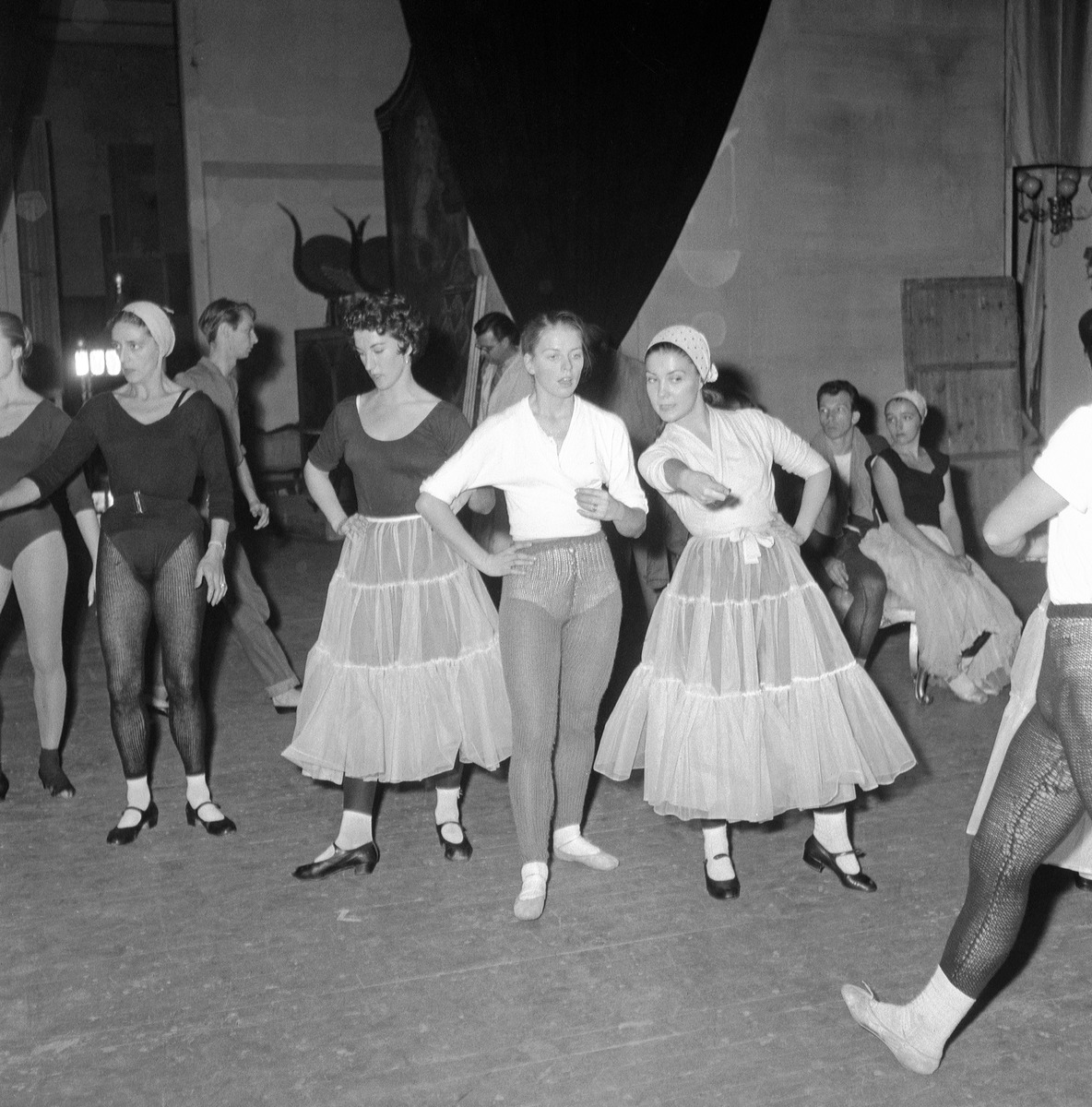
A black-and-white photograph captures a rehearsal or performance of classical ballet, shot indoors under bright stage lighting. In the foreground, two female dancers in classical costumes occupy the center of the frame: one wears a white wrap over her shoulders with a white headpiece, while the other wears a white top, white headpiece, and a full petticoat or tulle skirt in a layered style. Both are en relevé with turned-out positions. To the left, a third dancer in a dark leotard and white headpiece maintains a similar stance. The background reveals a stage set with large horns or crescents (possibly from a theatrical prop or set piece) and additional dancers in dark leotards. The setting suggests mid-twentieth-century theatrical production, with stark lighting that emphasizes the dancers' positions and the geometry of their bodies. The photograph appears to be documentation of an institutional ballet company's work.
The dancing
Three dancers occupy the center ground in classical ballet positions, rising onto the balls of their feet (en relevé) with pulled-up spines and turned-out legs. The dancers' arms are held in closed or near-closed positions at waist level or slightly higher, with relaxed shoulders. The two dancers wearing white wraps and headpieces display identical posture and spacing, suggesting they are performing the same combination or exercise. Their weight appears distributed evenly over the balls of the feet, and their torsos show the elongation expected of classical ballet technique. The uniform alignment and spacing of the three central figures, along with the visible line of additional dancers behind them, indicates this may be a corps de ballet or group ensemble section.
The dance depicted
This is classical ballet, almost certainly from a professional or state-supported company given the scale of production visible. The style of costume—particularly the white headdresses (possibly Swedish traditional dress elements or simplified tiaras) and the ankle-length petticoats—combined with the catalogue title referencing 'Stockholm Ballet' suggests this is a mid-twentieth-century Scandinavian ballet company. The dancers' technique and positioning align with Cecchetti or Vaganova-influenced training common to European classical ballet of the 1940s–1960s. The apparent rehearsal or performance setting and the coordinated ensemble work suggest this may document a specific production, though the title reference to 'Royal Opera Ballet, Stockholm Ballet (5)' suggests this is one of a numbered series of photographs of the same company or production.
How it was made
This is a black-and-white photograph, likely taken during a live rehearsal or performance under stage lighting. The high contrast and sharp detail suggest professional documentary or press photography rather than casual snapshot. The composition and lighting technique—particularly the use of stage lights to create depth and isolate the figures—indicate this was taken by a trained photographer, possibly an institutional photographer for the company or a journalist. The photograph's circulation via Europeana suggests it may have been part of a Swedish cultural archive or press collection, indicating it was created for publication or institutional documentation rather than private use.
About this work
This photograph documents a classical ballet company in rehearsal or performance, showing the disciplined ensemble work and costume practices of mid-twentieth-century Scandinavian ballet. The image captures three dancers in classical positions, with additional dancers visible in the background, all wearing coordinated costumes with white headdresses and traditional-influenced garments. The visual evidence—the dancers' training, technique, and the scale of the production—places this squarely within European classical ballet of approximately the 1940s–1960s, a period of significant institutional investment in national ballet companies across Scandinavia.
The work matters because it documents the actual practice and appearance of a state ballet company during a formative period in twentieth-century dance history, when European ballet was developing distinct national schools and aesthetic approaches. The photograph shows not the rarified world of premiere performances but the daily work of ensemble dancers, preserving evidence of training standards, costume design, stage production values, and the physical reality of ballet labor in this era.
How to look at it
Notice the identical postures and headpieces of the three central dancers—this deliberate repetition is fundamental to classical ballet ensemble work and speaks to the training and discipline required to achieve visual uniformity across multiple bodies. Observe the dancers' engagement with the balls of their feet (en relevé) and the elongation of their spines: these are technical achievements visible only to a trained eye, and this photograph preserves evidence of what was considered proper classical ballet form in this era. Pay attention to the background dancers, whose presence establishes the scale of the company and suggests this is a moment from a larger production or rehearsal sequence. The stage lighting, particularly the shadows cast by the dancers' bodies, emphasizes the three-dimensionality of the movement and the spatial relationships the choreography required.
The period
The mid-twentieth century saw the consolidation and state support of national ballet companies across Europe, with Scandinavia investing heavily in classical ballet as both an art form and a cultural institution. Sweden's Royal Opera Ballet (Kungliga Operans Ballett) was part of this movement, maintaining classical technique while developing a repertory that bridged international classics and new works. The period also saw increased documentation of dance through photography, both for publicity and for archival purposes, reflecting a new professionalization of dance and its relationship to institutional history.
Classical ballet technique during this era was dominated by European schools—particularly Cecchetti and Vaganova methods—which had been systematized in the early twentieth century and were now being transmitted through institutional training programs. The visible costume choices in this photograph, with their incorporation of traditional Swedish or Scandinavian elements (the white headdresses and folk-influenced skirts), reflect a broader mid-century tendency in European ballet to integrate national identity into classical form.
Where it lives
This photograph is held in Europeana, a digital aggregation of European cultural heritage collections. The catalogue reference to 'Royal Opera Ballet, Stockholm Ballet (5)' indicates it is part of a numbered series documenting the company, suggesting it was created as part of institutional or press documentation and subsequently archived.
Dance in this work
Questions about this work
What company is this and when was it photographed?
The catalogue identifies this as the Royal Opera Ballet, Stockholm Ballet, part of a numbered series (this is image 5). The costume style, lighting, photograph quality, and dancers' technique place it in the mid-twentieth century, likely 1940s–1960s. The exact date is not recorded, but the image is part of Swedish cultural archives now held in Europeana.
Is this a rehearsal or a performance?
The setting appears to be a stage with theatrical lighting and set pieces (visible background props), suggesting this could be either a dress rehearsal or a live performance. The technical clarity of the photograph and the apparent documentary purpose suggest it may have been taken during a rehearsal specifically for documentation purposes, though the stage lighting and full costumes indicate a formal occasion.
What do the white headdresses and petticoat skirts mean?
These costume elements likely represent either a specific production incorporating Swedish or Scandinavian folk elements into classical ballet, or a stylistic convention of the company during this period. The coordinated design across dancers suggests this is part of a deliberate aesthetic choice rather than individual variation. Such integration of national or regional dress into classical ballet was common in mid-twentieth-century European companies.
How many dancers are in this photograph?
At least seven dancers are visible: three prominently featured in the foreground (two in white costumes, one in black), and at least four more visible in the background. The background figures are less distinct but clearly part of the same ensemble or production.
More Ballet artwork