25 works in this view — arrow keys or swipe to move between them.
Dance in Art
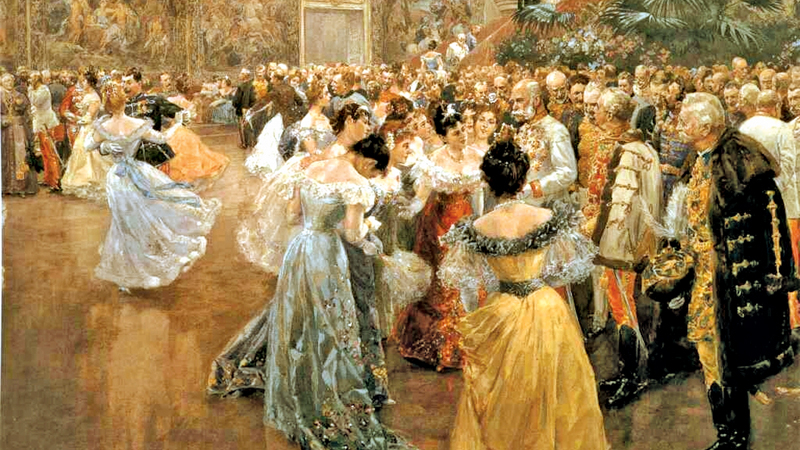
Court Ball in Vienna (panoramic)
Wilhelm Gause
- Era:
- 1900-1920 (Ragtime/Early Jazz)
- Rights:
- By Wilhelm Gause. In the public domain in the United States.
- Recorded as:
- public_domain
For dance historians, this work is crucial evidence of how the waltz was staged and experienced in elite society at the moment when it had become the dominant ballroom form of European aristocracy. For art historians, it exemplifies the society painting tradition and Gause's specific role as a chronicler of Viennese high society. For anyone studying the visual history of dance costume and deportment, the painting captures the silhouette, posture, and formal restraint expected of ballroom dancers in this period with precision that words alone cannot convey.
What you are looking at
A grand ballroom scene rendered in soft watercolor tones of cream, gold, and rust. The composition stretches horizontally across the canvas—panoramic format, as the title indicates—filled with a hundred or more figures in evening dress. The architectural setting is opulent: tall columns frame the space, and decorative garland swags or botanical elements hang overhead, suggesting a palace or grand hotel ballroom. The floor is highly polished. In the foreground, couples dance in various configurations; toward the center-left, a woman in a pale blue-grey gown with a high waistline and train dances with a man in dark formal dress. Other couples occupy the middle ground—some waltzing, some in quadrille formation. The background dissolves into a dense crowd of observers in evening wear: women in white, cream, and pale yellow gowns; men in black tailcoats and dress uniforms with military insignia. The lighting is soft and diffuse, suggesting gaslight or early electric illumination. The overall effect is one of refined social spectacle—the formality and profusion of figures conveys the scale and prestige of a court ball.
The dancing
The dancers visible in the foreground and middle ground move in closed positions characteristic of ballroom dance of the period. The couple at left shows the woman's frame angled away from her partner in the manner of the waltz or viennese waltz, her skirt caught in motion. Other couples appear to stand in quadrille positions—four dancers or pairs arranged in geometric formation. The men are uniformly in black tailcoats; the women in high-waisted gowns with full skirts that sweep the floor. Weight appears to be carried upright and centered, posture formal and controlled. The artist has rendered the bodies with enough specificity that the viewer can infer the restraint and verticality expected of ballroom dancers of this era, though footwork is not detailed enough to distinguish specific steps.
The dance depicted
This is unambiguously a scene of European court or elite ballroom dance, most likely the Viennese Waltz or Waltz, the dominant partner dance of the Gilded Age ballroom. The painting's title specifies Vienna—capital of the Austro-Hungarian empire and the historical home of the waltz—and the formal court setting, the date (suggested as early 1900s by dress), and the predominance of couples in closed hold with visible rotation all point to waltz. Quadrille formations are also visible, indicating that the evening included both waltz and the group dances that typically opened formal balls. The work documents the social function of dance among the aristocratic and wealthy classes of Central Europe at the turn of the twentieth century.
How it was made
The work appears to be a watercolor or gouache painting, characterized by soft washes of color, transparent layering, and the ability to capture the diffuse light of a gaslit interior. This medium was favored for ballroom scenes and society paintings in the late nineteenth and early twentieth centuries because it could render large crowds and architectural spaces with atmospheric depth while remaining quick enough for commission work. The panoramic format—wider than it is tall—suggests the painting may have been conceived as a decorative scheme for a ballroom wall or as a documented record of an actual court ball, a function such paintings served in elite European circles.
About this work
This is a panoramic watercolor of a Viennese court ball at the turn of the twentieth century, showing the waltz and quadrille in their moment of greatest prestige and regulation. Wilhelm Gause was a Viennese painter of society scenes and theatrical subjects, and this work exemplifies his practice of capturing ballroom spectacle with attention to costume, architecture, and the conventions of formal dance. The painting documents not the steps themselves but the *occasion* of dance—the social hierarchy, the dress code, the spatial arrangements, and the atmosphere of imperial refinement that surrounded ballroom dancing in Vienna during the Belle Époque. It belongs in a dance gallery because it preserves the context and grandeur of waltz culture at its historical apex, offering visual testimony to how dance functioned as a marker of class, nationality, and imperial power.
How to look at it
Approach this as a document of a specific moment and a specific social order, not as a dynamic representation of dance itself. The artist has chosen a freeze-frame of the ball at its peak—the moment when dancing and socializing are in full flow, when the room is crowded and the evening's energy is evident. Notice how the perspective pulls the eye from the dancers in the foreground back into the crowd, suggesting the depth and scale of the event. The formality of the figures—the uniformity of the men's dress, the careful arrangement of the couples in formation—is as much the subject as the dance itself. Look also at the contrast between the active dancers and the static observers; the ball was as much about being seen as about moving.
The artist
Wilhelm Gause (1853–1916) was an Austrian painter and illustrator best known for his depictions of Viennese society, theater, and ballroom scenes. He worked in watercolor and oil, and was particularly celebrated for his ability to capture large crowd scenes with atmospheric effect and social nuance. His paintings of balls, theatrical premieres, and society events were commissioned by the Austro-Hungarian aristocracy and appeared in major European exhibitions. Gause was embedded in the world he depicted—his subjects were the actual events and people of Vienna's imperial elite—and his work serves as a visual chronicle of that milieu in its final decades.
The period
The Viennese Waltz reached the height of its cultural prestige in the 1890s and early 1900s. Vienna had been the birthplace of the waltz in the late eighteenth century, and by the turn of the twentieth century, the dance was encoded as an emblem of Austrian identity and imperial refinement. The formal court ball remained the ritual center of aristocratic social life, despite the rise of new dances and the increasing informality of other contexts. Gause was painting this scene at a moment when both the waltz and the court ball as institutions were beginning their gradual decline—the First World War would effectively end the system Gause documented. In the art world, society painting and the chronicle of high-life events remained a significant genre, especially in Vienna and Paris, though it was already yielding prestige to modernist movements that rejected its representational traditions.
Where it lives
The acquisition history and current whereabouts are not documented in the available record.
Dance in this work
Questions about this work
How do we know this is a Viennese ball?
The title states it directly. In addition, the architectural vocabulary—the columns, the scale, the decorative swags—resembles known ballrooms of Vienna and Central Europe, and the style of dress and social organization are consistent with Austro-Hungarian court balls of the period. Gause was a Viennese painter documenting Viennese society, so this is a primary source for that context.
What dances are shown?
The dominant form is the Waltz or Viennese Waltz—visible in the couples in closed position with rotational movement. The geometric arrangements of some groups of four dancers suggest the Quadrille, which was typically danced early in a formal ball as a group dance before the evening moved to partner dances like the waltz. Both were standard elements of elite ballroom events in Vienna at this time.
Is this a real ball or an imaginative scene?
Gause often painted actual society events and was commissioned to document specific balls and premieres. However, the panoramic format and the density of figures suggest this may be a composite or idealized version of a ball rather than a strict record of a single evening. The work functions as both documentary and celebration of the ballroom as an institution.
Why are there so many people who aren't dancing?
A formal ball was as much a social and dynastic event as a dancing event. Observers—elderly people, those waiting for their turn, people managing the event, chaperones—were integral to the spectacle. The balance between active dancers and the surrounding crowd reflects the actual social function of the ball, where presence, dress, and social position mattered as much as participation in the dance.
More dance artwork