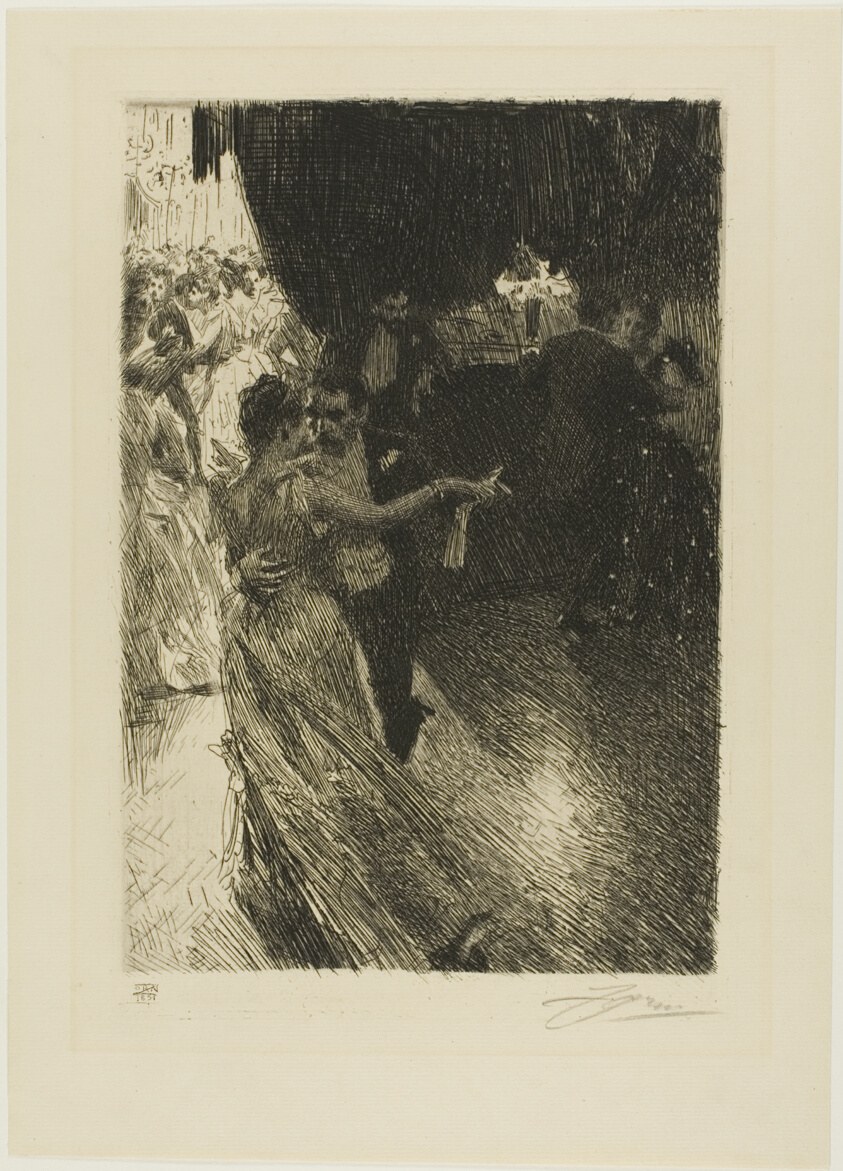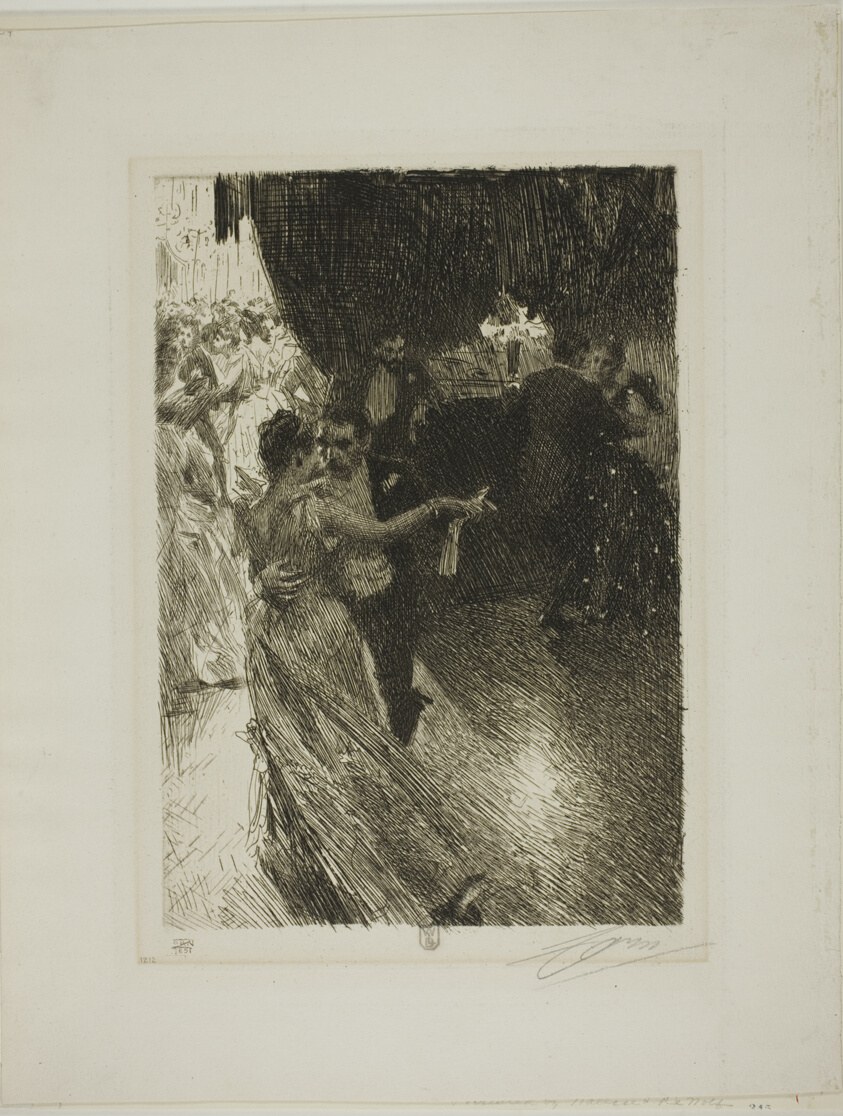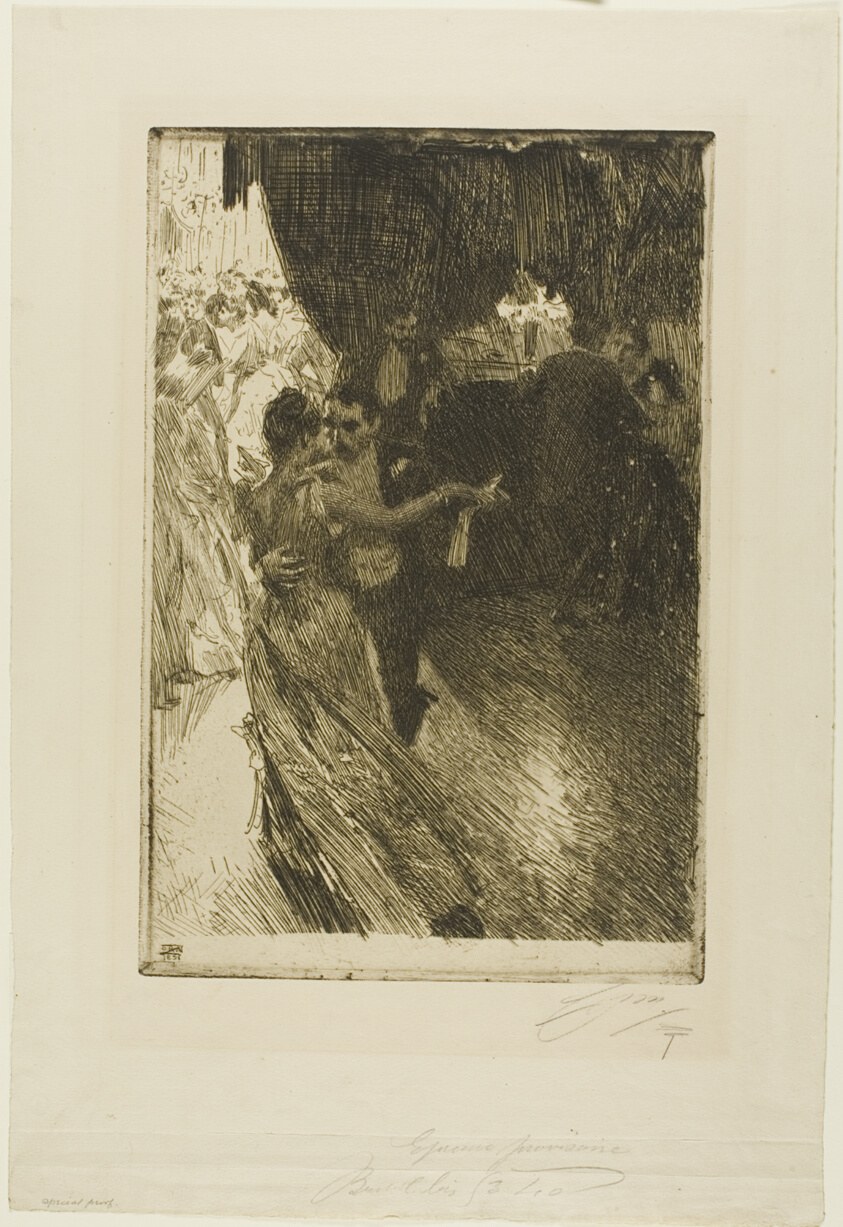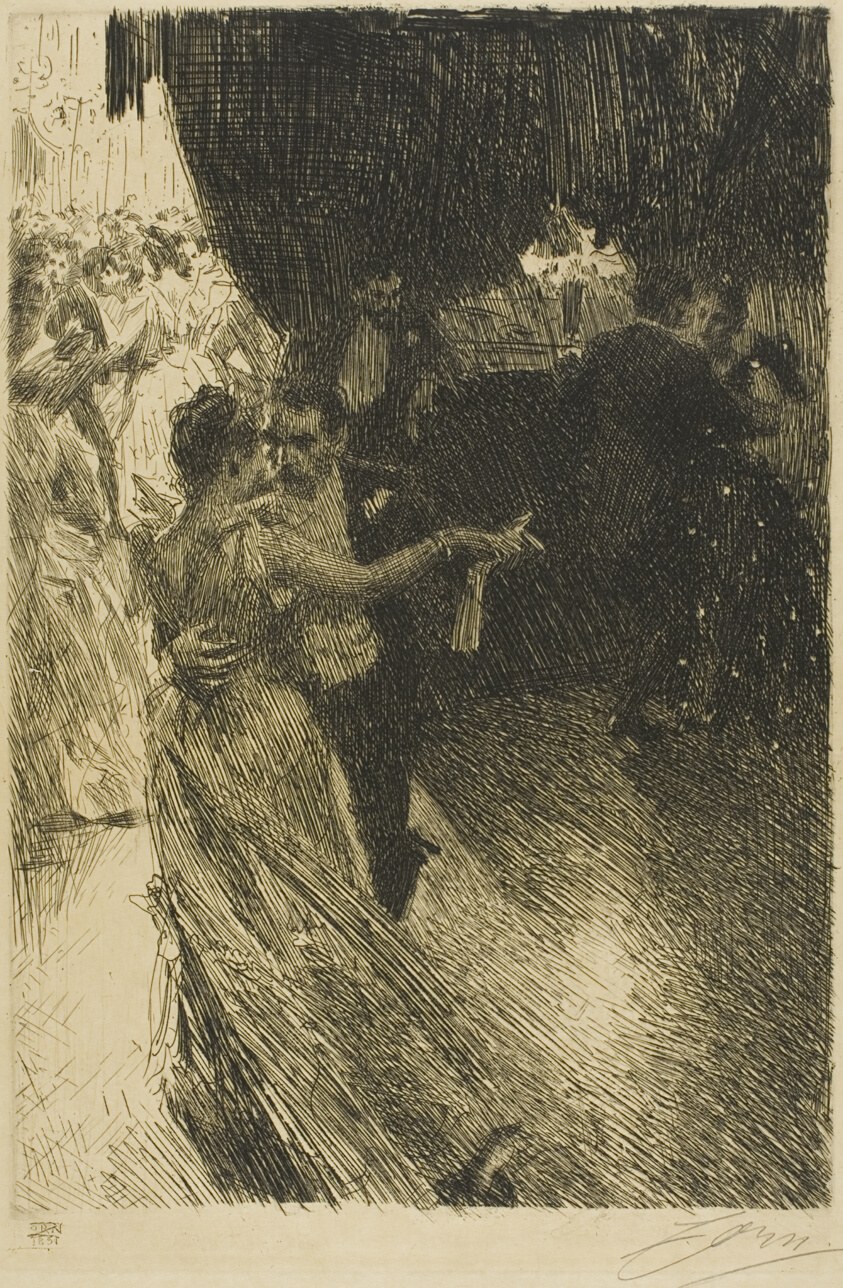
28 works in this view — arrow keys or swipe to move between them.
Dance in Art
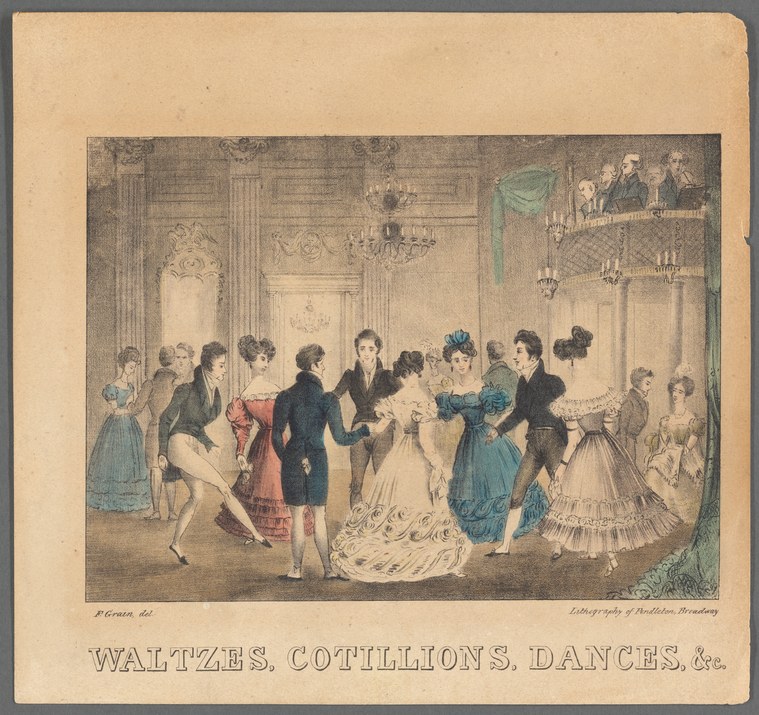
Waltzes, cotillions, dances, &c.
Unknown artist
- Medium:
- Lithograph
- Dance:
- Waltz
- Era:
- Late 1800s (Victorian Ballroom)
- Source:
- New York Public Library
- Rights:
- Public domain — free to use, share and adapt.
- Recorded as:
- public_domain
Ballroom dance images from this era often focus on single couples or idealized pairs, but this print preserves the structure of the social event itself—the crowding, the hierarchy, the presence of musicians and observers—that made 19th-century ball culture a complete social performance. For historians and dancers seeking to understand how these dances actually occupied social space and time, this image is invaluable.
What you are looking at
A formal ballroom scene rendered in soft, muted tones typical of hand-colored lithography. The composition shows a full orchestra or musical ensemble arrayed in a gallery above, looking down on an animated dance floor below where multiple couples and individual dancers move in various configurations. The setting is grand: tall fluted columns frame the space, ornate ceiling details suggest a palace or aristocratic residence, and elaborate chandeliers cast light across the scene. The dancers wear the full formal dress of the mid-to-late 19th century—men in dark tailcoats and trousers, women in voluminous ball gowns with dropped waistlines, puffed sleeves, and abundant skirts of pale blue, pink, and white fabrics. A particularly striking figure in the center wears a wedding gown with an exceptionally long train being attended by surrounding dancers. The floor teems with social activity: couples in closed embrace, individuals conversing, and the visual confusion and pleasure of a crowded public ball.
The dancing
The dancers occupy multiple registers of engagement. At center, a couple in formal closed position moves with the characteristic upright frame of 19th-century ballroom technique. Surrounding pairs maintain similar holds—man's right hand on woman's back, closed frame at the waist. The bride-figure's gown and the way dancers orbit around her suggest she is the focal point of the gathering, with other dancers adjusting their positioning to accommodate her voluminous train. Bodies are shown in motion with weight distributed through the legs; the artist has captured the typical small, controlled steps of the period rather than exaggerated theatrical movement. Group positioning suggests both solo couples and the possibility of group figures characteristic of quadrilles or cotillions.
The dance depicted
The title explicitly names waltzes, cotillions, and dances, and the visual evidence supports all three. The closed holds and upright posture indicate waltz technique. The gathering structure—a large mixed group in a formal ballroom with a structured social hierarchy (bride at center, musicians in gallery)—is typical of a cotillion, which was less a single dance than a social event comprising multiple figures and different dance types. Cotillions were the dominant form of aristocratic ballroom entertainment in the 19th century and frequently featured a bride or honored guest. The label at the base credits this as a lithograph and likely represents a popular entertainment print documenting fashionable dance practice among the European or Anglo-American upper classes.
How it was made
This is a hand-colored lithograph, a technique allowing for fine tonal gradation and subtle detail reproduction at lower cost than engraving, making it accessible to a broad middle-class audience. The soft palette—pale blues, flesh tones, grays, and cream—was typical of lithographic coloring of the period. The composition shows the careful staging of a moment of social spectacle rather than a documentary snapshot; the overhead view, the symmetry of columns, and the prominence of the bride suggest this is an idealized or exemplary scene rather than a record of a specific ball. Such prints circulated widely as souvenirs, fashion references, and documents of fashionable society behavior, typically sold by music publishers, stationers, or print sellers.
About this work
This is a mid-to-late 19th-century lithograph depicting the social dance environment of the European or Anglo-American ballroom at its height. It documents simultaneously the dances themselves (waltz, cotillion) and the social structures that organized them: the formal dress code, the presence of live musicians, the prominent role of a bride or honored guest, and the mixing of social ranks within a hierarchical space. The image is neither pure documentation nor pure fashion illustration but a hybrid form that taught viewers both how dance appeared and what it meant to participate in it.
The work is important precisely because it shows the ballroom as a complete social ecosystem rather than isolating the dancing body. We see the musicians who made the dances possible, the gallery of observers, the space's architecture and decoration, and the way a cotillion's social logic organized the floor—not everyone dancing at once, but a structured sequence of figures with pauses for conversation and observation. This was how the waltz and cotillion actually functioned in lived practice.
How to look at it
Note the overhead perspective, which allows the viewer to see the entire floor plan and social geography at once—a perspective no participant could actually occupy. This suggests the print is aspirational and pedagogical rather than documentary. Look at the bride's train and how surrounding dancers navigate around it: this is a visual statement about her centrality and the way even the choreography of a social event bends to social hierarchy. The softness of the coloring and the slight blur of motion in some figures conveys the dynamism of the event, while the careful rendering of dress fabrics shows the material culture that made ballroom dancing a marker of wealth and status.
The period
The mid-to-late 19th century was the era of the waltz's absolute dominance in European and Anglo-American ballroom culture, and the cotillion was its essential social frame. The waltz had been revolutionary in allowing couples to dance in closed embrace with minimal contact to the floor; by this period it was fully conventional. The cotillion, which had evolved from the French quadrille, was a highly structured social event in which an appointed leader (often the host or a honored guest) directed the sequence of figures. Balls were major social events that could last many hours and typically mixed waltz, polka, galop, and cotillion figures. This image dates from the era when lithographic print technology had made fashion and social documentation widely available, and prints like this served both to record fashionable practice and to teach it to aspiring participants.
Where it lives
This is a lithograph from the New York Public Library collection, likely one of many such popular prints produced for mass circulation in the mid-to-late 1800s. Such works were typically sold as standalone sheets or as part of fashion and etiquette publications.
Dance in this work
Questions about this work
What is a cotillion?
A cotillion was a structured social ballroom event, typically lasting an hour or more, in which an appointed leader directed a sequence of figures. These figures might be waltzes, quadrilles, galops, or other dances, and they alternated with pauses for conversation and socializing. It was the dominant form of ballroom entertainment for the upper classes throughout the 19th century, and the presence of a bride or honored guest at the center was typical.
Why are there musicians in the gallery?
A full orchestra or band was essential to ballroom dancing. The musicians played continuously through the event, following the leader's cues to change tempo or style as figures changed. Their elevated position in a gallery or balcony was conventional—they played but did not dance or mix socially with the attendees.
What does the bride's train tell us about 19th-century ball dress?
Wedding gowns in this era featured extraordinarily long trains that were often the work of seamstresses and assistants. The train was both a mark of expense and formality and a practical challenge on a crowded dance floor. This image shows how dancers had to adjust their movements and positioning to accommodate it, making the bride's dress itself part of the choreography.
Is this a real ball or an imagined one?
It is idealized. The composition is too symmetrical, the dress too uniformly fashionable, and the arrangement too orderly to be a record of an actual event. Rather, it is an aspirational image—a teaching tool showing how a fashionable ball should appear to those who aspired to participate in such events.
More Waltz artwork