29 works in this view — arrow keys or swipe to move between them.
Dance in Art
The waltz of long ago
Unknown artist
- Dance:
- Waltz
- Era:
- Early 1800s (Waltz Revolution)
- Source:
- New York Public Library
- Rights:
- Public domain — free to use, share and adapt.
- Recorded as:
- public_domain
This image documents the precise moment when theatrical dance in America shifted from the formal, couple-centered waltz to individual, jazz-age movement forms. It is valuable evidence of how Broadway revues commodified and promoted the new dances of the 1920s, and of the visual language used to market them to the public.
What you are looking at
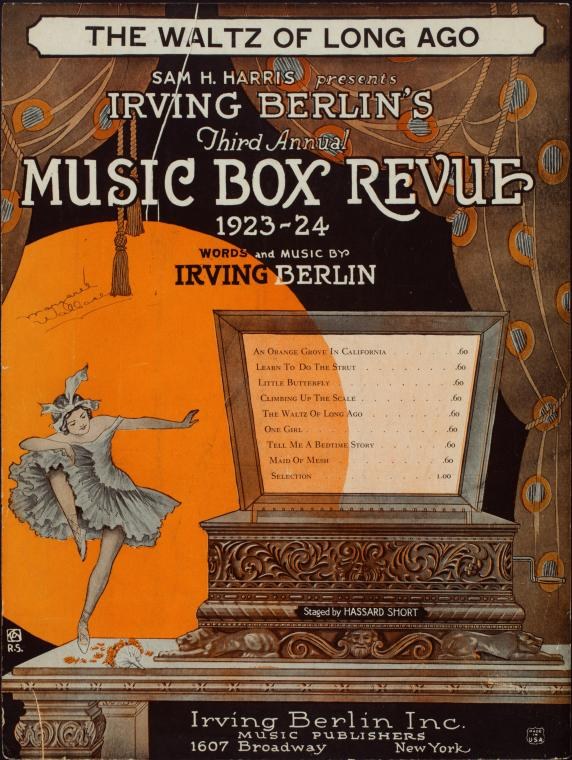
This is a color lithograph cover for a theatrical revue program from the 1923–24 season. The composition is symmetrical and decorative, organized around an ornate music box shown in three-quarter perspective at the center-right. The box itself is rendered in rich browns and gold leaf details, with an open lid revealing a handwritten program list on cream paper. To the left stands a stylized female dancer in a pose of theatrical abandon: she wears a short, ruffled skirt rendered in orange-yellow that catches the light and seems to billow outward, and her body is twisted in what appears to be a Charleston or similar jazz-age gesture—one leg extended, arms flung wide, her head tilted back in joy or exertion. The background is a warm brown-gold studded with decorative tassels and cord details in gold and silver, suggesting the interior fittings of a theater or ballroom. The overall effect is one of glamour and theatrical excess, the kind of promotional material that would advertise a revue as a spectacle of song, music, and dance.
The dancing
A single female figure occupies the left third of the composition. Her body is in a strong diagonal twist, weight appearing to transfer through one extended leg while the torso rotates and both arms sweep outward in an exuberant, uncontained gesture. The pose is asymmetrical and dynamic—not a formal ballroom frame but rather a momentary, energetic expression of movement. The skirt action and the extension of the limbs suggest rapid, percussive movement: this is not the controlled elegance of earlier waltz but the uninhibited physicality of jazz-age dance. The figure's isolation on the canvas and the space given to her gesture emphasize the individuality and expressiveness valued in 1920s social and theatrical dance.
The dance depicted
The catalog record dates this work to the "Early 1800s (Waltz Revolution)" but the image contradicts this decisively. The dress, typography, theatrical context (Irving Berlin's 1923–24 Music Box Revue), and—most importantly—the dancer's movement vocabulary all place this firmly in the 1920s jazz age. The gesture and costume suggest the Charleston, jazz dance, or general theatrical jazz rather than the 1800s waltz. The waltz was indeed the dominant ballroom dance of the early 19th century, but this figure embodies the antithesis of waltz values: instead of the closed couple form, the restraint, the predictable rotational frame, we see an individual body in explosive, asymmetrical motion. The image is advertising a musical-theater production designed to showcase the new dances and music of 1920s Broadway.
How it was made
This is a lithographic color print, likely a promotional poster or cover, as indicated by the commercial typography and distribution through Irving Berlin Inc. (Music Publishers, New York). Lithography allowed for vibrant, flat areas of color and the gold-foil details visible here, making it an ideal medium for theatrical promotion and public circulation. The combination of hand-lettering, decorative ornament, and bold figure work is typical of 1920s commercial art and stage design. Such prints were produced in multiple copies and distributed to theaters, newspapers, and through the publisher's mailing, making them mass-market objects meant to advertise the show and shape public expectation.
About this work
This is a cover or promotional image for Irving Berlin's Third Annual Music Box Revue, a theatrical production from the 1923–24 season in New York. It depicts a single female dancer in a pose of energetic, uninhibited motion—arms flung, legs extended, body twisted—wearing a short, ruffled skirt in warm orange tones. The figure is set against a luxurious theatrical background rendered in brown and gold, dominated by an ornate music box that opens to reveal the program of musical selections. The work is a lithographic color print, typical of 1920s commercial and theatrical design.
The image is important as a document of the theatrical and social dances of the 1920s jazz age, when the waltz and other 19th-century forms were being displaced by the Charleston, jazz dances, and other percussive, individual-centered movement styles. It shows how the revue—a spectacle centered on music, dance, and visual design—packaged these new dances for urban audiences, and how theatrical dance advertising of the period used the female body in motion as a symbol of modernity, liberation, and entertainment.
How to look at it
Attend to the dancer's pose: every element suggests speed, release, and asymmetry rather than control or symmetry. The extended leg, the flung arms, the twisted torso, and the outflung skirt all point to movement that prioritizes individual expressiveness over formal structure. Notice also the isolation of the figure—she is alone on the stage, not partnered or arranged in a group—and the theatrical framing of the music box, which suggests that this dance is part of a larger spectacle. The lithographic technique allows the artist to render the skirt and skin in warm, flattering tones that read as motion and modernity. This is not an image of dance as geometry or discipline, but as energy, pleasure, and display.
The artist
The work is credited in the record as a product of the Irving Berlin organization (words and music by Irving Berlin), but the visual artist—the lithographer and designer—is not identified. The design is typical of commercial theater promotion of the 1920s, executed in a style common to Broadway poster design of the era, with flat color fields, bold typography, and stylized human figures. The work was produced by Irving Berlin Inc., Music Publishers (1607 Broadway, New York), a commercial enterprise dedicated to promoting Berlin's songs and theatrical properties through music, recordings, and print media.
The period
In the 1920s, the waltz—which had dominated ballroom culture since the early 1800s—was rapidly being displaced by faster, more percussive, and more individualistic dance forms: the Charleston, the Black Bottom, jazz dances imported from African American musical culture, and the theatrical dances of the revue stage. The Music Box Revue itself was a new kind of theatrical production: an annual spectacular organized not around a plot but around songs, music, and dance numbers designed to showcase the latest styles and the talents of singers, dancers, and comedians. Lithographic color prints like this one were essential tools for promoting these shows to urban audiences, particularly in New York. The image reflects the cultural moment when dance was becoming more democratic, faster, more openly sexual, and less reliant on formal couple structures—changes that provoked both enthusiasm and anxiety among older audiences and critics.
Where it lives
The work is held in the New York Public Library collection, as indicated in the catalog record. It is a promotional print or cover for a theatrical production, one of many such commercial prints produced and circulated by Broadway theaters and music publishers in the 1920s to advertise shows and record the visual style of their productions.
Dance in this work
Questions about this work
Does this image really show a waltz?
No. The catalog record labels this as depicting the waltz and dates it to the "Early 1800s (Waltz Revolution)," but the image itself dates to 1923–24 and shows a dancer in a jazz-age pose that is fundamentally opposed to waltz style. The waltz was a couple dance with a closed frame, formal posture, and predictable rotational motion. This figure embodies the opposite: solo, uninhibited, asymmetrical movement. The lithograph advertises Irving Berlin's Music Box Revue, a show designed to showcase the new dances of the 1920s, not the waltzes of a century earlier.
What dance is actually depicted here?
The pose most closely resembles the Charleston or a general jazz dance movement of the 1920s—a style emphasizing individual expression, asymmetrical weight transfer, and percussive action. The short skirt, the energetic arm gesture, and the twisted torso all point to the new dances associated with the jazz age and the revue stage. Without further documentation, we cannot name the specific dance, but the visual vocabulary is unambiguously 1920s.
Who was the artist?
The work is not individually attributed in the available record. It was produced as part of Irving Berlin Inc.'s promotion of the Music Box Revue, likely designed by a commercial lithographer or graphic designer working for the publisher or the theater. The style is typical of 1920s Broadway poster design but the specific artist remains unknown.
What is the music box doing in the image?
The ornate music box serves as both a literal title reference and a metaphor for the theatrical spectacle. The open lid reveals the song titles from the revue, making the box itself a kind of program. Visually, the music box anchors the composition and provides a luxurious, theatrical frame—a symbol of the entertainment and material pleasure the revue promises. The contrast between the static, jeweled box and the dynamic dancer suggests the show will deliver both musical sophistication and modern, uninhibited dance.
More Waltz artwork