25 works in this view — arrow keys or swipe to move between them.
Dance in Art · 2019
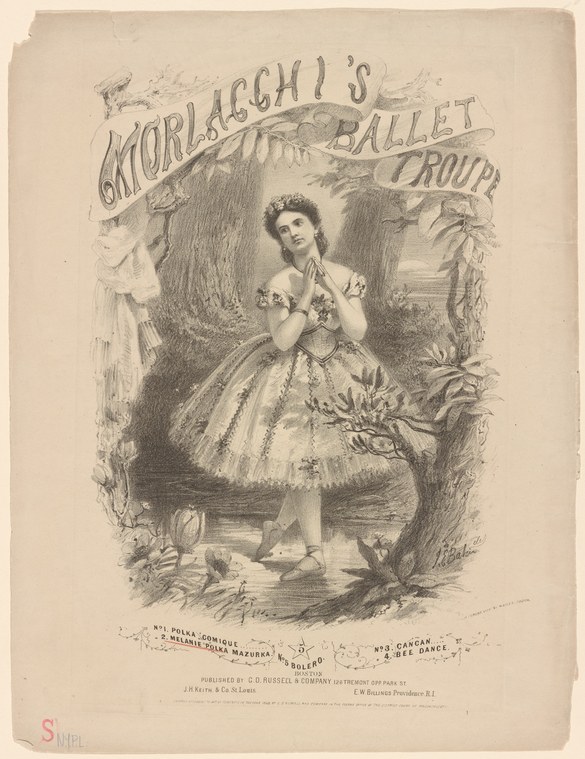
Morlacchi's Ballet Troupe
Unknown artist
- Medium:
- Dance:
- Ballet
- Source:
- New York Public Library
- Rights:
- Public domain — free to use, share and adapt.
- Recorded as:
- public_domain
This image captures the Romantic ballet aesthetic at its height of popularity, showing how the era visualized and sold the ideal of the ethereal, otherworldly ballerina to mass audiences. It also records Giuseppina Morlacchi, a major international star whose career spanned continents and decades but whose work is now less familiar than that of her contemporaries—making this print a valuable corrective to histories that centre only European companies.
What you are looking at
A young female dancer in a romantic tutu stands in a woodland glade, her body angled in a graceful pose with one arm raised and the other at her side. She wears a fitted bodice and voluminous skirt of pale fabric, pointe shoes visible beneath. The setting is pastoral and idyllic—trees frame the composition, vines and foliage suggesting a forest or garden retreat. The dancer's posture and the dreamy quality of the scene convey the ethereal aesthetic central to Romantic ballet. The print includes decorative text reading "MORLACCHI'S BALLET TROUPE" at the top, with smaller text at the bottom identifying performers and roles, indicating this is a theatrical advertisement or souvenir rather than a private commission.
The dancing
The single figure is a soloist in a classical ballet frame: her weight appears lifted, one leg supporting beneath the body while the other is extended or in a supporting position, the torso upright and elegant. Her arms follow the Romantic-era aesthetic of softness and gracefulness rather than the more geometric clarity of later classical ballet. The pose suggests a moment of repose or lyrical expression rather than virtuosic display. There are no partner relationships visible; this is an image of a featured dancer alone in character.
The dance depicted
This is a Romantic-era theatrical ballet, almost certainly one of the starring roles from a major European ballet company of the mid-19th century. Giuseppina Morlacchi (1817–1886) was an Italian ballerina who became famous across Europe and North America for roles in works like *La Tarantelle* and other popular spectacles. The sylphide-like quality of the pose—the lightweight frame, the ethereal tutu, the woodland setting—indicates a role in the Romantic tradition of supernatural or fey characters. The print format and the inclusion of troupe and character names mark this as publicity material for the company and this particular star.
How it was made
This is an engraving or lithographic print, established from the tonal line-work, the soft modeling of form through parallel lines, and the formal composition typical of mid-19th-century theatrical publicity. The technique allowed for rapid mass production and wide circulation, making it an economical way to advertise performances and sell souvenirs to theatre-goers. The legible text overlay—performers' names and the troupe title—is characteristic of commercial theatrical prints, distinguishing it from fine-art engravings and placing it squarely in the popular print market.
About this work
This is a mid-19th-century theatrical print advertising or commemorating a performance by Morlacchi's Ballet Troupe, likely dating to the 1840s–1860s when Morlacchi's star was highest. It depicts an unnamed but identifiable female soloist in Romantic ballet costume and character, posed in a woodland setting that evokes the supernatural and lyrical themes central to the era's ballet repertoire. The work belongs in a dance gallery because it documents both the aesthetic and the commercial apparatus of Romantic ballet: the idealization of the female dancer, the cult of the ballerina, and the use of print technology to create and sustain celebrity.
How to look at it
Observe the dancer's lifted posture and the way the artist has suggested weightlessness through the pose—the sense that she might float rather than step. Notice the woodland setting and its function: the trees and vines create an enchanted world, not a stage, making this less a document of what the stage looked like and more an image of the dream the ballet offered. The print's frame—the decorative text, the formal composition—marks it as a commercial product, an ancestor of the modern theatrical poster and the celebrity photograph.
The artist
The artist is not recorded. The print was published by D.O Russell & Company and printed by E.M. Rosenfeld (Philadelphia), suggesting American production or distribution, though the work may have been created in Europe and reprinted. The aesthetic and technique are consistent with mid-Victorian theatrical lithography.
The period
Romantic ballet (1830s–1870s) celebrated supernatural beings, exotic worlds, and the idealized female body, with the ballerina as the central figure. The era saw the rise of the star system and the international celebrity circuit, enabled by touring companies and print publicity. Morlacchi's career exemplifies this internationalism: she performed in Italy, France, London, and North America. By the 1840s–1850s, theatrical prints had become a major medium for shaping public taste and maintaining performer celebrity between engagements.
Where it lives
This print is held by the New York Public Library and was sourced from their collection. It is a mass-produced commercial object intended for public circulation, sale, and domestic display—a piece of theatrical ephemera rather than a unique artwork.
Dance in this work
Questions about this work
Who was Giuseppina Morlacchi?
Morlacchi (1817–1886) was an Italian ballerina and one of the most celebrated international stars of the Romantic era. She was known for her skill in character roles and spectacular feats, and she toured widely across Europe and North America. She was particularly famous for *La Tarantella*, in which she danced the Italian folk dance at virtuosic speed.
What is a Romantic ballet?
Romantic ballet (roughly 1830s–1870s) was an era in which ballet centered on supernatural and exotic themes—sylphs, spirits, maidens from far-off lands—and elevated the ballerina as the primary vehicle of the story. It favored ethereal, weightless movement, pointe work, and elaborate tulle skirts, and it was the era in which the modern star system in dance was born.
Why was this printed and distributed?
Theatrical prints were crucial marketing and merchandise in the 19th century. They advertised upcoming performances, celebrated star dancers, and gave audiences a keepsake to take home. This particular print served all three purposes, making Morlacchi's image and troupe name widely known and purchasable.
More Ballet artwork