26 works in this view — arrow keys or swipe to move between them.
Dance in Art
Scene de ballet
Unknown artist
- Medium:
- Dance:
- Ballet
- Source:
- New York Public Library
- Rights:
- Public domain — free to use, share and adapt.
- Recorded as:
- public_domain
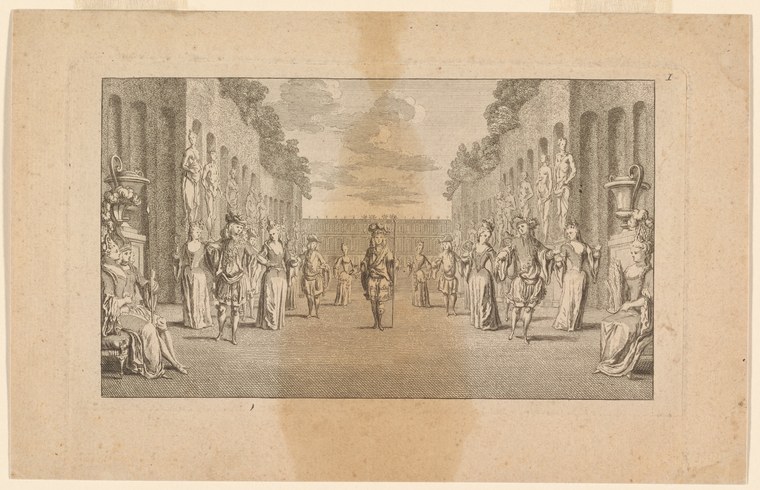
This image is a primary source for understanding 18th-century courtly dance as a lived social practice rather than a choreographed stage spectacle. It shows dancers in their architectural and social context—the setting matters as much as the movement—and reveals the dancer as a figure of leisure and courtship within an elite milieu. For historians of dance, fashion, and social history, it documents the bodily practices and spatial arrangements of an entire class.
What you are looking at
A formal garden or palace colonnade with paired columns receding toward a distant vanishing point, lined on both sides with statuary and classical urns. The space is populated with numerous figures in elegant dress: women in long gowns with full skirts, men in fitted coats and breeches. The figures are arranged in loose groupings and pairs across the floor, some standing, some in conversation, some moving. The middle distance shows what may be musicians or a small orchestra. The light is even and bright, suggesting daylight or a grand interior lit from above. The overall effect is of a formal social gathering in a neoclassical setting—a court or aristocratic assembly where dancing appears to be taking place or about to commence.
The dancing
The dancers are distributed across the floor in no rigid formation, suggesting social dancing rather than staged ballet. The women's full skirts are rendered with particular attention, falling to the ankle. The men stand upright in the formal posture of the period. Some figures appear to be in the closed hold of a partner dance—a man and woman positioned near each other with arms extended—though the engraving's fineness makes exact hand placement difficult to read. The overall impression is of elegant but relaxed movement: this is not a formal stage performance but a ballroom or garden fête where couples move about at will.
The dance depicted
This is almost certainly a scene of court or aristocratic social dancing, most likely from the 18th century given the dress, architecture, and social context. The neoclassical setting and the mixed-gender couples moving freely through space suggest this depicts a minuet, cotillion, or other formal social dance of the Enlightenment period. The absence of tight formation or synchronized movement argues against a staged ballet; this is the dance of courtship and social ceremony. The artist has chosen to show the dance as a moment of leisure and flirtation rather than virtuosity.
How it was made
This is a finely executed engraving, recognizable by the parallel line hatching used to create tone and shadow, the precise linear definition, and the tonal range achieved through varying density of line work. The technique allowed the artist to capture detail across a large composition while remaining reproducible—this was almost certainly a print circulated in multiple copies, reaching a wide educated audience. The fineness of the line work suggests mid-to-late 18th-century production; the subject matter and presentation indicate it was made for a cultivated public interested in scenes of courtly life.
About this work
This engraving depicts a formal social dance in an aristocratic or court setting, most likely a minuet or cotillion of the 18th century. The scene is set in a grand neoclassical garden or palace interior with paired columns and statuary, establishing the haute-couture context of the dance. The composition places the figures at leisure within this classical architecture, suggesting that social dancing was both a display of refinement and a site of courtship and pleasure. The print format and fine execution indicate it was made for a cultured public interested in scenes of aristocratic life. The work belongs in a gallery of dance because it documents how a specific social class understood and performed movement in a particular era—as an elegant, leisured, and fundamentally social act.
How to look at it
Attend to the spatial arrangement: the dancers are not in a tight formation but distributed across the floor in pairs and small groups, suggesting the freedom of social dancing rather than the lockstep of a corps de ballet. Notice how the architecture frames the dance—the receding colonnade creates perspective and grandeur, making the dance itself an ornament within a larger statement about classical order and aristocratic power. The artist has chosen a moment of relative stillness or gentle movement rather than a leap or turn, emphasizing the grace and composure valued in courtly dancing. The gender dynamics are visible too: the pairing of men and women, the prominence of the women's silhouettes, the men's supporting role—all speak to the social and erotic function of the dance.
The period
The 18th century saw the codification and spread of the minuet, cotillion, and quadrille as the dominant dances of European aristocratic society. These were dances of precision, restraint, and social hierarchy: they required instruction, were performed in paired or group formations, and served as a display of breeding and taste. The neoclassical aesthetic that dominates this print—the columns, urns, and rational perspective—reflects the broader Enlightenment valorization of classical order and refinement. This image thus sits at the intersection of Enlightenment aesthetics and the social rituals of the ancien régime. The print's circulation would have been among the educated elite and the aspiring bourgeoisie seeking to emulate courtly manners.
Where it lives
The work is held in the New York Public Library collection, sourced from the NYPL digital collections. It is catalogued as a print with no artist attribution, date, or medium formally recorded, though the image itself clearly identifies it as an engraving of the 18th century.
Dance in this work
Questions about this work
What dance is this?
The exact dance cannot be named from the image alone, but the setting, dress, and arrangement of figures point to a formal 18th-century courtly dance—most likely a minuet, cotillion, or quadrille. These were the dominant social dances of the European aristocracy, performed in pairs or small groups in ballrooms and gardens, and requiring training in proper deportment.
Why is the setting so grand?
The neoclassical colonnade, statuary, and perspective are not incidental decoration. They establish the social and aesthetic context of the dance: this is an aristocratic or court setting where dancing displays not just skill but membership in an elite class. The architecture frames the dance as part of a larger civilizational order.
Is this a real event or an idealized fantasy?
It is likely based on real court or ballroom practice but rendered in idealized form. The composition, the perfect lighting, the balanced distribution of figures, and the classical setting all suggest this is a vision of how aristocratic society wished to see itself—refined, orderly, and civilized. The print was made for circulation among the educated elite who recognized and aspired to this image.
How do I know this is an engraving?
The parallel line hatching used to create tone, the precision of the linear definition, and the absence of color all identify this as an engraving. The technique allowed for fine detail and multiple copies, making it ideal for distributing images of courtly life to a broad educated public.
More Ballet artwork