32 works in this view — arrow keys or swipe to move between them.
Dance in Art · 2019
Ballroom dancers
Unknown artist
- Medium:
- Dance:
- Ballroom
- Source:
- New York Public Library
- Rights:
- Public domain — free to use, share and adapt.
- Recorded as:
- public_domain
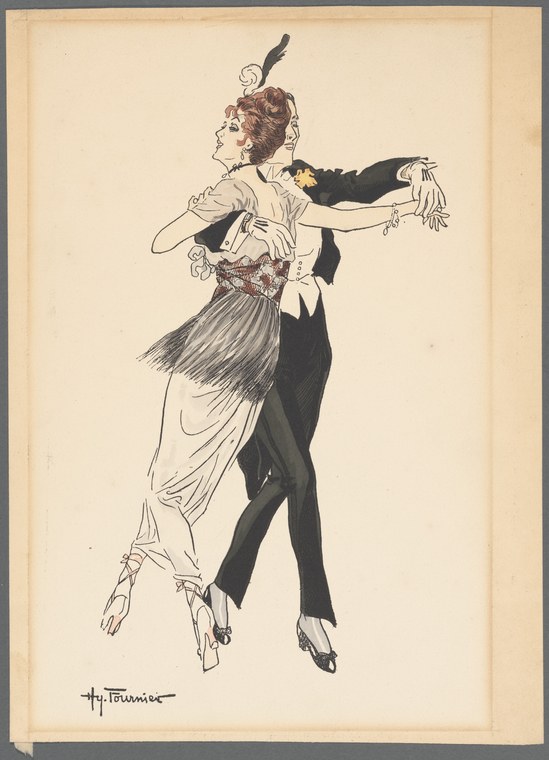
This image documents not just a dance position but the aesthetic values of 1920s–1930s ballroom dancing—the ideal of elongated line, supported extension, and partnered elegance that defined the era's approach to formal social dancing. For dancers and historians, it is evidence of how ballroom was taught and valued during this period: as a form emphasizing fluidity, frame, and visual beauty rather than complex footwork or speed. The work also records the gendered dynamics of ballroom dance in this era—the woman's dramatic lean and extension positioned as the visual and aesthetic center, supported by the man's stable frame.
What you are looking at
A man in formal evening dress and a woman in a flowing gown dance together in an intimate ballroom pose. The man wears a black tailcoat with a white shirt front and boutonnière; the woman is dressed in a white or cream bias-cut gown with a black drape or shawl across her shoulders and a decorative belt at the waist. She wears a feathered headdress tilted fashionably to one side. The composition is a three-quarter figure study against a plain cream background, cropped to show the dancers from roughly mid-torso upward, with their lower legs and feet visible. The woman's body leans back into the man's frame while her left arm extends dramatically away from her body; his right arm supports her across the back while his left hand holds hers extended. The line of the woman's body creates a strong diagonal, suggesting either a dip or a swaying sway characteristic of 1920s-30s ballroom technique. The drawing style is elegant and economical—linear, with selective shading in black ink to define the tailcoat, the woman's dark wrap, and her hair.
The dancing
The couple is in a closed ballroom frame with the woman in a pronounced back-lean, her torso supported by the man's right arm. Her left arm extends away from her body at shoulder height, creating an elongated line from fingertips to the crown of her head. The man stands upright, his frame open to accommodate her weight. Both figures are shown from approximately mid-hip upward. The pose suggests a moment of suspension or sway rather than active footwork—the artist has chosen a lyrical, stationary moment rather than a traveling step. The positioning and the ease of the line suggest the artist understood ballroom dancing as a form of supported, partnered movement with emphasis on upper-body extension and elegance.
The dance depicted
This is a ballroom dance, almost certainly a waltz or foxtrot from the 1920s–1930s, based on the formal evening dress, the closed position, and the characteristic back-lean and extension of the woman's frame. The woman's dramatic lean and extended arm position are hallmarks of American Smooth or International Standard Waltz technique from this era, where extension and flow were prized aesthetic values. The feathered headdress and bias-cut gown place this firmly in the interwar period when such fashionable evening wear was standard for ballroom dancing. The pose captures not a traveling step but the suspended, lyrical quality of the dance—the moment when partners are in balance and creating line rather than moving through space.
How it was made
This is a pen-and-ink drawing or print, executed in a linear style with selective use of black ink for definition and shading. The technique is economical and assured—quick, confident lines define the silhouettes and key structural points (the tailcoat, the woman's wrap, the profile of her face and hair), while areas of shadow (the man's jacket, her darker wrap) are rendered in solid black or bold hatching. The style suggests either a commercial illustration or a fashion/society illustration, the kind that would have appeared in magazines or newspapers documenting ballroom dancing and fashionable evening life. The clean, publishable quality and the focus on elegance and line over anatomical detail indicate this was made for reproduction and circulation to a broad audience interested in fashion and social dancing.
About this work
This is an elegant pen-and-ink illustration of a fashionable ballroom couple, almost certainly created in the 1920s–1930s based on the dress, the dance pose, and the drawing style. The artist has captured the aesthetic of interwar ballroom dancing—the formal evening wear, the dramatic extension and lean of the woman's frame, the closed partnership, and the emphasis on line and elegance over technical footwork. The work belongs to a tradition of ballroom illustration that documented both the dance itself and the social glamour surrounding it, serving as both a record of how people danced and an aspirational image of modern, fashionable leisure. It sits at the intersection of dance documentation, fashion illustration, and social history.
How to look at it
Attend to the woman's back-lean and extended arm: this is the core of the pose, and it tells you what the artist valued about ballroom dancing in this era. Notice how her weight is entirely supported by the man's frame, allowing her to extend away from the vertical and create a long line from her fingertips through her torso. The artist has chosen a moment of suspension and display rather than traveling movement—a lyrical instant rather than an action. The formal dress and the attention to elegance of line over complexity of footwork reflect how ballroom was understood in the interwar period: as a form of fashionable, partnered leisure emphasizing grace and visual beauty.
The artist
The signature on the drawing reads 'H. Fournier' or similar, but the artist cannot be definitively identified from catalogue records. The style is consistent with commercial fashion and ballroom illustration of the 1920s–1930s, a period when such work was often produced by illustrators working for magazines, newspapers, and dance schools. Many such artists remain attributed only by signature or initials.
The period
The 1920s and 1930s were the height of ballroom dancing as fashionable social practice and spectacle. The ballroom dance craze that had begun in the 1910s reached its peak; dancing was central to modern leisure, nightlife, and courtship. The formal evening wear depicted here—the tailcoat, the bias-cut gown, the fashionable headdress—reflects the aesthetic of the Jazz Age and the interwar period. Ballroom competitions were emerging, and the standardization of technique into what would become American Smooth and International Standard was underway. Illustrations like this one circulated widely in popular magazines, documenting fashionable society and teaching the public what ballroom dancing looked like.
Where it lives
The work is held in the New York Public Library collection, catalogued as a print. It was likely created as a commercial illustration for publication in a magazine or newspaper documenting ballroom dancing and fashionable society.
Dance in this work
Questions about this work
What dance is this?
Almost certainly a waltz or foxtrot from the 1920s–1930s. The closed position, the woman's characteristic back-lean and extended arm, and the formal evening dress are all hallmarks of American Smooth or International Standard ballroom dancing from this era. The pose captures a moment of suspension and line rather than a traveling step.
Why is the woman leaning back so far?
The back-lean and extension were core aesthetic values in 1920s–1930s ballroom dancing. This position, fully supported by the man's frame, allowed the woman to create a long, elegant line that was prized as visually beautiful and technically skillful. It also created a dramatic, romantic image that made ballroom dancing visually compelling for spectators and photographers.
How does the dress tell you about the era?
The woman's bias-cut gown, feathered headdress, and the man's tailcoat and boutonnière are all hallmarks of 1920s–1930s fashionable evening wear. The bias-cut construction was modern and allowed the kind of fluid, elegant line that ballroom dancers needed. The headdress and the formal tailcoat place this firmly in the interwar period, when ballroom dancing was at the height of its social prestige.
More Ballroom artwork