27 works in this view — arrow keys or swipe to move between them.
Dance in Art
Ballet dancer
Unknown artist
- Medium:
- Dance:
- Ballet
- Source:
- New York Public Library
- Rights:
- Public domain — free to use, share and adapt.
- Recorded as:
- public_domain
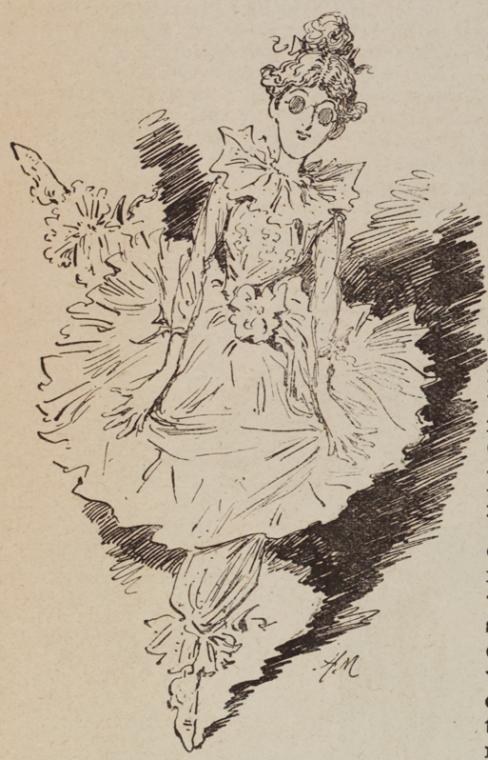
This drawing documents how ballet was promoted and understood in the commercial American theater of its era. The image shows not just a pose but a complete theatrical package—the costume, the carriage, the moment of technical accomplishment—indicating what contemporary audiences were meant to value in a ballet dancer. As an artifact of theatrical ephemera, it also reveals the history of dance documentation before photography became the dominant medium.
What you are looking at
A single female figure dominates this ink sketch, drawn in a loose, gestural style characteristic of theatrical illustration. She wears an elaborate costume of the late 19th or early 20th century: a fitted bodice with puffed sleeves and a dramatically voluminous skirt with deep flounces and ruffles that extends to the floor. Her hair is styled high and ornate, pinned up in the fashion of the period. The figure is caught mid-movement, her posture suggesting active performance rather than repose. Her left arm extends outward with fingers splayed expressively, while her body leans slightly forward in a dynamic contrapposto. The artist has used bold, confident line work and areas of heavy cross-hatching to suggest volume and shadow, particularly in the skirt and background, creating strong visual contrast that emphasizes the performer's silhouette. The drawing is unsigned or the signature is too faint to read clearly in this reproduction.
The dancing
The single dancer is depicted in three-quarter view, with her weight shifted to create a sense of forward momentum and lift. Her extended arm and splayed fingers convey expressiveness and control; her torso shows the upright carriage expected of classical ballet training. The elaborate costume—particularly the weight and volume of the skirt—suggests a dancer of considerable technical skill, as the movement demands lightness and elevation despite heavy drapery. The artist has captured a moment of extension and arrival, not preparation, indicating understanding of how a trained dancer suspends the body at the apex of movement.
The dance depicted
This is almost certainly a Romantic or late classical ballet dancer, based on costume, setting, and the conventional pose of theatrical illustration from the period. The figure's pose—extended arm, lifted carriage, the emphasis on the ethereal quality suggested by the skirt's movement—echoes the aesthetic priorities of Romantic ballet (1830s–1870s), though the costume details suggest this may be from the later 19th century, when those conventions persisted in commercial theater and touring companies. The work appears to be a study or promotion drawing of a specific dancer or role, likely created for a playbill, newspaper, or theatrical publication. Without further documentation, the specific role or company cannot be identified, but the technical competence and theatrical context are unmistakable.
How it was made
This is a pen-and-ink drawing, rendered with bold line work and systematic cross-hatching to build tone and volume. The technique suggests it was made for reproduction—either as an engraving base or as a direct illustration for publication in a newspaper, playbill, or theatrical magazine. The loose, economical approach to line, combined with dramatic contrasts of light and dark, is typical of commercial theatrical illustration of the 1880s–1920s. The style prioritizes recognizability and visual impact over anatomical precision, a practical choice for an image intended to be viewed from a distance or reduced in size for print. The New York Public Library's holding suggests this was part of American theatrical ephemera or periodical collections.
About this work
This is a theatrical illustration of a ballet dancer, rendered in pen and ink in the late 19th or early 20th century. The work captures a moment of performance rather than a portrait—the figure is shown mid-movement, in full costume, mid-gesture, in the style of commercial stage illustration. The costume, pose, and drawing technique all place it within the world of professional ballet theater in the Romantic tradition, a form that dominated American and European stages well into the early 20th century. The work is valuable as evidence of how ballet was publicized, perceived, and circulated through print media; the illustration itself is a historical document of theatrical practice and performer celebrity.
How to look at it
Note the moment the artist chose to freeze: not a preparatory pose or a moment of weight change, but an arrival—the extension complete, the arm fully opened, the body lifted. This is the moment a dancer wishes to project, the acme of the movement. Observe how the costume participates in the image: the skirt's volume and the direction of its folds suggest the momentum and velocity of the movement, not mere fabric. The cross-hatching in the background and the heavy lines around the figure's silhouette create a theatrical spotlight effect, isolating the performer from her surroundings—a convention of theatrical illustration that mimics stage lighting. The drawing style itself—bold, gestural, economical with detail—is typical of work made for reproduction at reduced size, where precision would be lost.
The period
This work dates to the era when ballet, having originated in the Renaissance court and formalized in the 17th century, had become a primary form of commercial theatrical entertainment in the United States and Europe. The Romantic ballet of the 19th century—epitomized by works like Giselle and Swan Lake—emphasized ethereal, weightless movement, often featuring supernatural or fantastical characters. By the 1880s–1920s, when this illustration was likely made, Romantic ballet conventions remained dominant in popular theater, though they were increasingly challenged by new pedagogies (particularly the Russian Imperial School) and emerging modern dance forms. Theatrical illustration of this kind was the primary means by which dancers achieved public visibility and celebrity; newspapers, playbills, and theatrical magazines circulated images that shaped public taste and memory. The loose, expressive drawing style reflects the conventions of commercial illustration of the period, when artists prioritized immediate visual impact and reproducibility over academic finish.
Where it lives
The work is held in the New York Public Library's collections. It was likely created as theatrical ephemera—a playbill illustration, newspaper advertisement, or magazine feature—and has been preserved as part of the Library's documentation of American theatrical history.
Dance in this work
Questions about this work
Is this a portrait of a specific famous dancer?
Without a signature or caption visible in the image, the specific dancer cannot be identified from the drawing alone. The work was created for theatrical promotion or publication, and the figure likely represents either a specific celebrated performer or a generalized 'ballet dancer' character. The Library's records do not identify the subject.
What makes this Romantic ballet and not classical?
The costume—particularly the bell-shaped skirt, fitted bodice, and puffed sleeves—reflects the silhouette of Romantic ballet (1830s–1870s), though the drawing style and publication context suggest it was made later, when Romantic conventions were still dominant in popular theater. The pose emphasizes weightlessness and ethereal carriage, hallmarks of the Romantic aesthetic. However, without more specific evidence (a role name, a known performance), 'Romantic ballet tradition' is the most precise claim.
Was this drawn from life or imagination?
Almost certainly from life or from memory/practice of a live performer, given the accuracy of the costume details and the naturalistic weight and balance of the figure. The drawing was made for theatrical promotion, not as a fantasy. However, like all theatrical illustration of the period, it was idealized and conventionalized—showing the dancer as she wished to be seen, not necessarily as she appeared in a specific moment.
What does the drawing technique tell us?
The pen-and-ink approach with bold lines and cross-hatching is characteristic of work made for newspaper or magazine reproduction. The style was practical: it held detail at reduced size, reproduced clearly in print, and could be executed quickly enough to meet publication deadlines. This is a commercial product, not a fine art print, though it was made with skill and understanding of its medium.
More Ballet artwork