28 works in this view — arrow keys or swipe to move between them.
Dance in Art
The Dance Class
Edgar Degas
- Medium:
- oil on canvas
- Era:
- Late 1800s (Victorian Ballroom)
- Source:
- Wikimedia Commons
- Rights:
- Public domain — free to use, share and adapt.
- Recorded as:
- public_domain
For dancers and historians, this painting is documentary evidence of how ballet was taught and experienced at a major European institution. For art historians, it marks a decisive shift away from ballet as an aristocratic spectacle toward ballet as a craft and a body at work—a reframing that influenced how dance was depicted in art for the next century.
What you are looking at
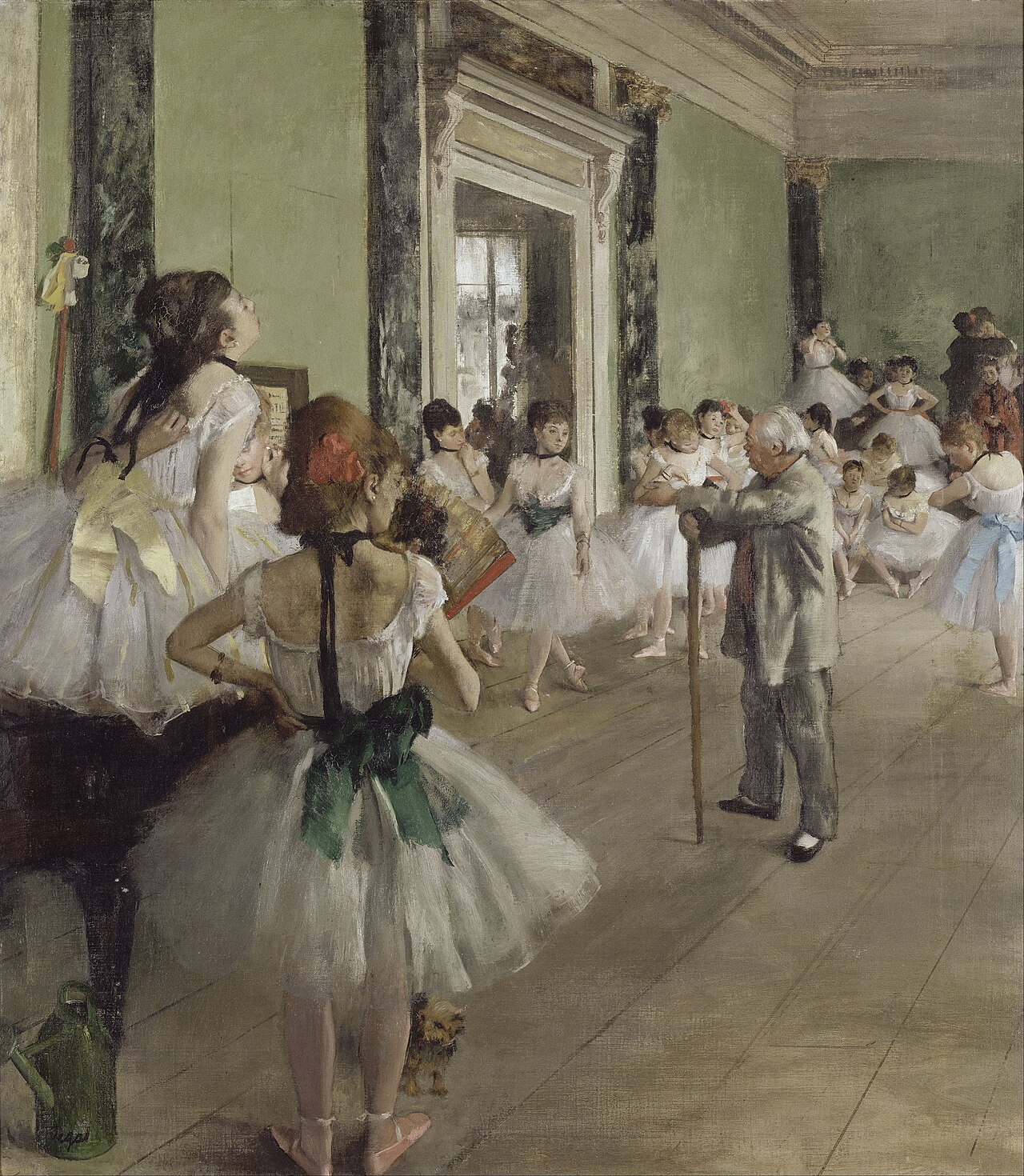
A ballet class in progress in a grand studio with pale green walls and classical architectural details. An elderly instructor in a gray suit stands near the center-right, observing dancers scattered across the room in various poses of rest and practice. The dancers, predominantly in white tutus and flesh-colored tights, occupy the full depth of the space: some stand at attention, others sit or crouch on the floor, a few stretch or practice positions near the walls. A tall mirror or glass door with white trim frames part of the scene. The light is cool and diffused, typical of northern studio windows, and the composition emphasizes the everyday informality of training rather than performance—bodies between corrections, weight momentarily at rest, the choreography of instruction rather than dance itself.
The dancing
The dancers' bodies show the characteristic turnout and upright carriage of classical ballet training, but they are captured in the pauses and transitions of a class rather than in sustained positions. Several sit or recline with their legs extended in a relaxed turnout; one stands with arms lowered and weight centered; others maintain the alert posture of students awaiting instruction. The instructor's upright stance and gesture suggest he is observing and correcting. There is no balletic tableau or unified ensemble work—instead, a documentary moment of individual bodies in the rhythms of training.
The dance depicted
This is a classical ballet class, likely at the Paris Opéra based on the institutional setting and the style of training visible. The image captures the pedagogical rather than performative aspect of ballet: the repetitive work of technique, the dependency on a master instructor's eye, and the individual student's relationship to discipline and correction. The dancers' white tutus and the formal architecture place this in the Romantic or late 19th-century ballet tradition, where technique was codified and classes followed established progressions of exercises and variations.
How it was made
Oil on canvas, executed with a soft, almost sketch-like handling of light and form. The medium allowed Degas to build form through color and tone rather than line, and to capture the transient quality of studio light and the subtle shifts in dancers' posture and attention. The loose, unfinished quality of much of the painting—particularly the background and peripheral figures—mimics the fleeting, unstudied nature of observation itself, as if the artist were recording a moment of actual studio practice rather than composing a formal arrangement.
About this work
This is one of Degas's numerous ballet class paintings, a work that established a new subject for fine art: the pedagogical moment and the laboring body of the dancer in training rather than the glamorous performer on stage. The painting documents a specific historical practice—the hierarchical, individualized instruction of classical ballet in the late 19th century—while also engaging with broader concerns of Impressionism: the capture of light, the informal composition, the psychology of attention and posture. It belongs to a body of work by Degas that fundamentally changed how dance could be represented in art, moving away from the staged fantasy of Romantic ballet painting toward the unglamorous, repetitive, physically rigorous work that ballet actually was.
How to look at it
Look first at the composition: how the instructor is positioned as a still point amid the scattered, informal arrangement of dancers. Notice the variety of poses—some dancers are almost limp with fatigue or inattention, others alert and ready. Attend to the way Degas has used the architectural space and the mirror or door to create depth and a sense of the actual room where this training took place. The painting invites you to recognize what you are seeing not as a dance but as the work that makes dance possible—the unglamorous, repetitive, physically demanding labor that was invisible to the audience in the theater.
The artist
Edgar Degas (1834–1917) was obsessed with ballet as a subject, producing hundreds of pastels, paintings, and prints of dancers between the 1870s and early 1900s. He attended classes at the Paris Opéra, sketched from life, and developed an intimate knowledge of the physical grammar of classical training. Unlike earlier ballet painters who idealized the performance, Degas was interested in the behind-the-scenes reality: rehearsals, classes, the strain and sweat and boredom of technique. His work established ballet as a legitimate subject for serious painting and created a visual archive of 19th-century dance pedagogy that remains unmatched.
The period
This painting dates to 1874, at the height of French Impressionism and during the flowering of Romantic ballet in its late phase. The Paris Opéra was at the center of European dance training, and classical ballet technique was becoming increasingly standardized and codified through the teaching of figures like Jules Perrot and others. Simultaneously, Impressionist painters were turning away from historical and mythological subjects toward the modern world and everyday life. Degas's choice to make ballet class a subject of fine art was both a modernist move—capturing contemporary life—and a recognition that dance itself, as a physical practice and not just a spectacle, deserved serious artistic attention.
Where it lives
The work's holding collection is not recorded in the catalogue entry. The source is listed as Wikimedia Commons, suggesting it is a public-domain image of a work in a major collection; the painting is likely in a major European or North American museum.
Dance in this work
Questions about this work
Is this the famous Degas ballet class painting?
Degas painted multiple ballet class scenes; this is one of several from the 1870s onward. The composition and setting are characteristic of his studio rehearsal paintings, but Degas did not typically title his works with such specificity, and the exact identity and location of any single painting can be difficult to establish without provenance documentation.
Were ballet classes really like this in the 19th century?
This painting likely reflects what Degas observed at the Paris Opéra, where he was permitted to attend rehearsals and classes. The hierarchical structure—a male instructor, female dancers in practice costume, the emphasis on individual correction—was typical of the period. However, Degas composed his paintings from multiple sketches and memory; this is not a literal transcription but an artistic synthesis.
Why are some dancers sitting down?
In a ballet class, dancers move through exercises and variations with periods of rest between them. The seated and reclining figures may be waiting for their turn, recovering between sets, or simply captured in a natural moment of the class's rhythm. This casual documentation of the non-dancing moments is part of what makes Degas's work distinct from earlier, more idealized dance imagery.
What style of ballet is this?
This is classical ballet, the academic tradition codified in the 19th century. The white tutus, the turnout, the formal instruction method, and the setting in an institutional atelier all place this in the late Romantic or early modern ballet tradition, before major stylistic innovations in the 20th century.
More dance artwork