29 works in this view — arrow keys or swipe to move between them.
Dance in Art · 2023
The Pet of the Ballet
Unknown artist
- Medium:
- Dance:
- Ballet
- Source:
- New York Public Library
- Rights:
- Public domain — free to use, share and adapt.
- Recorded as:
- public_domain
This print is a direct witness to how Romantic ballet was commodified, circulated, and remembered in the nineteenth century. For a dancer or historian, it shows both the costume vocabulary of the period and the machinery by which individual performers became celebrities and their images became collectible objects. The print preserves the appearance of a dancer whose name has been lost but whose fame was real enough to justify her portrait's mass production.
What you are looking at
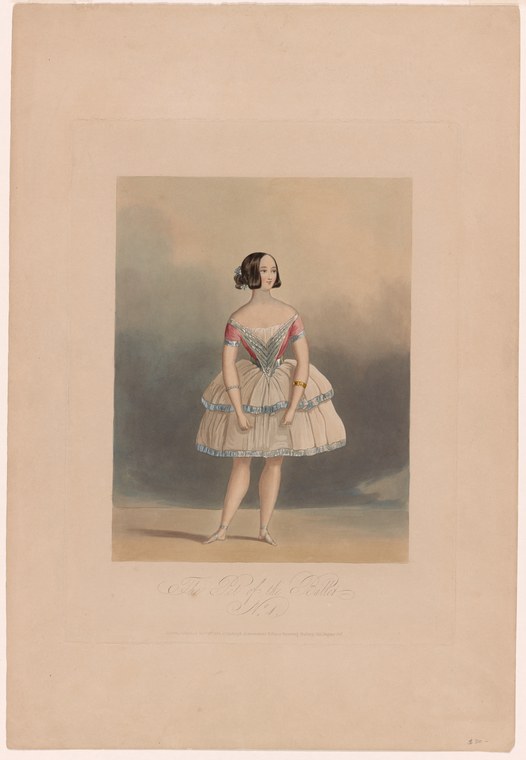
A young woman in Romantic-era ballet costume stands alone against a luminous, atmospheric background that fades from tan-gold at the stage floor to soft grey-green above. She wears a short tulle skirt of pale cream with blue trim at the hem, a fitted bodice in coral or rose silk with ornamental detail at the neckline, and short puffed sleeves. Her dark hair is parted and swept back in ringlets typical of the 1830s–1840s. She stands in an easy, frontal pose with weight on one leg, arms relaxed at her sides, gazing directly outward with the composed, serene expression expected of a ballet performer. The setting suggests a stage interior rather than a narrative scene: the figure is isolated, presented to the viewer as a portrait of a dancer, not engaged in dramatic action. The soft modeling and warm tonality evoke the gaslit theaters of the period.
The dancing
A single dancer occupies the center of the frame in a standing pose that is neither demanding nor formally positioned. Her weight appears to rest primarily on one leg, the other relaxed; her arms hang naturally at her sides with palms facing inward. The posture is upright but unremarkable—no turned-out positions, no visible stretch or extension of the limbs. The frame is a three-quarter frontal view that emphasizes the costume and the face rather than the mechanics of the body. This is portraiture of a performer, not a record of movement.
The dance depicted
This is a ballet figure from the Romantic era, most likely the 1830s or 1840s, when the short tulle skirt and light-toned, corseted bodice became the standard costume. The title 'The Pet of the Ballet' suggests a star dancer or a popular character, and the solo presentation indicates she held individual fame. The costume—fitted bosom, puffed sleeves, and the distinctive short tutu with its layered tulle—is the visual vocabulary of Romantic ballet at the height of its fashion. The dancer's serene, frontal presentation and the absence of dynamic movement suggest this is a promotional or commemorative portrait of a celebrated performer rather than a scene from a specific ballet.
How it was made
This is a hand-colored lithographic print, as evidenced by the soft tonal modeling, the subtle gradations of wash, and the characteristic texture visible in the background and dress. The technique allowed for rapid reproduction and mass circulation, making it a form of cheap popular theater merchandise—a print sold to audiences to commemorate a favorite dancer or performance. Lithography was the dominant medium for theatrical imagery from the 1820s onward, ideal for capturing the flattering likeness and rich costume detail that audiences desired. The print appears to be French in origin and execution, reflecting the dominance of Paris as the center of ballet and theatrical print production in this period.
About this work
This is a lithographic portrait of a celebrated ballet dancer from the Romantic era, likely 1835–1845, presented in the costume and pose convention of the period's theatrical prints. The title identifies her as 'The Pet of the Ballet,' a descriptor that suggests fame and popularity among contemporary audiences. The image is a record of fashion, costume convention, and star appeal as much as it is a document of dance itself: the tutu, the corseted silhouette, and the serene frontal presentation are all tropes of the commercial ballet imagery that circulated through European and American cities during the height of Romantic ballet's popularity.
The work belongs in a gallery of dance in art because it is one of thousands of such prints that shaped how audiences imagined and remembered the dancers they saw on stage. It is not a record of a specific ballet or a narrative moment, but rather the visual equivalent of a theater playbill or celebrity portrait—a memento that connected the audience to the performer and the culture of the balletomane.
How to look at it
Observe the tulle skirt closely: the layers, the trim, and the way the fabric is rendered with soft parallel lines that suggest translucency and movement even though the figure is static. Notice the contrast between the rigid corseted bodice and the flowing skirt—this tension between structure and lightness is central to Romantic ballet aesthetics. The pose itself is worth noting: it is not a step or an arabesque, but a moment of repose and display. The background is deliberately undefined, keeping the focus on the costume and the face. The artist has rendered the dancer as an object of beauty and desire, not as a body in motion.
The period
This print dates to the height of the Romantic ballet era, when the Paris Opéra and its stars dominated European dance culture. The short tulle skirt shown here—the tutu—became standard only in the 1830s; before that, skirts were longer and heavier. The soft, ethereal quality of the costume reflected Romantic aesthetic values: weightlessness, youth, melancholy beauty. Lithographic portraits of dancers became a major commercial product in the 1830s–1850s, sold in print shops and theater lobbies across France, England, and North America. The female dancer had become a celebrity icon, and her image could be circulated, collected, and commodified independent of her performance. This print is one artifact of that transformation.
Where it lives
This print is held in the New York Public Library's collection. The catalogue record identifies it as a print but provides no information on the original artist, date, or edition. The NYPL holds a substantial collection of theatrical imagery from the nineteenth century, including many similar portraits of dancers and opera singers.
Dance in this work
Questions about this work
Who was the dancer portrayed?
The catalogue record does not identify her by name, only by the title 'The Pet of the Ballet.' This suggests she was a well-known performer of the 1830s–1840s, celebrated enough to warrant a lithographic portrait, but the specific dancer's identity has not been recovered. Theater historians and collectors of Romantic-era ballet may be able to identify her from other documents or print catalogues.
What is the tutu in this image?
The short, layered tulle skirt shown here is the classical Romantic-era tutu, which became standard ballet costume in the 1830s. It was lighter and more mobile than earlier skirts, and the tulle fabric created the ethereal, weightless appearance central to Romantic ballet's aesthetic. This costume type became iconic and remains recognizable as 'ballet' to modern audiences.
Why is she standing still if this is a dance image?
This is a commemorative or promotional portrait, not a scene from a ballet. Dancers were often depicted in standing poses in prints sold as souvenirs or collectibles. The image celebrates the performer's fame and costume rather than capturing a moment from choreography. Such prints allowed audiences to own and display images of their favorite dancers.
What does 'pet of the ballet' mean?
The title suggests a popular, celebrated, or favored dancer—a star who was beloved by audiences. In the context of Romantic ballet, such titles were used to market prints and acknowledge a performer's celebrity status. The term reflects the way male-dominated theater culture often infantilized and exoticized its female dancers.
More Ballet artwork